

ART

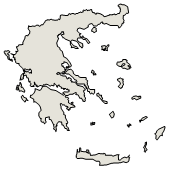
GreeceGreece

Administrative Region : Epirus
Regional unit : Ioannina

Patero (Πάτερο) Ioannina

Patero is a village in the prefecture of Ioannina at an altitude of 730 meters [1] and belongs to Katsanochoria of Epirus[2][3]. It is located north of the ancient castle of the area (4th century BC), about two kilometers in a straight line. According to the Kallikratis program, together with the settlements of Kostitsi, Nistora and Fortosi, they form the local community of Fortosi, which belongs to the municipal unit of Katsanochoria of the Municipality of North Tzoumerka and, according to the 2011 census, has a population of 44 inhabitants[4]. It formerly belonged to the Municipal District of Fortosi of the Municipality of Katsanochoria and in the 2001 census had a population of 73 inhabitants.

History

No evidence has ever been found within the boundaries of the village that would prove an occupation as old as that of the castle. An "ancient" tomb two hundred meters south of the monastery of Zoodochos Pigi is not from the time of the castle, but rather from the period of the Turkish occupation, if not a little earlier (12th-14th centuries). In the local dialect it was referred to as Pater. This is also mentioned in a note in the Minaia of the metropolitan church of Agia Paraskevi dated 1863. It is curious that the older ones used it as a feminine gender, Pater, and when referring to it they used the expression st' Pater. It is possible that the expression meant st' Pater with the accusative Pater, as is still common today in modern Greek, from the archaic accusative Pater (papas). Perhaps it first became known as the dwelling of a monk or priest or its monastery predated the village. However, the same method is still used today for other villages of Katsanohoria and not only: in Kalentzi, in Fortosi, in Kostitsi, but also in Pramanta, in Agnanda etc., instead of the "correct" in Kalentzi, in Fortosi, in Kostitsi, in Agnanda, in Pramanta).

When it was first inhabited is not certain. Its central church of Agia Paraskevi was built in 1650[5] and the apse of the sanctuary was probably painted in 1654, the apse of Prothesa in 1695 and the rest of the church after 1700, probably by hagiographers of the well-known family of painters from the neighboring village of Fortosi. The lower parts of the walls were never painted and the church thus gives the impression of an unfinished work. The remaining hagiography is of excellent post-Byzantine art with a variety of themes. The church is a basilica with a dome, supported by four pillars and a transverse arch, and has been declared an ancient monument since 1972[6]. If the village managed to build a magnificent church in 1650, it means that it had already existed for many decades, if not centuries. In any case, the village had already existed since the 1520s, since at that time it was recorded in the Ottoman tax register with approximately 30 families.

The church of Agios Nikolaos on its northern edge is newer. The Monastery of Zoodochos Pigi to the south and near the two wells from which the village was watered was built immediately after the liberation of 1913, while it had existed since at least the 18th century.
Education

The school is a building of 1888 with the inscription "Gerokostopoulios School 1888" and has been classified as a monument since 2008 because "on the one hand it is a typical example of an Epirus school building of the beginning of the 20th century, with remarkable morphological and architectural elements and on the other hand it is closely linked to the educational history of the settlement and the memories of its inhabitants"[7]. It is a donation by Achilleas Gerokostopoulos, a minister in the government of the time (1890-1892), of the free Greek kingdom, who is considered a benefactor of the area[8]. The minister's uncle Christodoulos Gerokostas emigrated from the village to Patras, where he became rich as a merchant and the minister's father followed him there with his family. The money with which the "Gerokostopoulios School" was built was bequeathed to Achilleas by his uncle Christodoulos for this purpose. His house in the village is still preserved as it was.

Boys and girls attended the school even during the Turkish occupation, which ended only in 1912. The course of study was four years. Those who wanted to, boys or girls, could continue at the Greek (semi-gymnasium) in the neighboring village, Kalentzi. In the 1970s and 1980s, there were still women living in the village who had also been taught French in Helleniko. It is noteworthy that throughout the last century, illiteracy in the village was zero.
Residents

The people of Patrio were mainly engaged in animal husbandry and agriculture, and in other crafts, such as carpentry, tailoring and tsangari. Some were emigrating even in the 19th century. Few had higher or higher education before 1950. Since 1960, the majority have at least a high school education. In recent years, the school has not been operating due to a lack of students. The permanent residents today do not exceed 9. In the past, they reached 180 with 25 houses. In the summer, when the houses used as summer houses are filled, they now reach 100 and the village gives the impression of a flourishing and prosperous place.

References

Encyclopedia Nea Domi. Athens: Tegopoulos - Maniateas. 1996. p. 164 vol.27.
Frangos, Christos (2010). Ioanninon&f=false Epirus-Northern Epirus, Tzoumerka and Katsanohoria: History, Folklore, Cultural Monuments, Tourism Check |url= value (help). Christos Frangos. ISBN 9789609318044.
"Arachthos-Katsanohoria". athenorama travel. Retrieved 28 October 2018.[dead link]
"Official Gazette of the results of the 2011 PERMANENT population census", p. 10561 (p. 87 of the pdf)
"Fortosi - Kostitsi - Patero - Nistora". www.voreiatzoumerka.gr. Retrieved 4 November 2018.
Nikos, Kapetanakos E. "PERMANENT LIST OF DECLARED ARCHAEOLOGICAL SITES AND MONUMENTS". listedmonuments.culture.gr. Archived from the original on 29 November 2021. Retrieved 4 November 2018.
Nikos, Kapetanakos E. "PERMANENT LIST OF DECLARED ARCHAEOLOGICAL SITES AND MONUMENTS". listedmonuments.culture.gr. Archived from the original on 19 May 2022. Retrieved 4 November 2018.
Administrator. "Epirotic Benefactors of the Turkish and Greek Occupations | L.E.A.D.I. | Ioannina Lawyers' Support and Mutual Assistance Account". leadi.gr. Archived from the original on 10 October 2020. Retrieved 4 November 2018.

Municipal unit Katsanochoria
Community Aetorrachi
Aetorrachi (Αετορράχη, η)
Lazaina (Λάζαινα, η)
Community Elliniko
Elliniko (Ελληνικό, το)
Community Kalentzi
Kalentzi (Καλέντζι, το)
Community Koritiani
Koritiani (Κορίτιανη, η)
Community Monolithi
Agios Georgios (Άγιος Γεώργιος, ο)
Monolithi (Μονολίθι, το)
Xirovouni (Ξηροβούνι, το)
Community Pigadia
Pigadia (Πηγάδια, τα)
Community Plaisia Malakasiou
Plaisia (Πλαίσια, τα)
Community Platanoussa
Dafni (Δάφνη, το)
Zoodochos Pigi (Ζωοδόχος Πηγή, η)
Platanoussa (Πλατανούσσα, η)
Community Fortosi
Kostitsi (Κωστήτσι, το)
Nistora (Νίστορα, η)
Patero (Πάτερο, το)

Greece :

A - B - C - D - E - F - G - H - I - J - K - L - M -
N - O - P - Q - R - S - T - U - V - W - X - Y - Z

Retrieved from "http://en.wikipedia.org/"
All text is available under the terms of the GNU Free Documentation License

Ancient Greece

Science, Technology , Medicine , Warfare, , Biographies , Life , Cities/Places/Maps , Arts , Literature , Philosophy ,Olympics, Mythology , History , Images

Medieval Greece / Byzantine Empire

Science, Technology, Arts, , Warfare , Literature, Biographies, Icons, History

Modern Greece

Cities, Islands, Regions, Fauna/Flora ,Biographies , History , Warfare, Science/Technology, Literature, Music , Arts , Film/Actors , Sport , Fashion

---

Cyprus

Greek-Library - Scientific Library

Greece

World

Index

Hellenica World
