

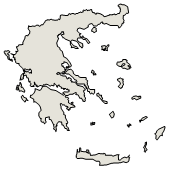

Administrative Region : Peloponnese
Regional unit : Messinia
Mali (Μάλη) Messinia
Mali[5] (older names: Mala), is a small mountainous settlement near Filiatra and is administratively under the Municipality of Trifylia, in the Prefecture of Messinia.
Location
The village is located east of Filiatra at an altitude of 956[1]-980[2] meters and is approximately 20 kilometers from the coast of the Ionian Sea. It is approximately 19 kilometers from Filiatra, and is approximately 9.5 kilometers from Plati, which is located to the west of the settlement.
History
The village, located in a depression in the shadow of Mount Agios Konstantinos (altitude 1,225 meters) to the north, the hill of Ag. Varvara to the west and the hills of Mavro Longo Noka, Astra and Martzena to the east, has a long history. According to the most likely version, it is believed that it took its name from a settler who was of Albanian or Arvanite origin, as the word "Mali" in Albanian means "big mountain".[2]
During the period of the Villehardouins and the Principality of Achaia, the village was under central administration, which was exercised from the capital of the principality, in Andravida. During the period of the Ottoman occupation, it belonged to the Kontovounia Valley along with 32 other villages in the wider area.[2]
During the Revolution of 1821, the inhabitants of the village, along with the rest of the mountainous inhabitants of the area, also known as Arkadinoi, found themselves on the side of the Elder of Morea, Theodoros Kolokotronis. In Mali, subsequently, Dimitrios Koliopoulos, known as Plapoutas, raised his "horde" to confront Ibrahim and when Papaflessas, in 1825, was fighting Ibrahim during the Battle of Maniaki, Plapoutas with 3,000 armed men was encamped in Mali.[2]
Mali would find itself again in the spotlight in 1866, when Sotirios Sotiropoulos, then Minister of Finance (later, in 1893, he also served as Prime Minister), while vacationing on his estate in Agrilis, fell victim to kidnapping by the Lafazanis-Papakyritsopoulos bandit gang, which operated in the wider area based in Olympia. He was held captive in the basement of the Kostakis family in what was then Katsimbali (later Exochiko, today Exochiko) and then transferred to Mali, remaining a hostage for 36 days, from where he was released, after his family paid a ransom. Out of gratitude to the villagers, who provided him with care, despite the bandits' guarding, during his hostage-taking, later during his term as prime minister he financed the construction of a road from the steep mountains of Mali, through Agia Mavra and Kerasitsa (this hamlet is now uninhabited) to Filiatra.[2]
Administrative history
The oldest official name of the village was Mali, as mentioned in 1835. From 1896 it was also referred to as Mala, until 1912, while from 1913 the name was corrected to Mali.[6][7] However, the village is found with similar names in earlier bibliographic sources-references. The settlement is mentioned in various censuses of the Venetian Pronoites of the Serene Republic of Venice, which were made during the thirty-year period (1683/84-1715), during which the Venetians occupied the Peloponnese. Mali belonged, in 1689, to the province of Arcadia (or Arcadia, i.e. the area of present-day Kyparissia), which was one of the 4 provinces into which the Methoni district was then divided (Phanariou province, Arcadia province, Navarinou province and Methoni province).[8] The settlement of Mali was annexed to the old Municipality of Tripoli in 1835.[9] In 1840[10] it was detached from the Municipality of Tripoli and annexed to the old Municipality of Kyparissia, until 1842,[11] when it returned to the Municipality of Tripoli. Mali is mentioned in 1853 in the second volume of "Hellenic" by Iakovos Rizos Ragavis as a village in the Municipality of Tripyli in the Province of Trifylia with a population of 301 inhabitants, based on the 1851 census.[12] In 1899, also referred to as Mala, it was transferred from the Prefecture of Messinia and became part of the Prefecture of Trifylia,[13] for about a decade, until 1909, when it returned to the Prefecture of Messinia,[14] as a settlement in the Province of Trifylia. In 1912, as Mala, it was detached from the Municipality of Tripyli and designated as the seat of the Community of Mala,[15][16] while in 1913[17] the name of the settlement and the community were corrected to Mali and the Community of Mali respectively. In 1940, the settlement of Kerasea was annexed to the Community of Mali, which was abolished in 1991.[18] Mali remained the seat of the homonymous community from 1912 to 1997, when then, in the context of the changes that occurred in local government, through the "Kapodistrias" plan, it was subordinated to the abolished Municipality of Filiatra,[19] until 2010. Since 2011, after the new changes of the "Kallikratis" plan, it now belongs to the new Municipality of Trifylia.[5][20] This municipality was established with the Kallikratis Program by merging the pre-existing municipalities of Aetos, Avlona, Gargaliana, Kyparissia, Filiatra and the community of Tripyla.
Residents
The settlement, based on the 2011 census, has 17 permanent residents, who are mainly engaged in livestock farming[2] and various agricultural activities.
Population Evolution of Mali Messinia
Census Population
1689 81[8]
1844 284[21]
1851 301[12]
1879 439[8][22]
1889 334[23]
1896 498[24]
1907 545[25]
1920 221[26]
1928 345[27]
1940 305[28]
1951 224[29]
1961 47[30]
1971 7[31]
1981 93[32]
1991 105[33]
2001 99[34]
2011 17[35]
Buildings-events
The settlement consists mainly of houses and farmhouses. The inhabitants of the village, who are mostly engaged in livestock farming, have founded the "Association of Livestock Breeders of Kontovounia", which is headquartered in the village and organizes various annual events.
References
Mali, from the website: buk.gr
Source: The article by lawyer Nikos A. Panagiotopoulos-Velmachos, entitled "Mali. The beautiful stone-built village of Kontovouni", in the magazine "Flash of Messinia", issue 279, November 2012, pp. 26-32.
Postal Code Mali Messinia.
Telephone codes of Greece, Zone 27: Filiatra: 27610
3) Postal Code Mali: Mali Archived 2017-06-16 at the Wayback Machine., from the website: www.dimostrifylias.gr of the Municipality of Trifylia.
16/10/1940.
Administrative Changes of Settlements > Mali – Mala – Mali (Messenia), from the website: www.eetaa.gr
Spiridon Lambros, “Census of the Prefecture of Methoni under the Venetians Archived 2015-12-09 at the Wayback Machine.”, Bulletin of the Historical and Ethnological Society of Greece, volume 2 Archived 2017-11-06 at the Wayback Machine., From the Perris Brothers Printing House, Athens 1883, pp. 686-710. From the Digital Library of the University of Ioannina, Census 1689, No. 123 Mali - Census 1879, No. 123 Mali, pp. 704-705.
21-04-1835.
Government Gazette 22A - 18/12/1840.
Government Gazette 29A - 17/11/1842.
Iakovos R. Ragavi, Greek, In Athens, 1853, volume two, p. 582.
Government Gazette 136A - 08/07/1899.
Government Gazette 282A - 04/12/1909.
Government Gazette 262A - 31/08/1912.
Administrative Changes of Settlements > K. Mala (Messenia), from the website: www.eetaa.gr
Government Gazette 200A - 09/10/1913.
17/03/1991.
Government Gazette 244A - 04/12/1997.
Government Gazette 87A - 07/06/2010.
Stamatakis, I. D., "Topographical Map of Greece, Containing the Names, Distances and Population of Municipalities, Cities, Towns and Villages. / Collected from various official documents of the Northern Government, and published by I. D. Stamatakis". From the G. Vlassaridou Printing House. Athens 1846, p.41.
Ministry of the Interior, "Statistics of Greece - Population 1879, from the S. K. Vlastos Printing House, Athens 1881. Also: "Statistics of Greece - Population 1879", p. 125.
Ministry of the Interior, Department of Public Economy and Statistics, "Statistics of Greece - Population - Census of 15-16 April 1889", Part Two - Tables A', from the National Printing House and Lithograph, Athens 1890, p. 91.
Ministry of the Interior, Department of Public Economy and Statistics, "Statistical Results of the Population Census, on 5-6 October 1896", Part Two - Tables - A' Population by Prefecture, Provinces, Municipalities, from the National Printing House and Lithograph, Athens 1897, p. 107.
Ministry of the Interior, Census Service, Statistical Results of the General Population Census, as of October 27, 1907", Edited by: Georgios Chomatianou, volume two, from the Michael Nikolaidou Printing House, Athens 1909, p. 395.
Ministry of National Economy, Directorate of Statistics, "Population of the Kingdom of Greece, as of the Census of December 19, 1920", from the National Printing House, Athens 1921. Also: "Population of the Kingdom of Greece, as of the Census of December 19, 1920", p. 239.
Ministry of National Economy, General Statistical Service of Greece, "Population of Greece according to the Census of 15-16 May 1928". (Actual population ratified by the decree of 23 November 1928), from the National Printing House, Athens 1935. Also: "Population of Greece, according to the Census of 15-16 May 1928", p. 279.
Ministry of National Economy, General Statistical Service of Greece, "Population of Greece according to the Census of 16 October 1940". (Actual population by prefectures, provinces, municipalities, communities, cities and villages), from the National Printing House, Athens 1950. Also: "Population of Greece, according to the Census of 16 October 1940", p. 308.
National Statistical Service of Greece, "Population of Greece according to the Census of 7 April 1951". (Actual population by prefectures, provinces, municipalities, communities, cities and villages), from the National Printing House, Athens 1955. Also: "Population of Greece, according to the Census of 7 April 1951 Archived 2013-05-14 at the Wayback Machine", p. 150.
National Statistical Service of Greece, "Population of Greece according to the Census of 19 March 1961". (Actual population by prefectures, provinces, municipalities, communities and settlements. Approved by the joint decision of the Ministers of Coordination and Interior No. 46929/6877/1961), from the National Printing House, Athens 1962. Also: "Population of Greece, according to the Census of 19 March 1961", p. 145.
National Statistical Service of Greece, "Population of Greece according to the Census of 14 March 1971". (Actual population by prefectures, provinces, municipalities, communities and settlements. Ratified by the joint decision of the Ministers of the Deputy Prime Minister and the Interior No. 3893/Ε637/1972), Athens 1972. Also: "Population of Greece, according to the Census of 14 March 1971", p. 140.
National Statistical Service of Greece, "Actual Population of Greece according to the Census of 5 April 1981". (Ranked by the joint decision of the Ministers of Coordination and the Interior No. 7908/δ'554/12-4-1982), Athens 1982. Also: "Actual Population of Greece according to the Census of 5 April 1981", p. 151.
National Statistical Service of Greece, "Actual Population of Greece according to the Census of 17 March 1991". (Ranked by 24197/Γ' 3812/24-11-1993 joint decision of the Ministers of National Economy and Interior), Athens 1994. Also: "Actual Population of Greece according to the Census of 17 March 1991", p. 184.
National Statistical Service of Greece, "Actual Population of Greece. Census 2001". (Ranked by 6821/Γ5-908/4-6-2002 joint decision of the Ministers of Economy and Finance and Interior, Public Administration and Decentralization), Athens 2003. Also: "Real Population of Greece. Census 2001", p. 186.
"Population - Housing Census 2011. Resident Population Archived 2018-09-27 at the Wayback Machine.", Hellenic Statistical Authority (ELSTAT).
| Municipal unit Filiatra |
|---|
| Municipal Community Filiatra |
| Agia Kyriaki (Αγία Κυριακή, η) |
| Αγία Πεθαμένη, η |
| Agrilos (Άγριλος, ο) |
| Βρύσες, οι |
| Giolaka (Γιόλακα, η) |
| Κουντρίον, το |
| Λαγκουβάρδος, ο |
| Lempestena (Λεμπεστενά, τα) |
| Limenari (Λιμενάρι, το) |
| Merolithi (Μερολίθι, το) |
| Στόμι, το |
| Filiatra (Φιλιατρά, τα) |
| Community Exochiko |
| Exochiko (Εξοχικόν, το) |
| Community Mali |
| Mali (Μάλη, η) |
| Community Plati |
| Plati (Πλάτη, η) |
| Community Chalazoni |
| Chalazoni (Χαλαζόνι, το) |
| Community Christianoupoli |
| Christianoupoli (Χριστιανούπολη, η) |
Greece :
A - B - C - D - E - F - G - H - I - J - K - L - M -
N - O - P - Q - R - S - T - U - V - W - X - Y - Z
Retrieved from "http://en.wikipedia.org/"
All text is available under the terms of the GNU Free Documentation License
| Ancient Greece
Science, Technology , Medicine , Warfare, , Biographies , Life , Cities/Places/Maps , Arts , Literature , Philosophy ,Olympics, Mythology , History , Images Medieval Greece / Byzantine Empire Science, Technology, Arts, , Warfare , Literature, Biographies, Icons, History Modern Greece Cities, Islands, Regions, Fauna/Flora ,Biographies , History , Warfare, Science/Technology, Literature, Music , Arts , Film/Actors , Sport , Fashion --- |

