


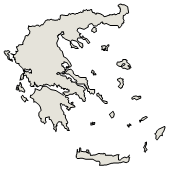
Administrative Region : Peloponnese
Regional unit : Messinia
Agia Kyriaki (Αγία Κυριακή) Messinia
Agia Kyriaki,[4] is a seaside settlement near Filiatra and administratively falls under the Municipality of Trifylia, in the Prefecture of Messinia. From the late 19th century to the early 20th century, it was the main port,[5] that is, the harbor, of Filiatra (today Limenari is also considered a port). It was a relatively small port with significant export activity for the international trade of raisins from the Trifylia region.[4]
Location
The northern entrance to Agia Kyriaki, from the Filiatra–Marathoupolis road.
The village is located on the Filiatra–Marathou coastal road, at an altitude of 1[1] meters and is washed by the waters of the Ionian Sea.[4] It is approximately 80 kilometers from the capital of the prefecture, Kalamata, to the northwest of it.[6][7][8][9] Agia Kyriaki is approximately 4.5 kilometers southwest of Filiatra.
History
Classical, Roman and Byzantine era
In the wider area of Agia Kyriaki, according to one version, ancient Erana is located, in which there was a sanctuary, which was probably dedicated to Eranaios Poseidon.[4][5] There was previously, as evidence, a marble statue head attributed to this god, but it was lost during the Occupation.[4][5] During the Roman era, baths were also created in the area.[4][5][8] It is believed that a Byzantine-Early Christian temple with a five-aisled basilica was rebuilt in the 4th century on the ruins of the sanctuary of Ancient Erana.[4] During excavations, in the area of the late Roman bath and the early Christian basilica, coins from those times were also found.[4][5][10]
"Raisin Society"
The village itself has a history that begins towards the end of the 19th century. Its small port, as well as the old abandoned raisin processing factory, played a decisive role in the development of the village,[4] but also of the entire region of Filiatra, which participates in the "raisin society", as according to historian Kaiti Aroni-Tsichli: "A whole world lives and develops around the cultivation and trade of raisins, the "raisin society". In large urban centers, such as Patras, a port city par excellence that organizes the production of the product and controls exports, or Pyrgos, but also in villages and towns, such as Xylokastro, Lechaina, Gargalianoi or Filiatra, the entire life and activities of the residents are determined by the raisin".[11][12]
Administrative history
The settlement, initially named Agia Kyriaki Ormos, was annexed to the old Municipality of Erani in 1896,[13][14] while shortly afterwards, in 1899, it was transferred from the Prefecture of Messinia and became part of the Prefecture of Trifylia,[15] for about a decade, until 1909, when it returned to the Prefecture of Messinia,[16] as a settlement of the District of Trifylia. In 1912, the village was separated from the Municipality of Eranis and became part of the Community of Filiatra,[17][18] until 1997, when, as part of the changes that occurred in local government, through the "Kapodistrias" plan, it was subordinated to the abolished Municipality of Filiatra,[19] until 2010. Since 2011, after the new changes of the "Kallikratis" plan, it now belongs to the new Municipality of Trifylia.[4][20] This municipality was established with the Kallikratis Program by merging the pre-existing municipalities of Aetos, Avlonos, Gargaliana, Kyparissia, Filiatra and the community of Tripyla.
Residents
The settlement, based on the 2011 census, has 197 permanent residents, who are employed in tourism, fishing and mainly in various agricultural activities, such as olive growing, other tree crops and greenhouses.
Population Evolution of Agia Kyriaki Messinia Census Population Population Evolution Chart
1896 13[21]
1907 43[22]
1920 39[23]
1928 325[24]
1940 99[25]
1951 91[26]
1961 50[27]
1971 55[28]
1981 30[29]
1991 163[30]
2001 339[31]
2011 197[32]
Buildings – sights – events
In addition to the houses in the village, there is the Church of Agia Kyriaki, near the port,[8] which belongs to the Holy Metropolis of Triphylia and Olympia. Agia Kyriaki, from which the village takes its name, is celebrated on 7 July, with a service and procession of the icon of the Saint in the harbor, while one of the largest festivals of Trifylia is held at the same time, attracting people from the wider area.[4][5] The village's harbor, as well as the homonymous Agia Kyriaki Beach, are also considered important sights.[5]
See also
Filiatra
Municipality of Trifylia
Administrative division of the Regional Unit of Messinia
Administrative division of the prefecture of Messinia
former Municipality of Filiatra
References
Agia Kyriaki Archived 2017-07-05 at the Wayback Machine, from the website: buk.gr
Postal Code Agia Kyriaki Messinia.
Telephone codes of Greece, Zone 27: Filiatra: 27610
1) D.K. Filiatra: Agia Kyriaki Archived 2017-06-16 at the Wayback Machine, from the website: www.dimostrifylias.gr of the Municipality of Trifylia.
"Messinia: Olive Culture in the land of Messinia" - "Messinia. The Culture of the Olive in the Messinian Land", Biotourism Guide - Biotourism Guide, from the website: biopolitics.gr, Biotourism – Olive Culture in the land of Messinia, published by: "Biopolitics International Organisation" - "International Organisation of Biopolitics", Athens 2015, ISBN 978-960-7508-55-3, p. 352.
Publications «Ellada»
Structure
«Holidays»
statistics.gr
Early Christian Basilica - Late Roman Bath Archived 2013-10-18 at the Wayback Machine, in YA 15904/24-11-1962 - FET 473/Β/17-12-1962 Archived 2016-03-05 at the Wayback Machine: "On the declaration of archaeological sites. PREFECTURE OF MESSINIA. District of Triphylia: 3) Ruins of an early Christian basilica of a late Roman bath, in the area of Agia Kyriaki Filiatra", according to the Permanent List of Declared Archaeological Sites and Monuments of Greece Archived 2018-04-01 at the Wayback Machine, by the National Archives of Monuments of the Ministry of Culture.
Kaiti Aroni-Tsichli, "The Raisin Issue and the Social Struggles. Peloponnese 1893-1905", "Papazisi" Publications, Athens 1999, ISBN 960-02-1321-6, ISBN 978-960-02-1321-8.
Source: The article by Nasi Balta, entitled: "The culture of the raisin. Raisin cultivation in the Peloponnese in the 19th century, the economic crisis and the farmers' revolt. The political, cultural and social context", 06/02/2000, in the newspaper To Vima.
FET 59B - 17/06/1897.
Administrative Changes of Settlements > Agia Kyriaki (Messenia) Archived 2021-05-15 at the Wayback Machine, from the website: www.eetaa.gr
Government Gazette 136A - 08/07/1899.
Government Gazette 282A - 04/12/1909.
Government Gazette 262A - 31/08/1912.
Administrative Changes of Settlements > K. Filiatron (Messenia), from the website: www.eetaa.gr
Government Gazette 244A - 04/12/1997.
Government Gazette 87A - 07/06/2010.
Ministry of Interior, Department of Public Economy and Statistics, "Statistical Results of the Population Census, on 5-6 October 1896", Part Two - Tables - A' Population by Prefectures, Districts, Municipalities, from the National Printing and Lithography Office, Athens 1897, p. 106.
Ministry of the Interior, Census Service, Statistical Results of the General Population Census, as of October 27, 1907", Edited by: Georgios Chomatianou, volume two, from the Michael Nikolaidou Printing House, Athens 1909, p. 395.
Ministry of National Economy, Directorate of Statistics, "Population of the Kingdom of Greece, as of the Census of December 19, 1920", from the National Printing House, Athens 1921. Also: "Population of the Kingdom of Greece, as of the Census of December 19, 1920", p. 240.
Ministry of National Economy, General Statistical Service of Greece, "Population of Greece according to the Census of 15-16 May 1928". (Actual population ratified by the decree of 23 November 1928), from the National Printing House, Athens 1935. Also: "Population of Greece, according to the Census of 15-16 May 1928", p. 277.
Ministry of National Economy, General Statistical Service of Greece, "Population of Greece according to the Census of 16 October 1940". (Actual population by prefectures, provinces, municipalities, communities, cities and villages), from the National Printing House, Athens 1950. Also: "Population of Greece, according to the Census of 16 October 1940", p. 305.
National Statistical Service of Greece, "Population of Greece according to the Census of 7 April 1951". (Actual population by prefectures, provinces, municipalities, communities, cities and villages), from the National Printing House, Athens 1955. Also: "Population of Greece, according to the Census of 7 April 1951 Archived 2013-05-14 at the Wayback Machine", p. 149.
National Statistical Service of Greece, "Population of Greece according to the Census of 19 March 1961". (Actual population by prefectures, provinces, municipalities, communities and settlements. Approved by the joint decision of the Ministers of Coordination and Interior No. 46929/6877/1961), from the National Printing House, Athens 1962. Also: "Population of Greece, according to the Census of 19 March 1961", p. 144.
National Statistical Service of Greece, "Population of Greece according to the Census of 14 March 1971". (Actual population by prefectures, provinces, municipalities, communities and settlements. Ratified by the joint decision of the Ministers of the Deputy Prime Minister and the Interior No. 3893/Ε637/1972), Athens 1972. Also: "Population of Greece, according to the Census of 14 March 1971", p. 140.
National Statistical Service of Greece, "Actual Population of Greece according to the Census of 5 April 1981". (Ranked by the joint decision of the Ministers of Coordination and the Interior No. 7908/δ'554/12-4-1982), Athens 1982. Also: "Actual Population of Greece according to the Census of 5 April 1981", p. 150.
National Statistical Service of Greece, "Actual Population of Greece according to the Census of 17 March 1991". (Ranked by 24197/Γ' 3812/24-11-1993 joint decision of the Ministers of National Economy and Interior), Athens 1994. Also: "Actual Population of Greece according to the Census of 17 March 1991", p. 183.
National Statistical Service of Greece, "Actual Population of Greece. Census 2001". (Ranked by 6821/Γ5-908/4-6-2002 joint decision of the Ministers of Economy and Finance and Interior, Public Administration and Decentralization), Athens 2003. Also: "Actual Population of Greece. Census 2001", p. 186.
"Population - Housing Census 2011. Resident Population Archived 2016-04-18 at the Wayback Machine.", Hellenic Statistical Authority (ELSTAT).
Sources
Encyclopedia Britannica, 1978, 2006.
Encyclopedia Britannica, 1963.
Encyclopedia Domí, 2002-4.
"Ellada" Publishing Organization, maps (Varelas).
"Diakopes" magazine, D.O.L. ed., 2010.
"ROAD" maps.
Hellenic Statistical Authority.
eetaa.gr
| Municipal unit Filiatra |
|---|
| Municipal Community Filiatra |
| Agia Kyriaki (Αγία Κυριακή, η) |
| Agia Pethameni (Αγία Πεθαμένη, η) |
| Agrilos (Άγριλος, ο) |
| Vryses (Βρύσες, οι) |
| Giolaka (Γιόλακα, η) |
| Kountri (Κουντρίον, το) |
| Lagkouvardos (Λαγκουβάρδος, ο) |
| Lempestena (Λεμπεστενά, τα) |
| Limenari (Λιμενάρι, το) |
| Merolithi (Μερολίθι, το) |
| Stomio (Στόμι, το) |
| Filiatra (Φιλιατρά, τα) |
| Community Exochiko |
| Exochiko (Εξοχικόν, το) |
| Community Mali |
| Mali (Μάλη, η) |
| Community Plati |
| Plati (Πλάτη, η) |
| Community Chalazoni |
| Chalazoni (Χαλαζόνι, το) |
| Community Christianoupoli |
| Christianoupoli (Χριστιανούπολη, η) |
Greece :
A - B - C - D - E - F - G - H - I - J - K - L - M -
N - O - P - Q - R - S - T - U - V - W - X - Y - Z
Retrieved from "http://en.wikipedia.org/"
All text is available under the terms of the GNU Free Documentation License
| Ancient Greece
Science, Technology , Medicine , Warfare, , Biographies , Life , Cities/Places/Maps , Arts , Literature , Philosophy ,Olympics, Mythology , History , Images Medieval Greece / Byzantine Empire Science, Technology, Arts, , Warfare , Literature, Biographies, Icons, History Modern Greece Cities, Islands, Regions, Fauna/Flora ,Biographies , History , Warfare, Science/Technology, Literature, Music , Arts , Film/Actors , Sport , Fashion --- |
