
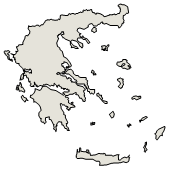

Administrative Region : Epirus
Regional unit : Arta
Gavria (Γαβριά) Arta
Gavria is a small village in the Municipality of Arta, in the Arta plain, and is approximately 8 kilometers from the city.[1]
Etymology
The exact origin of the name "Gavria" is not known, but there are three versions.
The gabbro tree, scientific name oriental hornbeam (Carpinus orientalis) from which, according to one version, Gavria took its name.
The first version is the one that claims that the name of the village comes from the antler tree (Carpinus). According to the German Slavologist Max Wasser, who with his work "The Slavs in Greece", carried out a comprehensive study on the Slavic place names of Greece, the name of the tree comes from the Bulgarian word gábъr.
A similar reference to the Slavic origin of the word is made by the German linguist Gustav Meyer, while according to the Lexicographical Bulletin of the Academy of Athens, the name Gavria and its derivatives indicate areas where there are deciduous trees, the eastern hornbeam (Carpinus orientalis) and the hornbeam (Ostrya carpinifolia).[2][3]
The second version claims that the name of the village is of ancient Greek origin. According to the Byzantium scholar Konstantinos Amantos, the toponym has its roots in the word gravio. The ancient orator Athenaeus in his work Deipnosophistae informs us that gravio was the wood of fir or holly.[4][5][6]
The third version claims that the name of the village probably came from Gabriel, Metropolitan of Nafpaktos and Arta. With the name “Gabriel”, there were 7 metropolitans:[7][8]
Gabriel I, 1271-1275.[9]
Gabriel II, 1386. Metropolitan of Ioannina who “claimed” the position of Nafpaktos, like his predecessor.
Gabriel III, 1561.
Gabriel IV Goras, 1581-1589. His election is mentioned in 1581 and his death in 1589 (June 24).
Gabriel V, whose name is mentioned in many Sigillae and Synodal decisions, to which he signed, such as in the Sigillae of Ecumenical Patriarch Cyril on the canonization of Saint Gerasimos of Cephalonia (July 1622) and served as metropolitan, in the period 1601-1632
Gabriel VI Blasius, who was born in Corfu, was appointed metropolitan of Nafpaktos and Arta, in the period 1647-1660. Sources tell us that he wrote a letter to the Duke of Nevers, who was preparing a revolution in Greece against the Turks. Dositheos counts him among the scholars, praises him as a theologian and a defender of Orthodoxy.[10]
Gabriel VII, Gagas, from Larissa, Metropolitan of Ioannina, Nafpaktos and Arti (the Metropolis of Nafpaktos and Arti, at the request of Ali Pasha of Epirus, was united with the Metropolis of Ioannina from 1808 to 1813). Gabriel VII, Gagas served as metropolitan from 1810-1813 and was the uncle[11] of Kyra Frosini, of Ioannina.
History
Antiquity
Gavria, along with the other villages of the plain, is located in a location that in ancient times was inhabited by the Dryopes, a Thesprotian tribe, who were expelled in 625 BC by the Corinthians. Human activity in the area was intense due to the short distance separating Gavria from the port of Ancient Ambracia, Ambraco, also known as Fidokastro. The findings brought to light by archaeological research confirm the existence of residential sites in the surrounding area. Excavations carried out in 1976 at the site of Galatsida Gavria brought to light large limestone blocks, which belonged to building walls, sherds of Hellenistic period vases and a piece of the base of a large jar.[12][13][14]
The Venetian Archives
Spanish real, the currency with which the villages of Arta paid tribute to the Venetians in exchange for protection from pirates.
Historically, the first source that informs us of the existence of the village is the Venetian archives.[15] From the late 17th century, the Venetians began to cooperate with various adventurer groups of irregulars, mainly Greeks from Cephalonia and Ithaca, who plundered the rich areas of the Arta plain. The Venetians aimed, on the one hand, to create problems for the Turks and, on the other, to push the inhabitants of the rural areas to seek protection from the robber raids, paying a significant amount of money.[16]
A typical example is the Mani pirate Liberakis Gerakaris, who in 1696 plundered the city of Arta and the surrounding villages and stole approximately 50,000 reales, a huge sum for that time, but which also testifies to the wealth of the region. Based on the information provided by the archives, the Venetians knew about Gerakaris' plan to attack Arta and saw it as another opportunity to increase their income from the protection tax. The Artinians sent a letter to the Doge of Venice and informed him about Gerakaris' raid and about the fact that the Mani pirate robbed only Christians and did not cause any harm to the Turks and Jews. The Venetians arrested Gerakaris and imprisoned him in Brescia, Italy, where he died.[17][18]
According to the Venetian archives, we know that in 1695, during the reign of Silvestro Valiero, Gavria, along with many other villages in Arta, paid a tax to the Venetian administration in exchange for protection from pirate raids. The inhabitants of the villages of Arta paid a total of 1500 Spanish reales annually (1 reale was equivalent to 9½ Venetian pounds), while Gavria paid 3 reales.[19][20][21][22] This allows us to conclude on the one hand that Gavria was a small settlement and on the other hand that the settlement of the village took place many years before 1695.
Foreign travelers in Arta
European travelers who visited the plain of Arta in the 17th, 18th and 19th centuries describe the landscape of the area and give us important information about the life and activities of the inhabitants of the time. Salaora was the most important port of Arta and access to the city was via the road that passes through the villages of Aneza and Kostakious, between which Gavria is located. In 1676, the French doctor Jacques Spohn arrived in Arta and informed us that the entire area around the city cultivates tobacco and exports wool and roe.[23] According to the work "Voyage en Grèce" by the Italian politician Saverio Scrofani, in 1794 the inhabitants cultivated wheat, corn, barley, oats, beans and exported buffalo hides, a fact that testifies to the development of livestock farming. Scrofani also informs us about the export of wood from the significant forest areas with oaks and elms that existed in the plain and belonged partly to the state and partly to private individuals.[24]
The British soldier William Martin Leake visited the plain area in 1805. According to his book "Travels in northern Greece", Leake, on his way from Salaora to Arta, passed between the villages of Aneza and Kostakius and mentions the existence of corn fields, which separated deserted areas covered with chamomile.[25] A picture of the area is also given to us by the British traveler and politician John Hobhouse, who in 1809 disembarked at Salaora and on the way to the city of Arta, noticed some areas that served as pastures for horses and cattle.[26] The British doctor Henry Holland came to the area in 1812 and on the way to the city, passed through Aneza. Holland informs us about the pastures of the region and the crops of corn, wheat, rice and tobacco.[27] Reference to the important corn crops is also made by William Turner, a British diplomat and writer, who passed through the region in 1813.[28] François Poukeville, in his work "Journey to Greece", which was published in 1820, makes reference to the plain of Arta, which he characterizes as a particularly fertile area. The French traveler also informs us that during his excursion to the villages of the plain, he visited the area around Gavria and specifically the neighboring villages of Apomero and Kalomodia.[29]
19th century
According to Spyridon Aravantinos' work, "History of Ali Pasha of Tepelenlis", Gavria, unlike the neighboring villages of Aneza, Mytikas, Kostakioi and Kalomodia, was not among the estates of the Pasha of Ioannina, who owned most of the plain, while based on the work of Kon. Diamantis entitled "Arta and its surroundings during the times of the revolution", Gavria was a small settlement with 15 families at the time of the outbreak of the Greek Revolution of 1821.[30][31]
Panagiotis Aravantinos in his work "Chronography of Epirus" informs us that, based on the 1845 census list, Gavria was a privately owned village, belonging to the Ioannina department and inhabited by 13 Christian families, while the report of the Russian Vice Consulate of Arta, in 1877, informs us that the village was the property of the Metropolis of Arta and inhabited by 15 families.[32][33] In 1878, the Epirote scholar Vasilis Zotos, in his work "Epirotikai Meletai", refers to the two neighboring villages, Aneza and Kostakioi, and informs us that Kostakioi was about one hour away from Arta, while Aneza was about two hours away, which leads us to assume that the distance separating Gavria from the city was about 1 hour and 30 minutes.[34]
Ifikratis Kokkidis also refers to the village in his work "Odoiporika Epirou kai Thessalyas" published by the Greek Ministry of Military Affairs (Athens 1880) and gives us the information that the village was inhabited by about 50 people. I. Kokkidis informs us that the province of Arta was divided into 2 regions: the region of Arta and the region of Preveza. The region of Arta was divided in turn into 7 sections: Potamia section, Vryseos section, Radovizi section, Tzoumerka section, Kampos section, Karvasaras section and Lakka section. Gavria was part of Kampos section.[35]
The old school in Aneza, which during the 19th century was attended by students from Gavria and the surrounding villages.
Another notable source is the “Historical Essay on Arti & Preveza” (published 1884) by Seraphim Xenopoulos, Metropolitan of Arta. According to this source, at that time the inhabitants of the village attended church in the church of Saint Nicholas of Aneza. In front of the church there was a co-educational school, taught by a teacher and attended by approximately 180 students from Gavria, Mytika, Aneza, Apomero and Kalogeriko. The Metropolitan also refers to some grasslands that existed in the village and belonged to the Holy Metropolis of Arta, which, after the liberation of the city of Arta in 1881 and the definition of the Arachthos River as the border, passed into the ownership of the Holy Metropolis of Nikopolis and Preveza.[36]
An equally important source is the Ottoman census of 1895, published under the title "Bin üc yüz on bir sene-i maliyesine mahsus Yanya salnamesi. Yedinci defa olarak" (Ioannina Salnames for the fiscal year 1311, seventh edition).[37] According to the relevant Ottoman law, which had been in force since 1864, the primary division of the empire was the vilayet ("prefecture" or "general administration"). Each vilayet was divided into sanjaks, and these into kazades. According to this census, the village belonged to the Kaza Lourou, who was in the sanjak of Preveza, which in turn belonged to the vilayet of Ioannina. Based on this census, 14 families (hanedes) lived in Gavria with a total population of 82 people (33 men, 49 women). The statistics also inform us that Gavria was 2 hours and 30 minutes away from the seat of the kaza, Filippiada, a distance approximately the same as that of Jenitsari (part of today's Aneza) and 1 hour shorter than that of neighboring Psathotopi. This information, as well as the fact that the residents attended church at the church of Agios Nikolaos of Aneza and not at the church of Agios Vlasios in Psathotopi, lends some basis to the claims of the residents, who claim that the original location of the village was next to Aneza, specifically at the location "Palaiochoria".[38] The engineer lieutenant colonel Nikolaos Schinas in his work "Odoiporikon Epirou" published by the Greek Ministry of Military Affairs (Athens 1897) informs us that 24 farming families lived in Gavria at that time and the village was a vakuf of the Metropolis.[39][40]
Greco-Turkish War (1897)
During the unfortunate Greco-Turkish War of 1897, Gavria and the neighboring villages were temporarily liberated. The war declared by the Ottoman Empire against the Kingdom of Greece in 1897 was a consequence of the then outcome of the Cretan problem, the former refusing the request to hold a referendum in Crete in order for the Cretan people themselves to provide a solution to the problem. The occasion was given when on March 27 with the old / April 8, 1897 with the new, armed irregular corps stormed into Turkish-occupied Macedonia.
After the Treaty of Constantinople (1881), the Arta Bridge and the Arachthos River defined the borders of Greece with Turkey, in Epirus.
The Greek expeditionary army was formed into three divisions. The 1st Division, commanded by Major General Nikolaos Makris, had its headquarters in Larissa, the 2nd Division, commanded by Colonel Georgios Mavromichalis, had its headquarters in Trikala, and the 3rd Division, commanded by Colonel Thrasyvoulos Manos, was in the Arta area. The military forces present in Arta were the following: The 6th Infantry Regiment, the 9th Infantry Regiment, the 10th Infantry Regiment, the 12th Infantry Regiment, the 1st Evzone Battalion, the 3rd Evzone Battalion and the 10th Evzone Battalion. In the area, in addition to these forces, there was also the 1st Artillery Regiment with 4 mountain and 4 plain artillery batteries and two artillery ammunition companies, an Engineer battalion with 5 companies and a Telegraph platoon, three cavalry companies of the 1st Cavalry Regiment, 6 surgical units and 2 supply platoons. In total, the Greek forces present in Arta numbered approximately 22,000 soldiers.[41]
At the entrance to the Amvrakikos Gulf was the Western Squadron of the Greek fleet, under Captain Dimitrios Kriezis, and was divided into two sub-squadrons. According to the plan, one Squadron would be responsible for bombarding the fortresses within the Amvrakikos Gulf, while the other Squadron would bombard the fortress of Preveza and generally control traffic in the Amvrakikos Gulf. The Western Squadron consisted of the following ships: The battleship "Spetsai", the ironclad "King George I", the steamer "Evrotas", the troopship "Thrace", the troopship "Ionia", the steamer "Aktion", the steamer "Amvrakia", the gunboat "A", the gunboat "B", the gunboat "C", the gunboat "D", the steamer "Kichli", the steamer "Afroessa" and the cruiser "Miaoulis". The transport of war material within the Amvrakikos Gulf was carried out by the steamer "Macedonia".[42][43]
On the morning of 6 April/18 April 1897, Palm Sunday, the steamer "Macedonia" was heavily fired upon at the mouth of Preveza and ran aground in a shallow area towards Aktio.[44] This event marked the beginning of the war on the Epirus front. In the city of Arta, the Greek army took up a fighting position and the 9th Infantry Regiment was ordered to move to Peranthi. The headquarters had been established at the "Korodimos" position and the ammunition had been transferred to Menidi for security reasons, while the transfer of the hospital to Kompoti had also begun. On the same day, an order was given for the total evacuation of the city of Arta.
The Arta Defense Barracks, 1897.
At 2 p.m. the commander of the Western Squadron telegraphed to the commander Thrasyvoulos Manos and informed him that he had received an order to begin artillery fire against the fortresses of Preveza and Amvrakikos and an hour later Colonel Manos also gave the order to the infantry that was in Arta to open fire along the Arachthos line. The 2nd Field Artillery was the first to hit the Turkish fortress at the "Imaret" position and received an immediate response with a barrage of fire from the 6 large guns, which were fired in a coordinated manner against the Arta Defense Barracks. During the hostilities in Imaret there was also a simultaneous exchange of fire at the Arta bridge and in the area of Kato Panagia and Peranthi. At 4 p.m. the gunboats of the Greek fleet bombarded the fortress of Salaora and destroyed the 2 "Armstrong" type guns.[45]
On the evening of 6 April, a movable bridge was placed at the height of Peranthi and on the morning of 7 April, a company of engineers, a company of the 9th Infantry Regiment and 2 cavalry companies crossed it and after a fierce battle they captured the villages of Neochori, Pachykalamos and Akropotamia. The Greek army, with the assistance of two ships of the Amvrakikos Squadron, captured the entire area up to the mouth of the Arachthos in a very short time. At the same time, soldiers of the 12th Infantry Regiment, who were at the height of Glykorizo, managed to cross to the opposite bank of the Arachthos and occupy the village of Keramates.[46]
On 8 April, an engineering company, a field artillery regiment and the Soutsos regiment with 300 horses crossed to the opposite bank of the Arachthos and settled in Neochori and with the help of the 12th Regiment occupied the villages of Anthotopos, Agia Paraskevi and Kalomodia. The Turks, using the women and children of the area as a shield, retreated to the village of Mytika and fortified themselves in the Tower of Fuat Bey where there were approximately 1000 soldiers. The commander of the 2nd brigade, Brigadier General Sechos ordered the cavalry to reconnoiter the area and at 5 pm he received heavy fire around the villages of Psathotopi, Jenitsari and Mytika while a small detachment of Turkish cavalry was sent to drive off the Greek cavalry. On the evening of the same day, Brigadier General Sechos was ordered not to advance beyond the line Anthotopos-Agia Paraskevi-Psathotopi-Mytika.[47]
Greek soldiers disembark at Salaora and transfer of a Turkish cannon. The Greek flag was the only one to be raised on a Turkish building throughout the war, 1897.
On the morning of 9 April, information arrived that the Turks had abandoned the Artino plain during the night and had moved towards the Louros bridge. Infantry Lieutenant Tyligadis crossed the Arta bridge with the escort of a platoon to reconnoiter the area and at 10 a.m. he arrived at Kostakios where the residents welcomed him with cheers. At 11 a.m. the commander of the 1st brigade, Brigadier General Botsaris announced the capture of the Arta bridge and proceeded towards Kostakios and gave the order to reconnoiter the entire area of the plain and the Antipillar Petros Manos captured the villages of Aneza, Genitsari, Kalogeriko, Gavria, Psathotopi, Apomero and Mytika. Significant quantities of food, corn and sheep were located in Psathotopi and passed into the hands of the Greek army.
At noon of the same day, Major General Soutsos settled in Jenitsari and proceeded to reconnaissance towards the Kostakia area, while Major Gerogiannis occupied the "Metzitie" station in Aneza and destroyed the telegraph lines of Salaora. In the afternoon of the same day, Athipilarchos Petros Manos went to Salaora and did not detect enemy forces, while a large number of munitions had been abandoned by the Turks and passed into the hands of the Greek army. Brigadier General Sechos, who later arrived in Aneza and ordered the Gerogiannis battalion to occupy Salaora. On the same day, a body of approximately 100 Epirote rebels under the command of the chieftains Psathas and Spyros Kostas also arrived in Aneza.
The next day, 10 April, the 3rd battalion of the 9th Infantry Regiment under Brigadier General Secho departed from Aneza via the village of Rahi towards the Louros bridge, while an engineering company and a battalion remained in Aneza. Companies of the 9th, 10th and 12th Infantry Regiments were stationed in Salaora and at 11 am Governor-General Tombazis arrived with the steamer "Aktio" and 200 soldiers disembarked, who raised the Greek flag at the occupied fortress.[48] By the evening of 10 April, the villages of Gavria, Psathotopi, Mytikas, Aneza, Kalogeriko, Vigla, Rachi, Kalovatos, Plisioi, Kirkizates, Strongyli, Zavaka, Kalomodia, Agia Paraskevi, Kostakioi, Akropotamia, Keramates, Neochori, Anthotopos, Chalkiades, Rokka, Agios Spyridonas, Eleftherochori, Kampi and the town of Filippiada had been liberated.[49][50]
The poor organization of the Greek army, the absence of adequate supplies and the lack of foresight on the part of the political class forced the army to retreat to the original lines on May 2/15 and finally to sign an armistice on May 7/20, 1897 and to end hostilities on the Epirus front. Finally, with the mediation of the European powers and Russia, on September 20, the war activities came to a definitive end and peace was signed.
Before the liberation
According to the “Proceedings of the Louros and Philippiada Demogerontia” of 1900, the ownership status of the village remained unchanged and at that time the Metropolis of Nikopolis and Preveza leased the Gavria estates to a tenant named Konstantinos Tolias, who in turn subleased them to a Turk named Mustafa Aziz Aga.[51] In 1910, the Metropolis of Nikopolis and Preveza published the data of the census it carried out that same year in the entire ecclesiastical region and informed us that Gavria was under the Louros department and that 102 people lived in the village.[52]
First Balkan War and liberation
The steamship Acheloos was one of the legendary "four rivers" of the Greek navy.
On 4 October 1912, the Ottoman Empire declared war on Bulgaria and Serbia, while refraining from declaring war on Greece, hoping for a peaceful settlement. The very next day, however, the Greek government declared war on the Ottoman Empire as a member of the Balkan Coalition.
According to the attack plan, the Thessaly army, commanded by the Crown Prince Constantine, would take the brunt of the operations, while the Epirus army, commanded by General Konstantinos Sapoutzakis, would have a purely defensive role. The headquarters of the Epirus army was in the city of Arta. The military forces present in Arta were the following: The 15th Infantry Regiment, the 3rd Evzones (Tsoliades) Battalion, the 3rd Independent Evzones Battalion, the 7th Evzones Battalion and the 10th Evzones Battalion. In the area, in addition to these forces, there were also two squadrons of field and mountain artillery, an engineering company, a cavalry troop, supply and surgical units. The Epirus army had also been joined by bodies of Cretan volunteers and a platoon of Cypriots. In total, the Greek forces present in Arta numbered approximately 11,000 soldiers.
At the entrance to the Amvrakikos Gulf was the Amvrakikos naval squadron, which consisted of the following ships: The steam barge "Aktion", the steam barge "Ambracia", the steamer "Pineos", the steamer "Acheloos", the steamer "Evrotas", the steamer "Alpheus", the gunboat A, the gunboat C and the gunboat D.[53]
During the 1912 war, the area of the Arta plain was placed under the responsibility of Lieutenant General Alexandros Kontoulis
General Sapoutzakis, based on the information he had about the organization and movements of the Turkish army, considered it appropriate to cross the Arachthos and attack, and therefore sent a telegram to the General Staff of the Army, which, however, responded negatively to his proposal. Sapoutzakis ignored the telegram and at 2 pm on October 6, the 7th Evzone Battalion crossed the Arta bridge with artillery escort, repulsed the Turks and established itself in Kostakios and the Maratios area. It is likely that the liberation of Gavria and the remaining villages of the plain took place the next day, when the Greek army occupied and fortified the surrounding villages of Kirkizates, Plisios, Rokka, Chalkiades and Ammotopo. The area of Arta was divided into 3 sectors of responsibility and the villages of the plain were taken over by the commander of the 3rd Evzone Battalion, Lieutenant Colonel Alexandros Kontoulis. At noon on October 7, Kontoulis sent mounted troops to all the villages of the plain to declare, with their presence, the liberation and integration of the area into the Greek state. In the afternoon of the same day, bodies of irregular Epirotes from the villages of the plain joined the army corps of Alexandros Kontoulis.
The Amvrakikos naval squadron, from the first day of the war, had entered the Amvrakikos Gulf and escorted the merchant ships “Pylaros”, “Amalia”, “Angeliki”, “Ismini” and “Alkyon”, which were transporting food and war material from Vonitsa and Amfilochia to the port of Kopraina. On October 8, the naval squadron received orders to head to the port of Salaora and expel the Albanian guerrillas who had settled there and were obstructing the reconnaissance activities of the Greek army in the area. When the landing took place in Salaora, the Greek soldiers found no one and according to information from the residents of Koronisia, the Albanians had fled on the morning of October 7.
On the evening of October 10, 1912, the Turks launched a fierce attack on the heights of Grimbovo, displacing the Greek units occupying the northern heights and then turning to the southern side, where they encountered resistance from the 15th Infantry Regiment of Lieutenant Colonel Georgios Polymenakos, who managed to hold the lines all night. That same evening, while the fighting in Grimbovo was in progress, a small detachment of 150 Evzones occupied the strategically important area of Anogia. At first light on October 11, reinforcements arrived on the heights of Grimbovo from the 3rd Evzone Battalion of Alexandros Kontoulis and the Greek army managed to expel the Turks from Grimbovo, who fortified themselves on the heights of Kampi. At dusk on 11 October, the Evzone corps stationed in Anogia launched a new attack, which resulted in the capture of the fortress at Pente Pigadia. However, the capture of Anogia and the fortress by the Evzones seriously endangered the Turkish army, and commander Esat Pasha ordered an immediate retreat towards Ioannina to avoid being cut off and annihilated in the Louros valley and the difficult passes of Pente Pigadia. The retreat took place on the night of 11–12 October 1912, and the Turkish army definitively abandoned the Arta region.[54]
Interwar period
According to sources from 1929, Gavria remained a private estate, with the Diocese of Nikopolis and Preveza owning 4/5 of the area, while the remaining 1/5 belonged to the Greek state. The total area of the estate amounted to 1541 acres and was distributed among various land uses. The cultivable areas covered 991 acres, while the residential areas amounted to 207 acres. In addition, there were 20 acres of ditches, 156 acres of marshland, 11 acres of roads and 10 acres of forest land. The meadows occupied 89 acres, the wastelands extended to 37 acres while approximately 16 acres belonged to the church of the Assumption of the Virgin Mary. Agricultural production mainly included beans (4,910 okadas), wheat (21,250 okadas), oats (26,250 okadas) and maize (66,285 okadas), with crops focusing mainly on the mixed production of cereals and legumes.[55]
World War II
The monument with the names of those who fell in World War II.
During World War II, thousands of Greek soldiers lost their lives. Among them were two residents of Gavria. Nassis Anastasios, born in 1916, was a soldier in the 40th Evzone Regiment and was killed on the Pogoni Buildings Hill on 21 November 1940, and Nassis Nestor, born in 1919, was a corporal in the 3rd Cavalry Regiment and was killed at Mazi, Konitsa, on 24 November 1940.[56]
After the signing of the final capitulation protocol of Greece on 23 April 1941, the region of Arta was occupied by Italian troops. From the first days of the occupation, the population of Arta, both rural and urban, faced major problems of survival. In 1942, resistance organizations appeared in the region. The villages of Arta were the main source of food for the guerrillas, from which they obtained food to support the struggle that was taking place in the mountainous mass of Tzoumerka.[57] From the beginning of 1943, the armed guerrilla movement experienced great growth in the Arta region. As for the Italian administration, it was trying to deal with the problems created by the increasing expansion of guerrilla activity in the countryside. The Italians' liquidation operations in the plain were limited in scale. After the capitulation of Italy, on 8 September 1943, the 37th Italian artillery division "Modena" commanded by Herberto Papini, which had been stationed in the Arta region, handed over its weapons to the Germans, who took control of the area.[58]
In addition to the problems created by the German occupation, the inhabitants of the plain were daily confronted with incidents and skirmishes, as well as repressive policies on the part of the two competing forces, EDES and ELAS. At that time, the forces of EDES were limited to the part west of Arachthos, essentially in the areas of Lakka Souli and Xirovouni, while the rest of Epirus was controlled by EAM-ELAS. Nevertheless, the area of the Arta plain belonged to the disputed areas, which resulted in the intense presence of both guerrilla groups.[59] Characteristic is the report of the 8th Division to the general headquarters of ELAS in which we read "At 7:00 PM on March 21, the president of Anez, Michael Rossas, led an Edesian Division to Anezan. By the morning of the 22nd, this division had reached the villages of Kostakios, Keramates, Gavria, Psathotopi, Mytika, Agia Paraskevi, Kolomodia" while there were also extreme phenomena of looting as another report from the same division informs us in which we read "The situation prevailing there (in the plain) is indescribable, thefts, looting, kidnappings, rapes, murders, constitute the action of the Edesian groups of Papapanos, Mikrova (district commander), Plastiras (village leader), Voidaros, Kaimenakis, Riganis (robbers) etc." as well as "In early May, they injured the priests D. Tsampans from Aneza and E. Giotis from Gavrian. Entire dowries were looted, especially in Aneza, Kostakious, Gavria, Ag. Spyridonas".[60]
A noteworthy event is what is described to us by the gendarmerie lieutenant Ioannis Plastiras, who in 1944, as part of his espionage activity, entered the city of Arta disguised as a priest and with a false identity card on which was written the details of the then priest of Gavria, Fr. Aristides Charalambous, and managed to gather important information about the liberation struggle.[61]
After the Civil War
The end of the war found the villages of the plain destroyed. The inhabitants of Gavria, due to the existence of a swamp, were unable to practice systematic cultivation and malaria was very common. The houses of the inhabitants were made of mud, straw and reeds. The first craftsmen appeared on the plain in 1949 and began to build stone houses with stone that they transported by cart from Mavrovouni in Vigla where a stonemason, with rudimentary explosives, did the mining and supplied the area with the raw raw material. Around that time, the first stone house in the village was built. The craftsmen were usually paid with agricultural products or whatever else each family had. Most houses had a vestibule and two rooms. Every house that was completed, there was a custom to place a wooden cross on the ceiling and make wishes.
Part of an Austrian map from 1887 showing the existence of a marsh in Gavria.
In the plain, in the early 1950s, the first irrigation projects to drain the swamp began to take place by the British company Boots Ltd, and systematic spraying with airplanes began to deal with the mosquito plague. According to the scientific journal Rivista di Malariologia, the aerial spraying in Gavria took place on 22 June 1953 and a high quantity of insecticide was used, which indicates the significant problem faced by the village's residents.[62] Malaria, as well as the significant number of residents with the Mediterranean anemia stigma (heterozygous β-Mediterranean anemia), sickle cell anemia and G6PD deficiency, were the reason for conducting a scientific study in the summer of 1962. The result of the study was that these specific categories of people were more resistant to malaria.[63][64][65]
In the early 1960s, new roads began to be laid and the current road from the village to the main road connecting the city of Arta with Koronisia was opened and asphalted, making access to the city easier. According to an Austrian map from 1910, before the opening of the road, access to the city of Arta was only possible via a rural road leading to Kostakios. The movement of residents, which before the construction of the road was done by cart or on foot, changed form and the first buses took the place of horses. In 1969, the urban transport line Arta - Mytikas was launched, significantly facilitating access to the city.[66]
In the 1960s, a small cheese factory (badziario) of the Theodorou brothers from Vathypedo began operating in Gavria. The farmers of Gavria and neighboring villages transported the milk in tins and delivered it to the cheesemaker (badzio), who made cheese. The cheese factory was housed in a small stone house and the cheese production process was done manually. Its operation was continuous until the late 1980s, when the first modern dairies with automated dairy production lines began to appear in the area, which led to its abandonment.[67][68]
In the mid-1960s, with the opening of the labor markets of Germany, Australia and America, several residents emigrated in search of a better fate. The poor economic situation of most families and the need to find work led many children to drop out of school as soon as they finished elementary school or even before completing basic education, because they were pressured by their parents to work in the fields or learn a trade.[69]
In the early 1970s, the restructuring of crops followed. The monoculture of rice gives way to cotton and later to citrus fruits, a lucrative crop that gave a great boost to the local economy.
Administrative changes
Until 1919, Gavria was part of the community of Aneza, from which it was separated in 1921 and united with the neighboring community of Kostakia.[70] Gavria was recognized as an autonomous community in 1930, with the Presidential Decree of 23/07/1930.[71] In 1997, the community was abolished and, according to the Kapodistrias Plan, Gavria became a municipal district of the newly established Municipality of Amvrakikos, with Aneza as its seat.[72] The law was in force until the end of 2010, when it was replaced by the new administrative division provided for by the Kallikratis Plan, resulting in Gavria being incorporated into the Municipality of Artaia.[73]
Location and Access
Gavria is located in the heart of the Arta plain and is adjacent to other villages such as Psathotopi, Apomero, Mytika, Aneza, Kalomodia, Kostakios and is approximately 3.5 km from the facilities of the technology-agriculture schools of the TEI of Epirus. Also, the distance separating the village from the lagoons of Amvrakikos is approximately 14 km.[74] It is connected by road to Arta via the Arta-Koronissia Provincial Road.[75] The village is served by the Arta-Mytika line of the Arta Urban Bus Service.[76]
Demographics
Today the population amounts to 308 permanent residents (2021 census),[77] showing a decrease compared to the 2011 census, where the population amounted to 377 residents.[78] Approximately 1% of the total population of the enlarged Municipality of Arta resides in Gavria. The population of the village, after years of continuous growth (from 1961 to 1991 the population remained above 400 residents), decreased in the 2001 census. The first time the village exceeded 400 residents was in 1961 while the maximum number of residents was recorded in 1991 with 445 residents. With the 2021 census, the population level approached that of 1940. The decrease is largely due to the movement of many residents to the city of Arta, to immigration, but also to the general climate of low birth rates.
Population fluctuations are reflected in the table below.[79]
The most common surnames in the village are Tziomakis, Nasis, Fountas, Lousias.[80]
Climate
The climate of the Arta plain area, based on the Emberger bioclimatic classification applied to Mediterranean climates, is assessed as moderately warm and humid, while based on the Köppen climate scale, the climate is classified as Csa with a lot of rainfall and humidity from autumn to spring and intense heat and relative dryness during the summer months.[81] The Thornthwaite climate type places the area in the B3' b4' s2 C2 category, meaning the climate is mesothermic (B3') with a thermal efficiency index (Ιθ) of 85.5 to 99.7 cm, a summer concentration index (Cθ) (b4') of 48.0 to 51.9%, a humidity climate type (C2) of semi-humid to humid, a large water deficit in summer (s2) and a dryness index of over 20%. The frost-free period begins in March and lasts until early December, while the temperature very rarely drops below -5 °C based on Mayr's climate-forest zones. Snowfall is rare, with the most significant in the last 30 years being that of March 1987.[82][83][84]
Climatic data for Gavria Arta
Month Jan Feb Mar Apr May Jun Jul Aug Sep Oct Nov Dec Year
Average Maximum °C (°F) 13.3 14.0 16.7 20.1 25.0 29.1 31.8 32.0 29.0 24.1 19.0 14.9 22.41
Average Monthly °C (°F) 8.5 9.6 11.0 14.5 18.6 23.1 25.7 25.7 23.7 15.8 10.9 9.7 16.4
Average Minimum °C (°F) 4.7 5.2 7.0 9.9 13.9 17.3 19.5 19.9 17.1 13.4 9.4 6.0 11.94
Rainfall mm (inches) 131.8 135 93.8 81.5 58.5 21.8 12.6 17.2 43.5 115.4 186 187.5 1,084.6
Humidity % 71.7 70.6 68.9 68.8 66.0 61.4 59.2 59.4 63.6 67.7 74.1 73.2 67.05
Average days of precipitation 11.7 10.9 10.2 9.1 7 3.7 2.3 2.4 4.5 8 11.8 13 94.6
Average monthly hours sunshine 144.5 128 182.9 192.8 276.9 307.7 348.2 336.6 259.1 203.8 150.2 127.4 2,658.1
Source: National Statistical Service of Greece [85][86]
Production and Employment
Citrus cultivation is particularly widespread in the wider area of Arta.
The residents' main occupations are livestock, poultry, pig farming and agriculture with the main crops: oranges, tangerines, kiwi, corn, clover. In recent years, pomegranate cultivation has also begun. Before the mid-1960s, rice cultivation was particularly widespread due to the marshy area that covered the area. The greenhouse cultivation of fruits and vegetables such as tomatoes, cucumbers and peppers is also noteworthy. Today, the total cultivable areas cover an area of 5,400 sq.m and correspond to 3.30% of the total cultivable areas of the former Municipality of Amvrakikos.[87][88]
The breed of sheep raised by the residents of the village and in general in the rest of the Arta region is noteworthy. The Arta sheep breed (Frizarta, Friesland-like or Friesland-like sheep of Arta) is a "synthetic" breed. Approximately 50% of its genes come from the Friesland breed, which is the best dairy-producing breed of sheep in the world. This improved breed was first created in the lowland area of Arta. The common sheep of the region were initially raised in this area. From 1900 to 1965, many breeds of sheep were introduced from time to time. From 1968, crossbreeding with East Friesland sheep began. This resulted in the creation of a homogeneous population of sheep, which from 1982 were recognized by the Ministry of Agriculture as a new known breed, the Arta breed.[89]
In Gavria there is an orange juice industry, a mechanical processing and production unit for metal products and special aluminum alloys, and a poultry farming cooperative, which was founded in 1966 by 8 poultry farmers and is today considered the largest industry in Arta.[90][91][92][93]
The village has an agricultural cooperative, which in the early 1990s built a privately owned weighbridge to serve the farmers of the area.
Flora and fauna
Gavria is located almost in the heart of the Artino plain and this has the result that the fauna and flora do not differ significantly from that of the neighboring villages.
Flora
Daffodils or bostines.
In terms of flora, much of the wild flora that is also found in the other villages of the plain, near the Amvrakikos Gulf, is found. The climatic and bioclimatic characteristics of the Arta region and the mild relief in the lowlands shape certain plant communities. Gavria is classified in the Quercetalia ilicis Zone, which occupies most of the lowland area and is distinguished in two subzones, the Oleo-Cetaronion and the Quercion ilicis. The Eumediterranean vegetation zone (Quercetalia ilicis) spreads at an altitude of 0 to 600 m. The Quercion ilicis subzone appears mainly in shrub form and is strongly degraded because most of the areas of this specific subzone have been cleared and attributed to crops.[94] Based on Mayr's Climatic Forest Zones, Gavria is located within the wetter zone of evergreen broadleaves (ΔΚΖ2). This zone is characterized by evergreen broadleaf shrubs with holly (Quercus ilex), oak (Arbutus unedo) and tree heath (Erica arborea).[95]
Typical plants of the area are the lapatas, the wild chard, the zochia or zochia, the daisies, the lilies near the irrigation canals, the poppies and the fragrant daffodils, known in Epirus as "vostines", plants which contain galanthamine, a characteristic substance that cures dementia. Outside the village, in the grasslands, on the banks of the irrigation canals but even on the edges of the dirt roads there are numerous thorny bushes with blackberries.
Variety of grapes "Izabela".
The area presents a large number of orange and tangerine trees but one can also find several peach, cherry, pomegranate, pear, fig, almond and orange trees. In the courtyards of the houses one can observe mulberry trees and in various places there are several plane trees, cypresses and poplars. Until the early 1990s, just outside the village, there was a small coniferous forest. The relatively temperate climate of the area and the fact that during the winter, temperatures below zero are rare, allow the planting of ornamental plants such as roses, carnations, cyclamens and tulips, which can be found in the courtyards and balconies of the houses.
In the plain area and in Tzoumerka, a grape variety called "izabela" or zambela thrives. The zambela is a hybrid grape that is particularly resistant and tasty and is ideal for the production of tsipouro but on the contrary is not suitable for the production of wine. It has a dark red or black color and is considered a wild vine. It cannot be cultivated as a vine. Usually, when it reaches about two meters, concrete pillars are used on which wire mesh is placed to support the plant, and this particular structure is called a "bed".[96]
Fauna
The rich vegetation is an important factor for the fauna of the area.
The fauna of the area around Gavria is rich and consists of a significant variety of species. An important role in this is played by the short distance of the village (approximately 2 km.) from the Corine and Natura biotopes of Amvrakikos.[97] The dense vegetation, the available quantities of water, the abundant food and the minimally polluted environment offer ideal conditions for the various species and constitute an excellent nesting site. The mammals that one can encounter in the area are mainly terrestrial (arboreal and terrestrial). Some of the mammals that live in the area are the fox, the ferret, the badger, the hedgehog and the weasel.
The area is a passage for migratory birds, but there are also several species that live permanently in the area. The number of birds such as the sparrow, the swallow, the stork, the goldfinch is particularly rich, as well as birds of prey such as the owl. In the past, before the drainage of the swamp, there were abundant wild ducks. During the summer months in the areas with high vegetation, one can encounter vipers, which feed on small animals, such as mice and small birds.
The number of lizards, which feed on insects, is also quite significant. During the spring months, one can observe fireflies and ladybugs, while bats are also present, which nest in various parts of the houses during the summer months. The number of frogs and common water snakes (Natrix natrix) of the Greek fauna, which live in the irrigation canals of the village, is also noteworthy.
Community structures, education and culture
The kindergarten and the primary school in the central square of Gavria.
The village has a newly built kindergarten and a two-room primary school with external stone decoration[98] which are located in the central square of the village. The area on which the school was built was donated by Efstathios Fountas. Until the early 1990s, there was a large stone fountain in the central square, which was built before the 1940s and from which the villagers got water at a time when there was no water supply system. The kindergarten was initially housed in a single-room building near the village church until the early 1990s. Secondary education is covered by the Aneza High School and Lyceum.
The central square of the village hosts, in addition to the primary school and the kindergarten, a building which belongs to the church and is rented from time to time for various uses. Above this building, an additional building has been constructed, which was previously used as a community office, while today it serves the activities of the rural clinic. In front of the primary school, a monument has been constructed, on which are inscribed the names of those who fell in the Second World War. Gavria also has a second square, considerably larger, with an area of 1270 sq.m. at the entrance to the village, near the church and has a white stone fence. Very close to this square and next to the church, stands the aqueduct, which was constructed in the 1980s and was a decisive step in the village's water supply from the springs of Agios Georgios Filippiadas.[99][100][101]
Cultural club
Gavria has an active cultural club, "Odysseas",[102] founded in 1980, which organizes excursions and cultural events every year. The main goal of the club is to contribute as much as possible to the cultural and spiritual upgrading of the village, but also to the preservation and dissemination of tradition and cultural heritage. In the past, the cultural club organized the traditional carnival in the village and presented shadow theater performances. The most active part of the club is the dance club. In the three sections of the club, the children's, the teenage and the adult sections, traditional dances from all over Greece are taught. The sections of the association, dressed in traditional costumes, participate every year in the cultural events that take place in the village on August 15.[103][104]
The Church of the Assumption
At the entrance to the village, near the square, is the parish church of the Assumption [105] The church was built in 1915, on a plot of land measuring 2 acres, which was donated by a resident of the village, Vasilios Nassis. It is a large, single-nave, street church with a modern loggia to the south. The church's precincts are enclosed by a wall and access to it is possible through the central entrance dominated by the renovated bell tower. The interior of the church presents wood-carved decoration and many frescoes. According to the inscription above the right entrance door, the church was renovated and frescoed in the 1990s under the leadership of Metropolitan Meletios of Nikopolis and Preveza at the expense of local families. The iconography inside the church is arranged in two zones. The lower one depicts full-length saints and martyrs, and the upper one depicts faces of saints and scenes from the life of Christ and the Virgin Mary. The dome of the church is decorated with the icon of Jesus Pantocrator.
The iconostasis of the parish church of Gavria.
The most notable element of the church is the iconostasis, which according to the carved inscription above the Beautiful Gate, dates from 1928. It is made of handmade wood and bears dense floral decoration. The epistyle of the iconostasis is decorated with 15 icons depicting the face of Jesus in the holy shroud and his disciples. Below the iconostasis of Jesus is an angel in the form of a star with 16 rays. At the top is depicted the Crucified One in the center of the Crowning Cross and the figures of the Virgin Mary and John the Evangelist in the sorrowful ones. Worthy of attention are the two dragons surrounding the Crowning Cross. In the center of the Beautiful Gate is depicted Jesus inside the holy chalice. The despotic icons on the sides of the Beautiful Gate are painted on canvas and depict the Assumption of the Virgin Mary, the Mother of God, Jesus Christ, John the Baptist and Saint George. On the lintel of the Beautiful Gate and above the despotic icons and the icons of the epistle, two-winged cherubs are depicted. The only parapet of the iconostasis is decorated with the full-length icon of the Archangel Gabriel.
In 1997, by ministerial decision, the church was designated as a historical monument and a building in need of special state protection.[106] Behind the holy church is the village cemetery. The outer wall of the cemetery displays a stone inscription that reads "Here there is no distinction between rich, poor, or great, they all lie together in the embrace of mother earth" and dates from 1970. Gavria is part of the Diocese of Nikopolis and Preveza.
Sports
Atromitos Gavrias
Official name A.O. Atromitos Gavrias
Founded 1958
Headquarters Greece
Stadium Gavrias Stadium
Championship Resigned from all competitions in 2010
First appearance
Second appearance
The village has a football field, measuring 12,346 m2 with natural grass.[107] The local team is Atromitos Gavrias, founded in 1958. The team finished in 2nd place in the 2005/2006 football season, 3rd place in 2006/2007, 13th place in 2007/2008, 8th place in 2008/2009 and 13th place in 2009/2010 [108] of the A' category of the E.P.S. Arta. Atromitos Gavrias, in the 1983/1984 season, reached the final of the Arta Cup.[109]
Old photo of the Atromitos Gavrias team.
Following incidents that occurred on 27 February 2010 at the Gavria stadium, the Board of Directors of the Arta Football Referees Association, in a statement, called on all its members to declare an indefinite suspension from playing for Atromitos' home and away league and cup matches. This resulted in Atromitos Gavrias, in a document submitted to the Arta Football Clubs Association on 19 March 2010, permanently withdrawing from the league due to the heavy financial burden of using referees from other prefectures.[110][111]
The Gavria stadium has hosted a children's and youth football tournament in recent years, which was established by the former Municipality of Amvrakikos and is continued by the Municipality of Arta. The Gavria stadium was the home of the AO Gefyra team, while today the Anagennisi Arta team uses the facilities during training.[112][113][114]
References
«Municipal districts of Amvrakikos». Archived from the original on 11 September 2011. Retrieved 21 March 2012.
«Gavria ON, Kr. Philippias (Lex.), ist offenbar eine griechische Ableitung auf -ιά von einem *Γάβρος, das einem bulg. gábъr, skr. grȁb »Hagebuche, Carpinus betulus« entspricht», Die Slaven in Griechenland, Max Vasmer, Berlin, Prussian Academy of Sciences, 1941
«Gavros (ό), Gavra (τα), Gavrias (ό). These are names of areas where the deciduous forest tree Zygia or two-leaf hornbeam (Carpinus duinensis/C.orientalis) or Ostrya or zygiophyllos (Ostrya carpinifolia) of the Cupressaceae family exists alone or in clusters [..] There is also a village in the province of Arta with the form Gavria (or).», Lexicographical Bulletin of the Academy of Athens, vol.14, p.197-198, 1982. -«Location where there used to be a gabbro. According to Gustav Meyer it is derived from the Slavic. gabrù < grabrù.», Lexicographical Bulletin of the Academy of Athens, vol.15, p.25.
«The names Gravos, Gavria, Gavrolimni, Gravia, Gavrias, Gavria, are all related to the par. Athenaeus, Deipnosophists, “gravion is the fir or oak wood”. Already the many formations and the transposition — Gravos - gabros, Gavria- Gravia, Gavrias - Gravias, indicate an ancient word.”, Linguistic Studies (In Athens 1964), p.457, Konstantinos Amantos.
“Stamatios V. Psaltis reduces the L. to the later gravion (= a torch made of holly or fir). Gavros, Gravons, Giavros, Gavrakia (ta), Gavriad' (tou), Gavro (to), Gavria (ta), Gavrias (o), Gavril (h) and Gravia (h) are types of the L. which occurs in many places (Epirus, Macedonia).», Lexicographical Bulletin of the Academy of Athens, vol.15, p.26.
«Amerias also gravio the lamp. Seleucus also explains this word in this way: ‘gravio is the wood of fir or oak, which, twisted and torn, is exposed and visible to travelers. Theodoridas is the Syracusan in the Centaurs dithyramb: pitch dripped from the gravios.», Athenaeus, Deipnosophistae, 15.57.
«List of bishops and metropolitans of Nafpaktos (1600-1833)». Archived from the original on 5 April 2006. Retrieved 21 March 2012.
"List of bishops and metropolitans of Nafpaktos (1367-1600)". Archived from the original on 4 January 2005. Retrieved 25 March 2012.
"Episcopal List of the Holy See of Arti". Archived from the original on 1 April 2012. Retrieved 25 March 2012.
Konstantinos Sathas, Modern Greek Literature: Biography of the Literally Brilliant Greeks, from the Collapse of the Byzantine Empire to the Greek National Uprising (1453-1821), Printing House of the Children of Andreas Koromilas, Athens, 1868.
George Finley in his work "History of the Greek Revolution", Volume 1, p. 74 states that "Efrosini was a relative of a priest", while Aravantinos in his work: History of Ali Pasha of Tepelenlis, Athens (1895), mentions Gabriel VII, as a relative of Frosini.
At the site of Galatsida Gavria, during the excavation of an irrigation ditch, large, roughly worked limestone blocks were uncovered. They most likely belong to the walls of buildings that were dismantled during the excavation work. Many unpainted fragments of large vessels, several black-painted ones from the Hellenistic period and a piece of the base of a large jar were collected from the surrounding area. Archaeological Bulletin, Chronicles, part 2, volume 31, 1976
Ancient Times, Prefecture of Arta
In 625 BC, the Corinthians, led by Gorgos, son of Kypselos, the tyrant of Corinth, founded a colony on the banks of the Arachthos River after expelling the local Dryopes. [1] Archived 2018-03-21 at the Wayback Machine.
Arta in the archives of Venice, “Skoufas” magazine of Arta, issues of 1955-56.
Vetsios, Eleftherios L, The diplomatic and economic presence of the Venetians in the region of Arta during the 18th century, Thessaloniki, 2007, A.S.V. , P.T.M., f.866, 7 Settembre 1686.
The French consulate of Arta (1702-1789), SIOROKAS A. GEORGIOS, Ed. IMIACH (INSTITUTION FOR IONIAN AND ADRIATIC STUDIES), December 1981.
A Historical Essay on Arta and Preveza (ed. 1884), Seraphim Xenopoulos, Letter from the Residents of Arta to the Venetian Governors, p. 347-350..
Doges of Venice from 1284 to 1797
A.S.V., Senato, Rettori, f. 130, 20 Settembre 1695.
The History of the Closed
Arta in the Archives of Venice 1696-1787, K. Mertzios, University of Ioannina.
"In Arta are reckoned seven or eight thousand Inhabitants? This Town, and the Country round about, Traffick in Tobacco, Botargo, and Furrs, with which they drive a great Trade", Journey Into Greece. 6 Books. Ith Variety of Sculptures. - London, Cademan 1682, George and Spon Wheeler Jacques, book 1, p.38 [2]
"L'Arta exports beaucoup de denrées qui proviennent de son territoire: les principales sont le bled, le maïs, l'orge, l'avoine, les haricots. Outre les productions territoriales, l'Arta a deux manufactures, l'une plus considerable que l'autre. La première est celle d’une espèce de drap grossier, brun ou blanc, qui sert à faire de ces manteaux que les gens de mer appellent caban[..]Le gulfe de l’Arta aussi beaucoup de bois, lélenques appartienten en’ partie au gouvernement et en partie aux particuliers.[..]Ces bois consistent, en chênes blancs et une petite quantité d’ormes.”, Voyage en Grèce de Xavier Scrofani, sicilien fait en 1794 et 1795, Volume 3, Saverio Scrofani, p.19-20.[3]
"Quitting Salaghora for Arta this morning at 5.45, we pass round the western end of the hill, and follow the causeway for half a mile across the lagoon; then enter upon the plain which, though now dry, is so marshy during the greater part of the year, as to be left uncultivated. But we soon arrive upon somewhat higher level, where are a few fields of corn among desert tracts covered with camomile; pass through Anazi and Postikius, both villages belonging to Mukhtar Pasha, the latter at 7.35, and from then pass through a continuation of tillage as far as Arta.", Travels in northern Greece - Volume 4, William Martin Leake, p202.
"We had passed one small village about three hours from Salaghora, and the road, from our leaving the marsh, had been over the plain, which was bounded on every side except that of the Gulf, by mountains, and which, though cultivated in some spots, appeared to serve principally as a pasture for horses and bullocks.", Travels in Albania and Other Provinces of Turkey in 1809 & 1810, Volume 1, John Cam Hobhouse Broughton.
"As we receded further from the sea, their aspect gradually became more luxuriant and fertile, and after passing the small village of Anesa, belonging to Mouctar Pasha, we found ourselves in a country glowing with wealth and beauty. The plain of Arta is in fact one of the most fertile districts and notwithstanding many deficiencies of culture, teems with a luxuriant and profitable vegetation. The greater part is occupied as pasture land? a large portion also is devoted to the culture of the maize, wheat, rice, and tobacco?", Travels in the Ionian Isles, Albania, Thessaly, Macedonia, Volume 1, 1819, p.116, Henry Holland.[4]
"Six miles from Salagorda, we passed the small Christian village of Anaisa, containing about twenty houses, and we then saw marks of cultivation in large fields of Indian corn, which wanted about six weeks of being ripe.", Journal of a Tour in the Levant, 1820, p.112, William Turner.[5]
"The Inachus descended its right bank for three quarters of an hour, and passed to Calamotia, leaving a quarter of a league to the south-west of Badoûla.", Voyage dans la Grèce, François Charles Hugues Laurent Pouqueville, 1820.
History of Ali Pasha of Tepelenlis / Sp. P. Aravantinos. Written on the basis of an unpublished work by Panagiotos Aravantinos, 1895, p.601
Arta and its surroundings during the times of the revolution, Skoufas Magazine/ Year 5th/ 1960 – Volume 2 p.266
Arta in the archives of Venice 1696-1787.
Chronology of Epirus: of the neighboring Greek and Illyrian countries, running through the events in order from the year of salvation until 1854. / Compiled by Panagiotou Aravantinou, p.320, published 1856.
Epirotic Studies, Itinerary of the Hellenic Peninsula, archaeological, historical, geographical, military, statistical and commercial, B. D. Zotos Molossos, Athens, 1878, p.30.
Travelogues of Epirus and Thessaly / by the Ministry of Military Staff Office, I. Kokidis, Athens 1880.
« The Holy Metropolis acquired estates, most of which later came to the Metropolis of Nikopolis, which is governed by it.», Historical Essay on Arti and Preveza (ed. 1884).
The Turkish statistics of Epirus in the 1895 yearbook, M. Kokolakis
« Another small village with a winter and meadow, located in the Kampos Department, near the village of Janitsari, and called Gavrias », Historical Essay on Arti and Preveza (ed. 1884).
Travelogues of Epirus, Nikolaos Th. Schina, p.198.
"Agricultural Property 1913-1918 in the Prefecture of Ioannina, K. Vakatsas" (PDF). Archived from the original (PDF) on 1 March 2021. Retrieved 25 November 2016.
Report on the military operations in Epirus during the Greco-Turkish War of 1897 / Compiled by the commander of the army in Epirus throughout the war, Thrasyvoulos Manos, Manos Thrasyvoulos, Athens, 1899.
History of the Greek Nation: Modern Hellenism (1833-1881, 1881-1913, 1913-1941), p. 157, Athens Publishing House, Athens, 1980
Historical archive of Vice Admiral I. Theofanidou, 1877-1939.
“On the morning of April 6, the Greek steamship “Macedonia” unloaded the altars and the half-masts it was carrying, and was exiting through the strait of the Amvrakikos Gulf, when the Turkish artillery from that side of the strait began to fire on it. However, the captain of the "Macedonia" managed to throw the ship onto the left bank and thus the passage remained free.", History of the Greek-Turkish War of 1897, Lygirakis Alexandros, In Athens, 1912, p.20.
"However, the results of this first bombardment were not insignificant. Salaora and the Skafidaki and Hamidie batteries were destroyed, and significant cracks and damage were caused to the other batteries, so that this first action of our fleet could have filled the future with hope.», History of the Greek-Turkish War of 1897, Lygirakis Alexandros, In Athens, 1912.]
«Finally, at around 2 p.m. the entire 9th regiment under the command of Colonel Golfinopoulou and Major Geroyiannis had already invaded enemy territory, with a similar artillery unit under K. Trikoupis and two cavalry battalions. This successful invasion, as the artillery lieutenant D. distinguished himself, Vournazos also destroyed the estates of the famous Fuat Bey, worth a million, and inflicted on our enemies 9 dead and 19 wounded, thanks to the brilliant action of the artillery, and the cooperation of two ships of the Amvrakikos Squadron, the opponents outnumbered on the battlefield fivefold and more.», History of the Greco-Turkish War: from the beginning of the last Cretan revolt until the end of the war, written on the basis of official documents and the most reliable information with many images and topographic maps / Elias I. Oikonomopoulos, 1897, p.440.
“And on this second day the Turks showed their inhumanity, which brought them into the rank of savages, in the midst of civilized Europe. For while the Greeks were advancing and the Turks saw that they would not be able to stop them, what did they think! to place in front of them old men, children and Christian women, so that the Greeks, shooting, could kill their fellow countrymen and co-religionists.”, History of the Greek-Turkish War of 1897, Lygirakis Alexandros, In Athens, 1912, p.44.
"On the same day, while Salaora, as is well known, had already been occupied by land since April 9, the Amvrakikos Squadron landed there a force of 200 men from Vonitsa.", Historical Study 1821-1897 and the War of 1897, Alexandros Mazarakis-Ainian, 1950, p.236.
History of the Greco-Turkish War: from the beginning of the last Cretan revolt to the end of the war, written on the basis of official documents and the most reliable information with many images and topographic maps / Elias I. Oikonomopoulos, 1897, p.462.
History of the Greco-Turkish War of 1897, Lygirakis Alexandros, En Athinais, 1912.
I. Metropolis of Nikopoleos & Preveza, Proceedings of the Demogerontias of Louros & Philippiados, vol. 51, 52
The late Giannitiko Pasaliki: space, administration and population in Turkish-occupied Epirus (1820-1913), Michalis Kokolakis, p.492 [6]
The liberation of Preveza, Karampelas Nikos, ed. Collections, 1992, ISBN 960-7463-005.
Army General Staff: the Greek army during the Balkan wars 1912-1913. Volumes A-C.
The general administration of Epirus: agricultural property 1913 - 1918, Vakatsas, Konstantinos, University of Ioannina, 2001
Fights and the dead 1940-1945, Directorate of Army History.
Myridakis, Michalis I, "Race Struggles: the National Resistance of EDES-EOEA 1941-1944", 1948: "We were facing great difficulties in collecting food, and because this had to be collected from the plain of Arta[..] Zervas asked if he would like to undertake to supply, at least, some food to the sections of EDES from the plain of Arta. Then he immediately accepted and received a sum of money for this purpose and went to the plain and collected food for EDES[..] From the food orders from the plain of Arta on the 18th of the month, 18 loads of corn, a few beans, a little oil, as well as 4 potato shipments from Skoulikaria."
Biagio Dradi Maraldi, Romano Pieri,Lotta armata e resistenza delle forze armate italiane all'estero,F. Angeli, 1990, p.30: «Divisione f.Modena: gen. Erberto Papini; sede del comando: Arta;»
December, the battles of 33 days, Insert Greek History, Free Press, p.128. [7] Archived 2013-01-24 at the Wayback Machine.
VIII DIVISION to the General Staff of ELAS/No.prot.3460
History of the Greek Gendarmerie during the period 1936-1950, by Apostolou V. Daskalakis.[8]
Rivista di malariologia, Volume 33, pag. 36, 1953
"In the summer of 1962, venous blood samples were obtained from 904 of the 950 inhabitants of two neighboring villages, Ghavria and Kalovatos, in the Arta prefecture of northwestern Greece with a high prevalence of various types of thalassemia, of hemoglobin S, and of glucose-6-phosphate dehydrogenase (G6PD) deficiency in this area, extremely marshy and malarious", Thalassemias, abnormal hemoglobins and glucose-6-phosphate dehydrogenase deficiency in the Arta area of Greece: diagnostic and genetic aspects of complete village studies', by G. Fraser, G. Stamatoyannopoulos, C. Kattamis et al, Annals of the New York Academy of Sciences, Vol. 119 (1964).
Mayo, O, Fraser, G R, and Stamatoyannopoulos, G: Genetic influences on serum cholesterol in two Greek villages. Human Heredity, 19: 86-99, 1969
Prevention saves from Mediterranean anemia.
It's raining again tonight, Costas Papatheodorou, 2010[dead link]
Arta Plain: geophysical and folklore elements, glossary of idioms, words and expressions, p.69, Charalambos Xilogiannis, 2018
Society and techniques: the choices of traditional cheesemaking, Evangelos Karamanes, 2011
THE WOMAN OF EPIRUS AND HER SOCIAL POSITION FROM ANTIQUITY TO MODERN TIMES, Eleni Balaska, Andriani Economou, Chrysostomos Stylios, Knowledge & Intelligent Informatics Laboratory, Department of Information Technology and Telecommunications, TEI OF EPIRUS.[9] Archived 2013-03-19 at the Wayback Machine.
The settlement of Gavria is detached from the community of Aneza and annexed to the community of Kostakia, Government Gazette 1A - 02/01/1921.[10][dead link]
"The History of Aneza". Archived from the original on 31 October 2012. Retrieved 21 March 2012.
"Organization of the Municipality of Amvrakiko". Archived from the original on 11 September 2011. Retrieved 21 March 2012.
"Administrative division of the Municipality of Artaia with the Kallikrates Plan". Archived from the original on 22 September 2020. Retrieved 21 March 2012.
Driving distances between cities, villages, countries
The Prefect of Arta G. Papavassiliou, accompanied by the Director of Planning Ch. Tsirogiannis, made an on-site visit and was informed about the progress of the project "Improvement-asphalting of the road from the Provincial Road of Arta-Koronisias to Gavria".[11] Archived 2016-03-04 at the Wayback Machine.
Urban Bus Schedules
"Greek Census 2011". Archived from the original on 16 October 2015. Retrieved 29 December 2012.
Population Census of 18 March 2001, Hellenic Statistical Authority (EL.STAT.).[12] Archived 2015-06-28 at the Wayback Machine.
"National Statistical Service of Greece Archives - N.S.Y.E". Archived from the original on 18 July 2012. Retrieved 21 March 2012.
"Greek Telephone Directory". Archived from the original on 4 April 2012. Retrieved 21 March 2012.
Macheiras, Balafoutis, CONTRIBUTION TO THE STUDY OF THE BIOCLIMATE OF THE GREEK TERRITORY (APPLICATION OF THE EMBERGER METHOD), Panhellenic Geographical Conferences, Proceedings 1, 1987: 349-357 . p.352-353
CLIMATE AND FOREST VEGETATION OF GREECE by Gouvas Markos, Sakellariou Nikolaou, Publication Number: 1/2011, ATHENS 2011, p.158 [13] Archived 2016-02-06 at the Wayback Machine.
Critical Factors Recording & Remote Alerting Network for the protection of Plant and Animal Production.[14] Archived 2010-01-22 at the Wayback Machine.
"1987: The ultimate snow for Arta". Archived from the original on 5 March 2011. Retrieved 12 December 2012.
T.O.T.E.E. CLIMATIC DATA OF GREEK REGIONS, Working Group, TECHNICAL CHAMBER OF GREECE. 1st edition, 2010
Center for Renewable Sources and Energy Saving
"Local Products of Amvrakiko Prefecture". Archived from the original on 12 September 2011. Retrieved 21 March 2012.
"Arable lands of Amvrakikos". Archived from the original on 12 September 2011. Retrieved 21 March 2012.
Breeds and crosses of high milk-producing sheep in our country, I. Katanos*, B.A. Bambidis, V. Skapetas and V. Laga, Department of Animal Production, School of Agricultural Technology, Alexandria Technological Educational Institute of Thessaloniki (ATEITH).[15] Archived 2016-03-04 at the Wayback Machine.
"History of the Agricultural Cooperative Movement of Arta" (PDF). Archived from the original (PDF) on 4 September 2013. Retrieved 24 March 2012.
Poultry Cooperative, Gavria
Visits of the Deputy Governor of Arta to businesses in ArtaB, Gavria
Cars will be withdrawn from 6 centers in Epirus, Gavria.[dead link]
Management of ecologically sensitive areas of the Epirus region, Stathis Dimitrios, CHANIA 2015, pp.135-145.[16] Archived 2015-04-20 at the Wayback Machine.
Climate and forest vegetation of Greece, Gouvas Markos, Sakkelariou Nikolaos, Athens 2011.[17] Archived 2016-02-06 at the Wayback Machine.
Tzoumerka - Geotropio Issue 506 - December 24
PHILOTIS", database on Greek nature.
Schools D.P.E of Arta
"Rural clinic of Gavria, Municipality of Arta".
"Composition of the General Water Supply Plan, DEYA of Arta, 2022" (PDF).
Google Planimeter
"Cultural Associations of N.Arta". Archived from the original on December 25, 2011. Retrieved March 18, 2012.
"Student Carnival Parade, Municipality of Arta".
"Cultural summer, Arta Events".
"Parishes of the Holy Metropolis of Nikopolis and Preveza". Archived from the original on 8 December 2011. Retrieved 18 March 2012.
Characterization of the Church of the Assumption of the Virgin Mary, Gavria commune, as a historical monument.[18] Archived 2022-08-16 at the Wayback Machine.
Minutes of the Meeting of the Regional Council of Epirus, 6-7-2023, p.131.[19]
Score A' E.P.S. Arta 2005-2006
"The Finals of the Arta Cup". Archived from the original on 14 July 2012. Retrieved 21 March 2012.
"The Fearless Gavrias has withdrawn". Archived from the original on March 24, 2010. Retrieved December 7, 2012.
«Atromitos Gavrias's sentence is "indefinite". Archived from the original on April 25, 2010. Retrieved July 9, 2012.
Anagennisi Arta wants a winning debut, 10-01-2020
Football tournament by the Municipality of Arta[dead link]
AO Gefyra, EPS Arta.
Sources
Regional Unit of Arta
Prefecture of Arta
Municipality of Amvrakikos
Holy Metropolis of Nikopolis and Preveza
Critical Factors Recording & Remote Alerting Network for the Protection of Plant and Animal Production
Directorate of Primary Education of Arta
E.P.S. of Arta
| Municipal unit Amvrakikos |
|---|
| Community Aneza |
| Aneza (Ανέζα, η) |
| Apomero (Απόμερο, το) |
| Mytikas (Μύτικας, ο) |
| Community Vigla |
| Vigla (Βίγλα, η) |
| Community Gavria |
| Gavria (Γαβριά, η) |
| Community Kalogeriko |
| Kalogeriko (Καλογερικό, το) |
| Community Koronisia |
| Koronisia (Κορωνησία, η) |
| Community Polydroso |
| Palaioskamia (Παλαιοσκαμιά, η) |
| Polydroso (Πολύδροσο, το) |
| Community Rachi |
| Rachi (Ράχη, η) |
| Community Strongyli |
| Strongyli (Στρογγυλή, η) |
| Community Psathotopi |
| Psathotopi (Ψαθοτόπιον, το) |
Greece :
A - B - C - D - E - F - G - H - I - J - K - L - M -
N - O - P - Q - R - S - T - U - V - W - X - Y - Z
Retrieved from "http://en.wikipedia.org/"
All text is available under the terms of the GNU Free Documentation License
| Ancient Greece
Science, Technology , Medicine , Warfare, , Biographies , Life , Cities/Places/Maps , Arts , Literature , Philosophy ,Olympics, Mythology , History , Images Medieval Greece / Byzantine Empire Science, Technology, Arts, , Warfare , Literature, Biographies, Icons, History Modern Greece Cities, Islands, Regions, Fauna/Flora ,Biographies , History , Warfare, Science/Technology, Literature, Music , Arts , Film/Actors , Sport , Fashion --- |

