

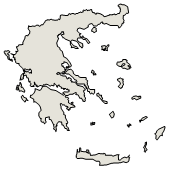

Administrative Region : West Greece
Regional unit : Aitoloakarnania
Podos (Πόδος) Aitoloakarnania
Podos is a village in the mountainous Nafpaktia[1][2][3] region of the Aitoloakarnania prefecture. It is built at an altitude of 882 meters on the northern outskirts of Papadia, enclosed within a very limited space bordered by hill ranges and heights. To the south are the bare mountain peaks of Kotroni and Tsakalaki. To the north are the peaks of Tsekouris and Ardini, which belong to the neighboring village of Ambelakiotissa, to the east is Skaloula, and to the west are the forested mountain peaks of Litharostrouga, Psili Korifi, Ailias, Agriokerasia and Petakas.
Podos is 48.9 kilometers from Nafpaktos by taking the route Nafpaktos, Eleftheriani, Podos[4] and 69.1 kilometers by taking the route Nafpaktos, Ano Chora, Podos.[5]
Information
The Podiotiko stream (Podiotorema – Podorema) is formed by the Skaltsorema and Xerorema and other small streams that originate from the slopes of the Tsakalaki mountain peak and contribute to the Kotsalos (Kakavos) at the Synodos location. Due to the abundance of water in Podos, at least 7 watermills operated. The plane-shaded square at the “Platania” location a few meters above the picturesque Megali Vrisi with its two stone bowls, the parish church of Agios Athanasios, which was originally built by the archpriest of the Kravara district Thanasoula Sismani (+ 1789) and rebuilt (1957 – 1960) with the beautiful stone-built bell tower (1928), Agios Georgios, whose original construction dates back to the Ottoman period, was rebuilt in 1952–55 in a prominent position, and the other country churches, solid or ruined, in beautiful and picturesque places, are some of the noteworthy elements of this village drowned in vegetation.[6]
Historical data
The village of Podos seems to have existed since ancient times, although the exact time of its creation is not known, and neither are its first settlers known, as they are lost in the depths of unrecorded history. The village flourished in terms of population and culture in the Medieval era and during the years of Ottoman slavery, experiencing a significant population boom after the Fall of Constantinople by the Turks in 1453, due to the influx, in the then inaccessible mountainous massif of Nafpaktia (Kravara) and due to the existence of many Orthodox Monasteries in the wider area, of many expatriate Christians who were seeking refuge and a place to hide from the fury of their Ottoman persecutors.
During the period of Turkish rule, it would be more correct to refer to it as a town than a village, since it numbered 400-500 families. This is believed since Podos was chosen to be the seat of the Turkish authorities and the Turkish courts, for the then Kravar District, in the location still called "Synodos" (from the various meetings that were held) next to the Kotsalos River (Kakavos or Kozitsianiko stream) and near the location "Koumaries", where the ruined Old Mill is located today, and Podos was the seat of the then Municipality of Apodotias.
The village or rather the town at that time extended approximately from the location "Kommeno Chorafi" to almost the location "Skombodo" or at least the location "Rountzeria - Kastanadia", and this entire area was flat and inhabited, which is proven by the discovery throughout this area of evidence that testifies to human residential activities (cornerstones of houses "angonaria", clay pots, etc.). Over time, however, the morphology of the soil changed, mainly due to subsidence, in 1913-15 and the area finally displays its current amphitheatrical appearance.
Name
As for the origin of the name Podos, little is known and only speculations, conclusions and thoughts can be made. However, what is certain is that it is a Greek word and not at all Slavic, as some have expressed the opinion arbitrarily and fundamentally unfoundedly. A supporter of this view is the Slavologist Vasmer who claims that the name Podos is connected to the Serbo-Croatian, Bulgarian and Macedonian "Pod" word which means floor or flooring, but it is obvious that the similarity of the words alone does not constitute proof of etymological origin. For this reason, the Ministry of Interior in the 1920s did not accept and did not allow the name change as was done with other villages that had Slavic names (Kozitsa, Lobotina, Vetopsista, etc.)
The most prevalent versions for the origin of the name are:
Taking into account that Podos was in the past a town, an administrative - commercial center, a main village and generally a focal point of local life at that time, even that it was until 1950 a transportation hub in the communication between Nafpaktos and the mountainous villages of Ambelakiotissa, Perdikovrysi, Klepa and Dendrochori and if it is taken into account that to the north of the area where Podos is located, on the Kotsalos River (a tributary of the Evinos or Fidaris) there was a stone bridge, of major importance for the then local community, which was used for road transport and connected Ambelakiotissa (Kozitsa) and specifically the Monastery of Panagia with Ano Chora (Megali Lobotina), it can be argued that the word comes from the Italian Ponte (Ποντε) which means bridge, initially it was modified verbally to Pontos (Pontos), then with the Latin script it became Podos (Pontos) and finally with a process of Hellenization of "d" to "δ" it took the final form Podos.
Taking into account that Podos was originally the seat of the Municipality of Apodtia, it is likely that the municipality also took its name from the Apodoti[7] (ancient people who lived on the Western and Eastern slopes of the SW side of Mount Korakos and in the Mornos valley near Ozoles, Locri.[7] ) and in turn the seat of the Apodoti was called Podos.
That it took its name from the word Podos (then, through a process of Hellenization of the "d" to "δ", it took the final form Podos) which means many waters and which indeed has many waters for irrigation and which make the soil very fertile and the area verdant.
That when the inhabitants of the surrounding villages went to Podos to resolve their disputes in the courts or for their various tasks, upon returning and being asked where they came from, they would answer "from here → (a)podo → from podo", hence the name Podos gradually became prevalent.
The name of the village of Podos and its inhabitants, the Podiotes, is found in various official "now historical" documents of that era such as:
Ottoman census records of population, activities, taxation, etc., sales bonds, land donations, which are preserved to this day in the Holy Monastery of Ambelakiotissa and the Notary Public of Kravara, court decisions, decisions of the then ecclesiastical hierarchy, travel notes of European diplomats of that era but even in an Ottoman Bouyourdi[8] (strict warning - order) of Mukhtar Pasha (son of Ali Pasha), references dating back from 1454 to 1889, proving the long-term and deep-rooted unaltered historical presence of this village.
After all this, it becomes clear that the village of Podos is a village with great timeliness and history, its inhabitants had a warm and active participation in all the struggles of the Nation and in the course of Hellenism, a history that left its indelible marks in the liberation struggles of 1821, where the people of Podos came into conflict and conflict with the Turkish conquerors many times, even with Ali Pasha of Ioannina, under the leadership of the local chieftain (captain) Kostas Chorafas.
Indicative of the then struggles of the people of Podio against the Turks was that the dead Turks who had been killed in the surrounding area were buried in a place west of the village that is still called "Turkish Memorial", a characteristic of the intensity of the dispute over the Ottoman power over the proud people of Podio was the proverb that prevailed and is said to this day: "Ali Pasha in Ioannina and Chorafas in Podos"
Also, the people of Podio have taken part in various ways and have paid the price of blood in all the struggles of the Nation, in the Revolution of 1821, in the Unfortunate War of 1897, in the Balkan Wars of 1912-13, in the Asia Minor campaign, in the Greco-Italian War of 1940-41 and in the National Resistance of 1941-44, mourning many worthy children of the village and yet writing brilliant pages of glory and history.
Past presidents of the community
Post-political[9]
...
1979-1986 Spyridon Panagiotopoulos[10]
1987-1994 Konstantinos Velis[11]
1995-1998 Athanasios Panagiotopoulos (last community leader)[12]
Presidents of the Local Community of Podos
...
Polykarpos Charalambopoulos (1956-2016) President, died in office on 12 October 2016.[13]
Population evolution of the Community of Podos
Population table of the community of Podos
References
"Mountainous Nafpaktia". Travels. Kathimerini.[dead link]
«www.orininafpaktia.gr».
«Mountainous Nafpaktia». Tourism. Municipality of Nafpaktos. Archived from the original on 13 March 2012. Retrieved 22 March 2012.
«Nafpaktos, Eleftheriani, Podos route». RGP.
«Nafpaktos, Ano Chora, Podos route». RGP.
«Photos of Podos».
«Apodotia and Apodoti». Update. Nafpaktiki Online.
«Definitions for bouyourdi». Update. slang.gr.
Election results in the Community of Podos, EETAA
Winner of the 1978 elections with 100%, re-elected in 1982, prevailing with 35 votes against 33 for Kostas Tsatsos.
Winner of the 1986 elections with 100%.Re-elected in 1990 with a difference of two votes from the second, Konstantinos Kioulias.
Winner of the 1994 elections with 100% as the only candidate.
The president of the community of Podos, Nafpaktia, "passed away" suddenly at the age of 50, sinidisi.gr, October 12, 2016, retrieved March 20, 2020.
| Municipal unit Apodotia |
|---|
| Community Ampelakiotissa |
| Ampelakiotissa (Αμπελακιώτισσα, η) |
| Community Anavryti |
| Anavryti (Αναβρυτή, η) |
| Community Ano Chora |
| Ano Chora (Άνω Χώρα, η) |
| Community Aspria |
| Aspria (Ασπριά, η) |
| Community Grammeni Oxya |
| Grammeni Oxya (Γραμμένη Οξυά, η) |
| Community Grigorio |
| Γρηγόριο, το |
| Community Elatovrysi |
| Elatovrysi (Ελατόβρυση, η) |
| Community Elatou |
| Elatou (Ελατού, η) |
| Community Kalloni |
| Kalloni (Καλλονή, η) |
| Community Katafygio |
| Γολέμιο, το |
| Katafygio (Καταφύγιο, το) |
| Community Kato Chora |
| Kato Chora (Κάτω Χώρα η) |
| Community Kentriki |
| Kentriki (Κεντρική, η) |
| Σέλλος, ο |
| Community Kokkinochori |
| Kokkinochori (Κοκκινοχώρι, το) |
| Σωτήρω, η |
| Chrisovo (Χρίσοβον, το) |
| Community Kryoneria |
| Kryoneria (Κρυονέρια, τα) |
| Community Kydonia |
| Κυδωνέα, η |
| Community Lefka |
| Λεύκα, η |
| Community Limnitsa |
| Limnitsa (Λιμνίτσα, η) |
| Community Mandrini |
| Mandrini (Μανδρινή, η) |
| Community Podos |
| Podos (Πόδος, ο) |
| Community Terpsithea |
| Terpsithea (Τερψιθέα, η) |
Greece :
A - B - C - D - E - F - G - H - I - J - K - L - M -
N - O - P - Q - R - S - T - U - V - W - X - Y - Z
Retrieved from "http://en.wikipedia.org/"
All text is available under the terms of the GNU Free Documentation License
| Ancient Greece
Science, Technology , Medicine , Warfare, , Biographies , Life , Cities/Places/Maps , Arts , Literature , Philosophy ,Olympics, Mythology , History , Images Medieval Greece / Byzantine Empire Science, Technology, Arts, , Warfare , Literature, Biographies, Icons, History Modern Greece Cities, Islands, Regions, Fauna/Flora ,Biographies , History , Warfare, Science/Technology, Literature, Music , Arts , Film/Actors , Sport , Fashion --- |

