

ART

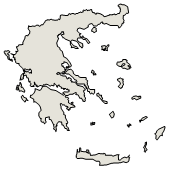
GreeceGreece

Administrative Region : Central Greece
Regional unit : Evoia

Vathy (Βαθύ) Evoia


View Larger Map

Vathy is a lowland town in the Regional Unit of Evoia at an altitude of 25 meters[1].

Geographical information

Vathy is located in mainland Central Greece, next to the northern and western coasts of the South Evian Gulf at a distance (by road) 11 km. S.-S.W. of Chalkida. Its inhabitants are mainly engaged in the cultivation of vineyards, olives and cereals. In the area there are wineries (especially Ritsona), some olive mills and flour mills. They are less involved in the cultivation of fruit and vegetables, domestic livestock, goat and sheep farming as well as the breeding of pigs and poultry. In addition, there are several industries and factories[2][3].

The Temple of Artemis (Photo: Glinard)

Historical elements - sights

In the wider area from Vathi of Avlida to the coves of Mikro and Megalo Vathi, many findings of ancient habitation from the Mycenaean period (16th - 12th century BC) have been found, and it is identified with ancient Avlida, from which the name of the municipal unit also came. The most important sights and archaeological sites are:[4].

The archaeological site on the hill "Pyrgos" at Paralia Avlida, where "funeral sites and monuments, archaeological sites, residential complexes" of the Prehistoric and Late Bronze Age have been found.
The archaeological site "The Two Ports", between the coastal zone between the Chalkida Shipyards and the AGET Hercules factory.
The sanctuary of Artemis of Aulis, next to and east of the Schimatari-Chalkida airfield and before the settlement of Mikro Vathy
The Mycenaean acropolis and the walls of classical times on the hill "Vessala".

Aulis was an ancient Boeotian city known since the Trojan War as the port from which the Achaean fleet departed. According to legend, during the Achaeans' stay in Aulis, Agamemnon received an oracle that he should sacrifice his daughter Iphigenia at the temple of Artemis of Aulis in order for a favorable wind to blow and for the fleet to be able to depart. From ancient descriptions it seems that the city was located near the coast of the Euboean Gulf between the bays of Great and Small Vathy, very close to Chalkida. It was built on a rocky hill, which is also evident from its characterization by Homer as Petroessa. but also by Strabo as "petrōdes chorion". The city in the following years was a port of Tanagra. According to mythology, its name was due to Aulis, daughter of the mythical king of Thebes Ogygus. It is known from the Trojan War and the sacrifice of Iphigenia. The Greek fleet had gathered in Aulis before departing for Troy. The area that has been revealed in Aulis is the place of worship of Artemis where the sanctuary of the goddess is located. The war between the Greeks and the Trojans does not find Artemis indifferent. One of the first incidents that occurred before the war even began was due to the anger and wrath of Artemis. The Greek fleet, due to the apnea created by the goddess, could not set sail. A random incident of Agamemnon's Achaeans had caused this situation. Once, without realizing it, he had invaded a grove dedicated to Artemis and had killed a sacred deer. The goddess was so enraged that she demanded the sacrifice of his daughter Iphigenia in order for favorable winds to help the Greek ships sail. The sanctuary's heyday lasted from the classical to the Roman period.

The wider area has been inhabited since Mycenaean times (16th - 12th centuries BC). Remains of the Mycenaean era have been found in the rocky area of Geladovouni. The continuous use of the site is attested by the discovery of part of an apsidal building from the Geometric period (10th - 8th century BC) under the temple of Artemis from the 5th century BC. At the same time, the Sacred Fountain was built. In the Hellenistic period (330 - 30 BC), the pronaos was added to the temple and a complex of workshops and a guesthouse were built further south. In the imperial period (30 BC - 330 AD), the temple was repaired, while the multitude of votive offerings shows the flourishing of the cult. The sanctuary was destroyed during the raids of Alaric's Goths in 396 AD. Later, bath facilities (thermae) were established on the site of the temple.

Aulis never became a city. It was considered part of the Theban province until 387 BC. Since then it belonged territorially to Tanagra. The Spartan king, Agesilaus, as the ''new Agamemnon'', sacrificed at the sanctuary of Artemis of Aulis, before setting off for Asia in 397 BC. Thus, uninterrupted habitation of the area is observed from the Mycenaean to the Roman period. Aulis managed to survive mainly thanks to the existence of the sanctuary of Artemis and the ceramic workshops. Reference to the sanctuary of Artemis of Aulis is made in Strabo (9,2,8) and Pausanias (9,19,6).

Sporadic excavations in the area were carried out in 1928, during the construction of the "Cement Chalkis" factory, and in 1954 by the superintendent of antiquities I. Threpsiades. More systematic investigations were carried out by I. Threpsiades between 1956 and 1961 with the support of the Archaeological Society. The findings of the excavations are kept in the Archaeological Museum of Thebes.[5]

Administrative data

It was officially mentioned as a settlement in 1835 when it was designated as the seat of the then municipality of Avlida until 1845. In 1912 it was mentioned again in the Government Gazette 262A - 31/08/1912 when it was detached from the municipality of Avlida and designated as the seat of the newly founded community of Vatheos[6]. According to the Kallikratis program, together with Mikro Vathy, Paralia and Ritsona, it forms the municipal community of Vatheos, which falls under the municipal unit of Avlida of the Municipality of Chalkida and according to the 2011 census, as a community it has a population of 4,098 inhabitants, while as a settlement it has 2,385[7].
References

Encyclopedia Nea Domi. Athens: Tegopoulos - Maniateas. 1996. p. 175, vol. 6.
"Vathi Destination - Tourist Information - Holidays Vathi - diakopes.gr". Holidays. Archived from the original on 18 June 2018. Retrieved 27 October 2019.
"VATHI (Small Town) Avlida - GTP". www.gtp.gr. Retrieved 27 October 2019.
"PERMANENT LIST OF DECLARED ARCHAEOLOGICAL SITES AND MONUMENTS". listedmonuments.culture.gr. Archived from the original on 3 November 2019. Retrieved 27 October 2019.
"Connect to Facebook". Facebook. Retrieved 19 January 2022.
"Administrative Changes of Settlements". EETAA. Retrieved 27 October 2019.
"Official Gazette of the results of the 2011 PERMANENT population census Archived 2021-10-04 at the Wayback Machine", p. 10659 (p. 185 of the pdf)

Municipal unit Avlida
Municipal Community Vathy
Vathy (Βαθύ, το)
Μικρό Βαθύ, το
Παραλία, η
Ritsona (Ριτσώνα, η)
Municipal Community Paralia Avlidas
Παραλία Αυλίδας, η
Community Kalochori - Panteichi
Καλοχώρι-Παντείχι, το
Community Faros
Faros (Φάρος, ο)

Greece :

A - B - C - D - E - F - G - H - I - J - K - L - M -
N - O - P - Q - R - S - T - U - V - W - X - Y - Z

Retrieved from "http://en.wikipedia.org/"
All text is available under the terms of the GNU Free Documentation License

Ancient Greece

Science, Technology , Medicine , Warfare, , Biographies , Life , Cities/Places/Maps , Arts , Literature , Philosophy ,Olympics, Mythology , History , Images

Medieval Greece / Byzantine Empire

Science, Technology, Arts, , Warfare , Literature, Biographies, Icons, History

Modern Greece

Cities, Islands, Regions, Fauna/Flora ,Biographies , History , Warfare, Science/Technology, Literature, Music , Arts , Film/Actors , Sport , Fashion

---

Cyprus

Greek-Library - Scientific Library

Greece

World

Index

Hellenica World
