

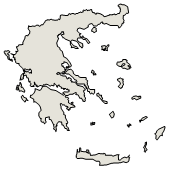

Administrative Region : Central Macedonia
Regional unit : Imathia
Koumaria (Κουμαριά) Imathia
Koumaria (Vlach: Doljani) is a settlement in Central Macedonia in the Regional Unit of Imathia.[1]
General
Koumaria is built at the foot of eastern Vermion with an average altitude of 780 meters.[1] It is a Local Community of the Municipality of Veria (together with the settlement of Xirolivado). It is located 13 km west of the city of Veroia and 12 km south of the Seli ski resort. It has a population of approximately 60 inhabitants during the winter season, while during the summer months its population increases and reaches up to 350 inhabitants.
The population censuses after World War II are:
Census 1951 1961 1971 1981 1991 2001 2011
Population 276[2] 237[3] 118[4] 156[5] 252[6] 170[7] 243[8]
History
Kumaria was once the only settlement of Vermion that was inhabited all year round. Its inhabitants are mostly Vlachs and refugees from Pontus.
The ancestors of the current Vlach inhabitants of Koumaria settled there, after first purchasing the 30,000-acre estate at the end of the 19th century, coming from Kato Vermio and Xirolivado. They trace their origin to the mountainous settlements of Grevena and mainly from Avdella and Samarina. Its original name was Doliani, meaning lowland or valley. In 1918, with the Royal Decree "On the recognition of communities in the General Administration of Thessaloniki", it became a community (Government Gazette 152/09-07-1918) which also included the villages of Kato Vermio and Xirolivado. In 1926, it was renamed Koumaria (Government Gazette 401/12-11-1926).[9]
Today the village does not have a pure Vlach population, as after the events of 1922 a group of about 30 refugee families from Pontus settled there.
After the events of 1822 with the destruction of Naoussa and the settlements of Vermio, the old village was destroyed. All that remained of the old settlement is the church of Agios Nikolaos. The current village was built on the ruins of the old one.
The new village was built based on an urban plan prepared by French students. Plots of land with space for a house and garden were carved out and a school and church were built. It quickly developed with three-story stone houses, of Epirus architecture unique for the time, several of which survive in good condition to this day. It was a model village for the time. At the beginning of the 20th century, Koumaria had the image of a prosperous and developing village and a large school building for the time. As the village took the form of a permanent settlement and among its inhabitants there were few families of the nomadic cattle breeders class, Koumaria was considered a place of residence of the wealthiest and most aristocratic Vlach families. In 1916, prominent figures of the village, acting as proxies for 93 families of the village, purchased the Arsoumbasi pasture from the heirs of Faik Pasha (contract no. 4381/14-4-1916). In the spring of 1926, as a result of Romanian Propaganda, approximately 40 Vlach families left for Romania, leaving their properties to the Greek State. Thus, in 1927, a group of about 30 refugee families from the Caucasus region and from various villages in the Trebizond and Santa regions moved to the village and were given houses and fields.
From Koumaria emerged important personalities such as George Murnu (Romanian: George Murnu), an academic in Bucharest and one of the greatest Homeric translators in the world.
References
Encyclopedia Papyrus Laroussee Britannica. 35. Papyrus Publishing House. 1996. p. 372.
Population of Greece according to the census of March 7, 1951, p. 71 of the pdf. Archived from the original on 2013-05-14.
Population of Greece at the census of 19 March 1961, p. 74 of the pdf.
Population of Greece at the census of 14 March 1971, p. 73 of the pdf. Archived from the original on 2013-05-14. Retrieved 2022-09-14.
Actual population of Greece at the census of 5 April 1981, p. 84 of the pdf.
Actual population of Greece at the census of 17 March 1991, p. 95 of the pdf.
Actual population of Greece - Census 2001, p. 96 of the pdf.
"Official Gazette of results of PERMANENT population Archived 2021-10-04 at the Wayback Machine," p. 10511 (p. 37 of pdf)
«EETAA-Administrative Changes of Settlements». www.eetaa.gr. Retrieved on 14 January 2023.
| Municipal unit Veroia |
|---|
| Municipal Community Veroia |
| Veroia (Βέροια, η) |
| Kydonochori (Κυδωνοχώρι, το) |
| Lazochori (Λαζοχώρι, το) |
| Mesi (Μέση, η) |
| Tagarochori (Ταγαροχώρι, το) |
| Community Agia Varvara |
| Agia Varvara (Αγία Βαρβάρα, η) |
| Community Ammos |
| Ammos (Άμμος, η) |
| Community Asomata |
| Asomata (Ασώματα, τα) |
| Community Georgianoi |
| Georgianoi (Γεωργιανοί, οι) |
| Lekfopetra (Λευκόπετρα, η) |
| Community Kastania |
| Kastania (Καστανέα, η) |
| Mikra Santa (Μικρά Σάντα, η) |
| Community Kato Vermio |
| Kato Vermio (Κάτω Βέρμι, το) |
| Community Koumaria |
| Koumaria (Κουμαριά, η) |
| Xirolivado (Ξηρολίβαδον, το) |
| Community Profitis Ilias |
| Profitis Ilias (Προφήτης Ηλίας, ο) |
| Community Rachi |
| Rachi (Ράχη, η) |
| Community Tripotamos |
| Kato Komnineio (Κάτω Κομνήνει, το) |
| Komnineio (Κομνήνει, το) |
| Tripotamos (Τριπόταμος, ο) |
Greece :
A - B - C - D - E - F - G - H - I - J - K - L - M -
N - O - P - Q - R - S - T - U - V - W - X - Y - Z
Retrieved from "http://en.wikipedia.org/"
All text is available under the terms of the GNU Free Documentation License
| Ancient Greece
Science, Technology , Medicine , Warfare, , Biographies , Life , Cities/Places/Maps , Arts , Literature , Philosophy ,Olympics, Mythology , History , Images Medieval Greece / Byzantine Empire Science, Technology, Arts, , Warfare , Literature, Biographies, Icons, History Modern Greece Cities, Islands, Regions, Fauna/Flora ,Biographies , History , Warfare, Science/Technology, Literature, Music , Arts , Film/Actors , Sport , Fashion --- |

