

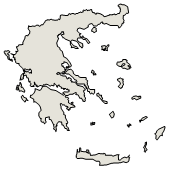

Administrative Region : Epirus
Regional unit : Arta
Agios Spyridon (Άγιος Σπυρίδων) Arta
Agios Spyridonas (old name known today as Imam Tsaous[1] or in the local dialect Mamtsaous) is a settlement and seat of the homonymous local community belonging to the Municipality of Arta, Greece.
According to the "Kapodistrias" Plan, Agios Spyridonas was until the end of 2010, a settlement of the Municipality of Filothei, with headquarters in Chalkiades. With the "Kallikratis" Plan, it was incorporated into the Municipality of Arta.
Location
It is built on the plain of Arta, 15 kilometers from Arta, on the banks of Louros, southeast of the fortress of Rogoi and is 5 km from the Rodia lagoon. Neighboring villages are Nea Kerasounta, Stroggili, Petra, Filothei, Kalovatos, Rachi, Polydroso and Vigla.
Local community
The local community of Agios Spyridonas also includes the settlements of Vathypedo and Dokimia. The local community is classified as a rural lowland settlement, with an area of 13,572 km² (2011).[2]
Population
Permanent [3][4][5]
Year Population
1991 1,062 (1,173)
2001 1,167 (1,284)
2011 971 (1,059)
2021 1,044
Actual (de facto) [2][6][7]
Year Population
1961 1,286 (1,532)
1971 1,230 (1,284)
1981 1,082 (1,173)
1991 1,070 (1,190)
2001 1,223 (1,340)
2011 976 (1,064)
(in brackets the population of the local community)
Name
When exactly did the name appear Imam Tsaous or Mehmet Tsaous is unknown.
In the 15th and 16th centuries, Ottoman records mention an official timaru by the name of Mehmet Tsaous in the Arta region. In the 17th century, the Turkish traveler Evliya Çelebi passed through Agios Spyridon, who then crossed the bridge over the Rubati River (Louros in Turkish). This bridge was located at the location of Kotsilochori (present-day Makronissos) and was later blown up by Ahmet Kurt Pasha to prevent the Chams from stealing.
In the Venetian archives, Imam Tsaous and the Rogi do not appear to have paid a protection tax for piracy, but the settlement of Imam Tsaous Roubas appears to have paid 4 rials.
In the mid-18th century, residents from various villages in the Arta region moved to the Peloponnese and founded new settlements there with the names of the villages from which they came. In Ilia, the settlement of Imam Tsaous (now Kentro) and Zambakas (apparently from the neighboring village of Zavaka, now Polydroso) was founded.
History of the village
There is no specific information about the founding of the village.
During the heyday of the Rogi, there was a rural settlement southeast of the fortress and across the Louros River, called Apogonia, whose inhabitants would lock themselves in the Fortress in case of danger. When in the 14th century the Rogi rebelled and did not accept reunification with Constantinople, John Katakouzenos camped here, who had received a mission from Emperor Andronikos Palaiologos to conquer the Rogi. Later, the entire area belonged initially to the Arvanite family of the Buas, then to the Italian counts Orsini and finally to the Tocca family.
In April 1449, a month after the capture of Arta by the Ottomans, the Rogi and their area surrendered. According to Ottoman records, the area belonged to the municipality of Rogoi (Nakhiges Rogoi) until 1574.
At the beginning of the 19th century, the English captain William Martin Leake passed through the village, who mapped it as Mahmutçaous. The English theologian and traveler Hughes reported that, in order to cross the dense forest from the present-day Kalogerou bridge to the Rogoi fortress, he called the garrison from Imam Çaous. Pouqueville says that the village of Imam Çaous is a tsifliki of Ali Pasha with a fertile plain and a hazel forest.
When Hursit Pasha moved against Ali Pasha, he installed a garrison of 500 soldiers in the village, while at the same time the Souliotes, led by Lambros Veikos, occupied the fortress of Rogoi. In 1821 the village seems to be one of the largest in the Haji Ovashi section (terpni plain) with 100 families. In 1845, Aravantinos says that Mamtzaous belonged to the category of muatzeli villages, that is, the residents paid a certain amount to the government, until the village was completely free from duties.
By 1880, the village became for the most part a Karapano manor. There is an oral tradition that Imam Tsaous also rose up with the other villages against Karapano and even threatened the Turkish commander that they would report to Constantinople. Kokkidis mentions in his military statistics the village with approximately 360 inhabitants in 1880. In the liberation struggles, the village was represented by Halastras Konstantinos, a Macedonian fighter and member of the National Society, with his own corps.[8] Later, his section joined that of Pavlos Melas.
In the war in 1897 the village was liberated for a few days and, after the events with the Kamarinians at the Fortress of Rogo, a section of the Ottoman Gendarmerie disarmed the villagers. In the Ottoman statistics of Salname the village is mentioned in 1895 with 183 inhabitants. The accession of Arta to the Greek state and the prohibition of the mountaineers to go to the Ottoman plain for work played a role in these statistics. In 1910, the Metropolis of Nikopolis and Preveza published the census data it carried out that same year throughout the ecclesiastical region and informed us that Agios Spyridonas was part of the Louros district and that 457 people lived in the village.[9]
The village was liberated in the First Balkan War, in the early days of October 1912. In 1924, the community of Imam Tsaous was forced to cede to the Refugees from Poulatchak and Kerasounta the side opposite Louros, known to everyone as Levounia or Liovounia, where Nea Kerasounta is built today. In 1926, the community was renamed Agios Spyridonas and included the settlement of Strongyli. During the interwar period, yellow fever, Spanish flu and malaria caused many deaths in Agios Spyridon.
Residents of the village participated in the Greco-Italian War of 1940. During the occupation, most of the village was assigned to the EAM and ELAS and some to EDES. After the Varkiza Agreement, many villagers were abused by the National Guard, imprisoned and sent to Makronissos. During the coup of 21 April 1967, many villagers were arrested and detained in the castle of Preveza. The villagers' hunting weapons were also temporarily confiscated.
Monuments
The church of Agios Spyridon was built between 1812 and 1813 on the ruins of the church of Agios Markos and Kotseki, which is apparently a continuation of the house of Kehagiambei, Ali Pasha, as described by a French secretary of the French consulate in 1820. In its final form as it is preserved today, it must be from the time of the Karapanos estate.
Economy-Culture-Sports
As in the past, today a large part of the village's residents are engaged in agriculture and livestock farming. There are several pig farms, cattle farms and small units with herds. Corn, clover, cotton, soybeans, etc. are the predominant crops. Also, fruit processing units and meat standardization units have been set up recently.
The village has an Educational and Cultural Association, an Agricultural Association and the Women's Association of Agios Spyridonas as well as a football team, the Panagrotikos Agios Spyridonas.[10]
Famous people from Agios Spyridon
Georgios Vaitsis, Olympiacos footballer in the 1980s - early 1990s
Dimitrios Dalakas, Panachaiki Patras footballer in the 1980s - early 1990s
Anastasios Dalakas, Anagennisi Arta footballer in the 1980s - early 1990s
Imam Tsaous in Literature
References to Imam Tsaous are made in Yannis Dalla's book "To Giofyri", which refers to the construction of the Kalogiros Bridge in 1853, and in Yannis Kalpouzos' novel "To Imareti", which gives an idea of what the village might have been like in the late 19th century.
Traditional cuisine
The classic culinary delights of the village include flat eel, grilled or skewered, drosines (a type of carp similar to the bream), pinnes with rice or fried pinnes, loofahs (codfish) roasted, grilled or cooked with rice, wild ducks and wild geese, wild birds such as grebes, egrets and woodpeckers, baked beans with greens, gobies and gopes, herb pies, pumpkin pies, etc.
References
«Pandektis: Imam Tsaousi -- Agios Spyridon». pandektis.ekt.gr. Retrieved 11 May 2023.
«Population-Housing Census 2011 - ELSTAT». www.statistics.gr. Retrieved 11 May 2023.
https://www.eetaa.gr/metaboles/apografes/apografi_2011_monimos.pdf
https://www.eetaa.gr/metaboles/apografes/apografi_2001_monimos.pdf
https://www.eetaa.gr/metaboles/apografes/apografi_1991_monimos.pdf
PL 1:193
PLM 1:465
Vrakas, Fotis (in English). Anthology of historical data from village Agios Spyridonas at Arta and his Region/Anthologie historischer Daten über das Dorf Agios Spyridonas Bei Arta und dessen Region/Anthology of historical data from village Agios Spyridonas at Arta and his Region/.
The late Giannitiko Pasaliki: space, administration and population in Turkish-occupied Epirus (1820-1913), Michalis Kokolakis, p.492 [1]
Groups of the Greek Orthodox Church of Arta.[2] Archived 2015-09-30 at the Wayback Machine.
Sources
Encyclopedia Papyrus Larousse Britannica, 1978, 2006 (PLM)
Encyclopedia Papyrus Larousse, 1963 (PL)
Seraphim Xenopoulos: Historical Essay on Arta and Preveza
Anthology of Historical Data about Saint Spyridon of Arta and its Region
The Rogi and the Adjacent Settlements, Imam Tsaous in International Cartography
Tradition and Customs from Saint Spyridon of Arta
THE LIFE OF THE RESIDENTS IN THE SETTLEMENTS OF THE PLAIN OF ARTA FROM THE 18TH TO THE 20TH CENTURY
Saint Spyridon Educational Association
Administrative Changes, Saint Spyridon of Arta
| Community Agios Spyridon |
|---|
| Agios Spyridon (Άγιος Σπυρίδων, ο) |
| Vathypedo (Βαθύπεδο, το) |
| Dokimia (Δοκίμια, τα) |
----
Agios Spyridon (Άγιος Σπυρίδων) Arta
Agios Spyridon (Άγιος Σπυρίδων) Fokida
Agios Spyridon (Άγιος Σπυρίδων) Lasithi
Agios Spyridon (Άγιος Σπυρίδων) Paros
Agios Spyridon (Άγιος Σπυρίδων) Pieria
Agios Spyridon (Άγιος Σπυρίδων) Voiotia
Greece :
A - B - C - D - E - F - G - H - I - J - K - L - M -
N - O - P - Q - R - S - T - U - V - W - X - Y - Z
Retrieved from "http://en.wikipedia.org/"
All text is available under the terms of the GNU Free Documentation License
| Ancient Greece
Science, Technology , Medicine , Warfare, , Biographies , Life , Cities/Places/Maps , Arts , Literature , Philosophy ,Olympics, Mythology , History , Images Medieval Greece / Byzantine Empire Science, Technology, Arts, , Warfare , Literature, Biographies, Icons, History Modern Greece Cities, Islands, Regions, Fauna/Flora ,Biographies , History , Warfare, Science/Technology, Literature, Music , Arts , Film/Actors , Sport , Fashion --- |

