
.
Byzantinische Armee, Kriegstechnik
Byzantium at war: AD 600-1453, John F. Haldon
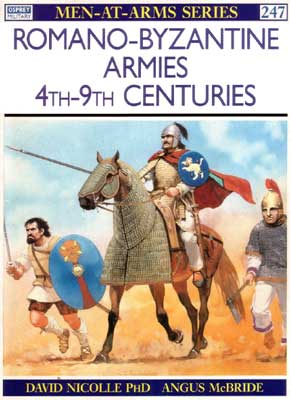
Romano-Byzantine armies 4th-9th centuries, David Nicolle
Byzantine Infantryman: Eastern Roman Empire C.900-1204, Timothy Dawson,Angus McBride
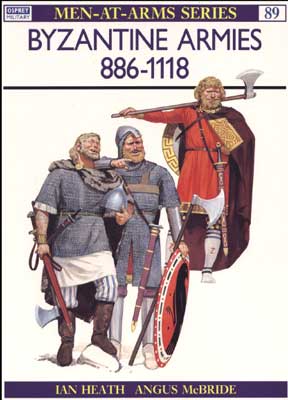
Byzantine armies, 886-1118, Ian Heath,Angus McBride
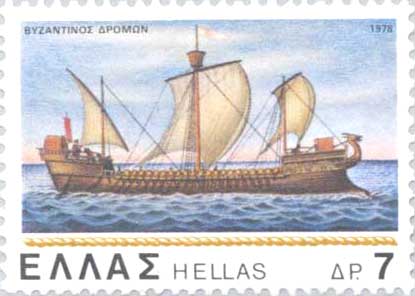
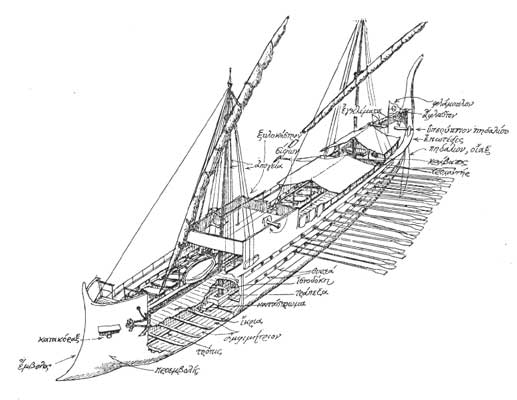
Byzantine Dromon (Runner) Ship
The Byzantine war ship „Dromon“. It measured 45-50 meters in length and its crew was 100-300 men.
The Dromon is more accurately a product of reverse evolution, paring away the complexities of large galleys in search of simpler and more cost effective solutions. In the process the technology of the triremes and the polyremes was lost, never to be recovered, and the Dromon provided a foundation for a new cycle of naval development which produced ships which had little or no lineal connection with those of antiquity. THE BYZANTINE NAVY
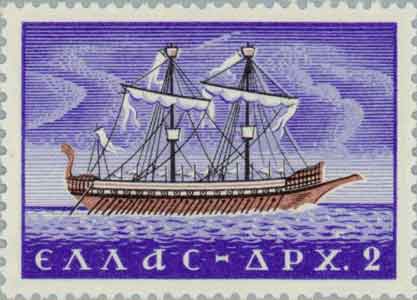
Another Ship type was the Chelandion (Χελάνδιον)
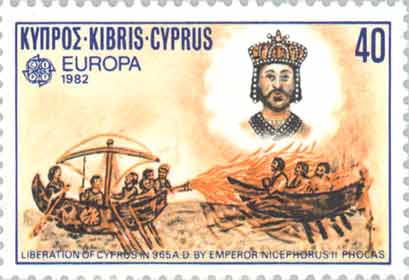
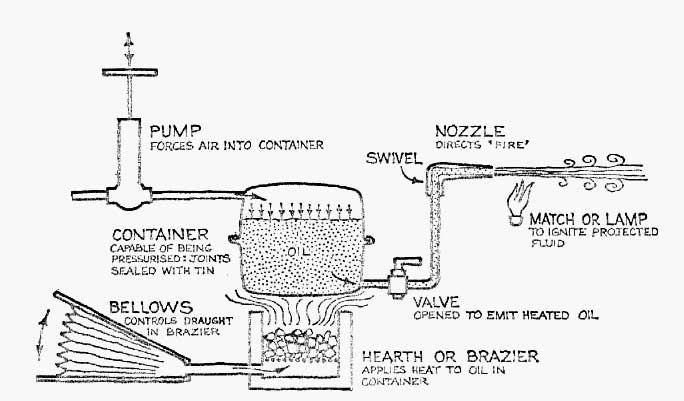
J. H Haldon, M. Byrne, A possible solution of the Greek Fire

Roman Pump Technology 100 AD
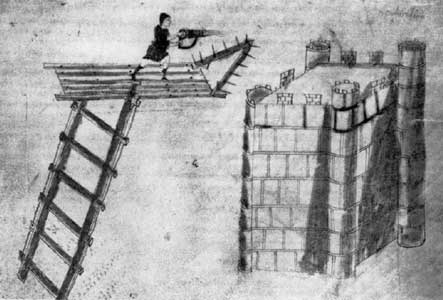
Greek Fire, using a Cheirosifon, Heron of Byzantium
The main weapon was the Greek Fire or Sea Fire (pyr thalassion) that was used on ships like the dromone and that was used for example to destroy two large Arab fleets, but this invention is a byzantine invention. A Syrian engineer Kallinikos (or Callinicus) of Heliopolis is assumed to be the inventor of Greek Fire around 673 AD. More Information , The Oil Weapons: Ancient Oil Industries
Weaponry
SIEGECRAFT Two Tenth-Century Instructional Manuals by “Heron of Byzantium” Denis F. Sullivan (PDF File)
Byzantine Warfare
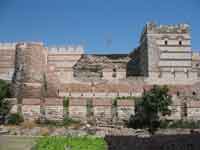
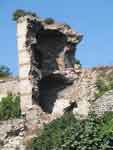
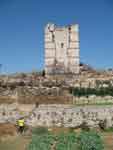
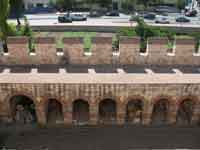
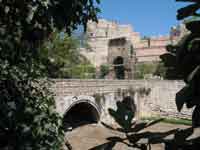
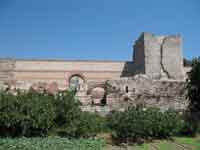
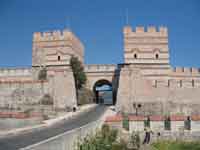
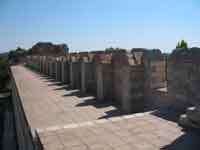
The Fortification of Byzantium
The whole of Byzantine history is the record of struggles between a civilized state and wild, or half-civilized, neighbouring tribes. Again and again was the Byzantine Empire de facto reduced to the limits of the capital city, which Anastasius had transformed into an unrivaled fortress (Catholic encyclopedia)
 |
 |
 |
 |
 |
 |
 |
 |
 |
 |
 |
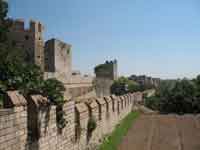
Theodosian Walls, Klicks to enlarge
Fortification: The Land Walls (Computer Reconstruction)
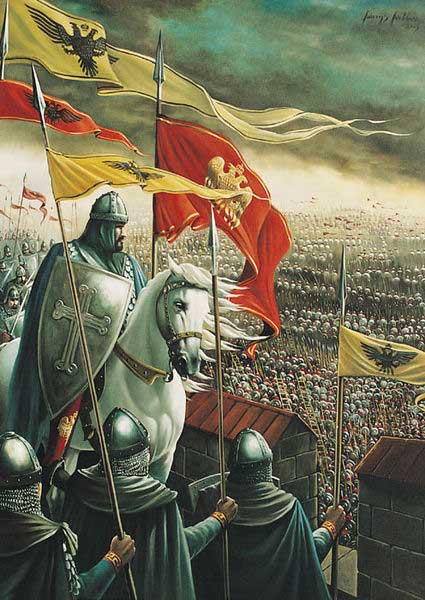
Constantine XI, the last Byzantine Emperor at the battlements, dawn of the 29th May of 1453" 200 X 145 cm,- oil on canvas, 2003 by Iannis Nikou
Battle of Ad Decimum
Battle of Anchialus
Battle of Callinicum
Fall of Constantinople
Battle of Dara
Battle of Dyrrhachium
Battle of Kleidion
Battle of Manzikert
Battle of Mons Lactarius
Battle of Myriokephalon
Siege of Nicaea
Battle of Nineveh (627)
Battle of Pelagonia
Battle of Pliska
Battle of Syllaeum
Battle of Taginae
Battle of Ticameron
Battle of Yarmuk
-David Nicolle , Romano-Byzantine Armies 4th - 9th Century- (Men-at-Arms Series) (Paperback), Osprey Publishing (UK) 1992, ISBN 1855322242
Ian Heath, Angus McBride (Illustrator) , Byzantine Armies Ad 1118-1461- (Osprey Men-at-Arms Series, No 287) Osprey Publishing (UK) 1995, ISBN 1855323478
David Nicolle, Sam Thompson, -Medieval Siege Weapons: Byzantium, the Islamic World & India AD 475-1526-, Osprey
-Medieval Siege Weapons: Western Europe AD 585-1385, Osprey
John Haldon, Byzantium at War, AD 600-?1453-, Essential Histories 33, Osprey Publishing 2002
(The Catapults were developed first in ancient Greece and the literature of Philo of Byzantium, Heron of Alexandria was an important source in Byzantium)
Reports in German
Logistik Historie und Zukunft (logistike techne and military, Alexander, Byzantium, etc..) some remarks
| Ancient Greece
Science, Technology , Medicine , Warfare, , Biographies , Life , Cities/Places/Maps , Arts , Literature , Philosophy ,Olympics, Mythology , History , Images Medieval Greece / Byzantine Empire Science, Technology, Arts, , Warfare , Literature, Biographies, Icons, History Modern Greece Cities, Islands, Regions, Fauna/Flora ,Biographies , History , Warfare, Science/Technology, Literature, Music , Arts , Film/Actors , Sport , Fashion --- |
