


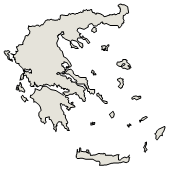
Administrative Region : Epirus
Regional unit : Ioannina
Zitsa (Ζίτσα) Ioannina
Zitsa is a village in the Prefecture of Ioannina,[1] known especially for its wine. Built in a semi-mountainous position on the left bank of the Kalamas River, it is located approximately 27 kilometers west of Ioannina. Administratively, it falls under the Municipality of Zitsa, but although it has given the municipality its name, it is not its seat. According to the 2021 census, its population amounts to 447 residents[2] while in the 2011 census it had 613 residents[3].
History
Zitsa was founded in the late Middle Ages, probably shortly before or after the beginning of the 15th century.[4] The first mention of it is in the Chronicle of Ioannina, in events of the year 1382, but it is not clear from the context whether it is a defensive position or an already established village.
The following theories have been put forward for the origin of the name:[5]
Slavic (like many other late medieval place names of Epirus) and meant soul or, according to others, border. A Serbian monastery with the same name exists near Skopje, where Stefan Dušan, founder of the house that ruled the Despotate of Epirus in the second half of the 14th century, was crowned king.
Greek, according to local legend, which tells that the first inhabitant of the village was a girl named Zoitsa, who discovered a water source there.[6]
Turkish, from the word şişa (bottle, flask).
Ottoman period
During the Turkish occupation (1430-1913) Zitsa became the main village of Kourendochori, as the Ottomans called the wider area. Contrary to the customs of Ottoman feudalism, it was never a private property: From 1430 to 1788 it was under the protection of the valide sultana (the mother of each sultan), while afterwards it was dedicated to the foundations of Mecca until the liberation. This is due to its strategic location, which ensured both the safe communication of Ioannina with Pogoni and Northern Epirus, as well as unobstructed observation of a large part of Thesprotia.[4]
The pivotal position and development of viticulture contributed to the creation of an urban-commercial stratum that was active in the Balkans and the entire Mediterranean basin.[7] At the same time, the monasteries of Prophet Elias and Patera, having metochias in Romania and Russia, financed the studies of many locals at universities, as well as the establishment of schools within the village.[4] From these came personalities such as the Ecumenical Patriarch Jeremiah I (first half of the 16th century), the Metropolitan of Hungary and Wallachia Dositheos Filitis (1734-1826) or the nationalist physician Demetrios Nikolidis (almost contemporary of the previous one, he was martyred with Rigas Feraios in 1798 in the prisons of Belgrade).
The heyday of the monasteries and their educational activity was interrupted in the mid-18th century, but the gap was soon filled under the influence of the Modern Greek Enlightenment and thanks to a series of donations from Zitsa residents in the diaspora. According to tradition, in 1764 the residents founded a new Greek school, the so-called Daskaleio, following the advice of Cosmas the Aetolian. In the first half of the 19th century. Constantios Filitis, then bishop of Vuzeio in Romania and nephew of Dositheos, donated several thousand groschen from his personal estate to establish a library and school, stipulating that not only the "old" but also the modern Greek language should be taught - the money became even more when Dositheos died and appointed Constantios as executor of his will. Their work was continued by Anastasios Filitis (d. 1883), who also bequeathed 300,000 francs to Zitsa and Ioannina for the establishment of scholarships. Special mention should also be made to Anastasios Goudinos, a merchant who was active in Wallachia and left six thousand imperial crowns to the schools of Zitsa in his will (written in 1868).[7]
Monastic Zitza! from thy shady brow,
   Thou small, but favoured spot of holy ground!
   Where'er we gaze, around, above, below,
   What rainbow tints, what magic charms are found!
   Rock, river, forest, mountain all abound,
   And bluest skies that harmonise the whole:
   Beneath, the distant torrent's rushing sound
   Tells where the volumed cataract doth roll
Between those hanging rocks, that shock yet please the soul.
.
Byron, Childe Harold's Pilgrimage, XLVIII
The visit to Zitsa is described in many chronicles of Western Europeans who toured Ioannina during the time of Ali Pasha. William Martin Leake (1809)[8], John Comphouse - Lord Byron (1809)[9] and Henry Holland (1813) are mentioned.[10] Certainly the most widely published of these visits is that of Comphouse and Byron, who stayed two days at Prophet Elias. The former recorded in his chronicle the miserable condition imposed on the monastery by Ali Pasha's rule, while the latter was so impressed by the view that he was inspired by a stanza from the famous poem Childe Harold.
The "salnames" of the vilayet of Ioannina for the fiscal year 1311 (March 1895 to February 1896), where the last detailed census of the Ottoman period is preserved, portrays Zitsa as a thriving community with 260 "hanedes" (families) and a total of 1,472 residents.[11]
Modern period
The village was liberated together with Ioannina in 1913 in the context of the First Balkan War. It actively participated in the National Resistance (1941-1945) mainly through the lines of EAM-ELAS, while during the Civil War that followed it was a theater of fierce battles due to its strategic location. In the post-war years, many residents were forced to emigrate, which was exacerbated by phylloxera epidemics that affected the vineyards until the early 1970s.[4] At the same time, the construction of new roads and the rearrangement of socio-economic structures largely nullified the autonomous role that Zitsa played in the wider region, transforming it into a satellite of Ioannina.[7]
Nevertheless, it remains to this day the main village of the region west of Ioannina, housing a number of public services, while in 2010 the Hellenic Meteorological Service installed a meteorological station.[12] It also houses the Vadokio Library with a collection of approximately 3,000 volumes, as well as a municipal art gallery. The latter is the work of the painter Kostas Malamos (1913-2007), born in Alexandria, Egypt but raised in Zitsa, who donated his personal collection of modern Greek engravings.[13]
Economy
Traditional activities of the village's residents are viticulture and livestock farming, while in the recent past marble mining has flourished. Of the above, what has given Zitsa international recognition is its eponymous wine (OPAP code ZT) made from white grapes of the Debina (grape) variety.
Although it is not known exactly when the cultivation of Debina (grape) was introduced, in the 18th century the village had already established its reputation as a wine-producing region. Nowadays, this particular variety is cultivated exclusively in the so-called Zitsa Viticultural Zone, which also includes the villages of Protopappas, Karitsa, Ligopsa, Klimatia and Gavrisioi. Around it, the local secondary sector has developed with three wineries.[14]
Administrative & demographic development
Community (1913-1998)
A local government was established in Zitsa under the name "Community of Zitsa" immediately after the liberation. In 1961, Melissi was annexed to the community, and in 1986, Sakellariko (until then part of the Community of Dafnofytos) was annexed. From a demographic point of view, its population evolved as follows:[5]
Census 1913 1920 1928 1940 1951 1961 1971 1981 1991
Village 1,148 1,093 1,220 1,289 1,332 965 951 966 792
Community id.(a) 1,100(b) id. id. id. 1,071 1,016 1,015 890
(a) Village and local government were the same.
(b) In 1920, the Monastery of Fathers was registered as an annex of Zitsa. Later, it was registered permanently together with Lithino.
Kapodistrian municipality (1999-2010)
Main article: Municipality of Zitsa (Kapodistrian program)
With the administrative reform of Kapodistrian (passed in 1997, entered into force in 1999), the community was merged with 4 others into a municipality that included a total of seven villages, with Zitsa becoming its seat.
During the 2001 census, the village had an actual population (they were there on the day of the census) of 879 inhabitants.[5]
Kallikratis municipality (2011)
Main article: Municipality of Zitsa
With the new administrative reform of the Kallikratis program (2010), the former municipality was merged with 4 others, forming the current one. The new municipality kept the name of Zitsa, but Eleousa was designated as its seat.
Personalities
Chrysanthos of Epirus (17th-18th century), scholar and educator
Dimitrios Nikolidis[15] (1765-1798), doctor and collaborator of Rigas Feraios
Michael Chrysochoos (1834-1921), cartographer and writer
Chrysanthi Zitsaia (1902-1995), writer
Achilleas Petritis[16] (1910-1998), officer of ELAS and DSE
Yannis Kapsalis (1972), singer
References
Encyclopedia Nea Domi. 13. Athens: Tegopoulos - Maniateas. 1996. p. 90.
«Official Gazette of the results of the PERMANENT population», p. 21690 (p. 108 of the pdf)
«Official Gazette of the results of the PERMANENT population census 2011», p. 10569 (p. 95 of the pdf)
Website of the Kapodistrian Municipality of Zitsa, History of Zitsa
Stephanos Pappas, Establishment and Administrative Development of the Communities, Municipalities & the Prefecture of Ioannina, entry Municipality of Zitsa. Publication of the TEDK of the Prefecture of Ioannina, 2004, ISBN 960-88395-0-5
Lambridis Ioannis, Epirotic Studies, 3 (1888), p. 15
Zitsa High School Website, Traditional and School History sections
William Martin Leake, Travels in Northern Greece, vol. iv, pp. 91-94. J. Rodwell, London, 1835.
John Cam Hobhouse, Travels in Albania and other provinces of Turkey in 1809 & 1810, vol. 1, Letter VIII. James Cawthorn, London, 1813.
Sir Henry Holland, Travels in the Ionian Isles, Albania, Thessaly, Macedonia, &c. during the years 1812 and 1813, ch. XXIII. Longman et al, London, 1815.
Michaels Kokolakis, The Turkish statistics of Epirus in the year 1895, list of nahiyes of Kurenta. Available in digital format at the National Research Foundation Repository.
Website metar.gr, New station in Zitsa Archived 2011-02-06 at the Wayback Machine.
Varvara Aggeli, The rare art gallery of Zitsa - ed. Epirotikos Agon, 22/04/2010
Website ntebina.gr
Modern Encyclopedia Eleftheroudakis, Encyclopedic Editions N. Nikas and Co. E.E., fifth edition updated with a supplement by volume, Athens 1964, volume 18, supplement, p. 266.
Achilleas Papaioannou, The True Grammos, Bibis, Thessaloniki 2005, p. 65.
Bibliography
Testament of Anastasios D. Philetos (copy), Testaments of the memorable benefactors of Ioannina, published by the Ephorate and the Committee on the Mercy of the City, Athens, from the printing house of the Perris brothers, pp. 192-196
Kosmas Theodore, Zitsa in the 19th century as seen by foreign travelers, Brotherhood of the Zitsa of Epirus, 1998.
Marineskou Florin, "The Sarindari Monastery of Bucharest, a Subdivision of the Monastery of the Fathers in Zitsa", Epirotic Diary 52 (2013), pp. 153-160.
Economos Vasilios, Zitsa. Small Town of Epirus, Published by the Zitsaion Brotherhood in Athens, 1969.
Papageorgiou Gisis, Greek Traditional Costumes. Epirus, vol. D, Miletus, 2013.
Greece :
A - B - C - D - E - F - G - H - I - J - K - L - M -
N - O - P - Q - R - S - T - U - V - W - X - Y - Z
Retrieved from "http://en.wikipedia.org/"
All text is available under the terms of the GNU Free Documentation License
| Ancient Greece
Science, Technology , Medicine , Warfare, , Biographies , Life , Cities/Places/Maps , Arts , Literature , Philosophy ,Olympics, Mythology , History , Images Medieval Greece / Byzantine Empire Science, Technology, Arts, , Warfare , Literature, Biographies, Icons, History Modern Greece Cities, Islands, Regions, Fauna/Flora ,Biographies , History , Warfare, Science/Technology, Literature, Music , Arts , Film/Actors , Sport , Fashion --- |
