

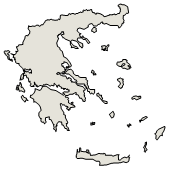

Administrative Region : West Macedonia
Regional unit : Kozani
Voskochori (Βοσκοχώρι) Kozani
Voskochori, officially Voskochorion, is a mountainous village in Kozani at an altitude of 770 meters[1].
Geographical information
Voskochori is located towards the eastern border with Imathia, at a distance of 24 km. E.-NE. of Kozani and 35 km. SW. of Veria. The village is built between two mountains and the Egnatia Highway and the Alexandreia - Kozani National Road pass to its south. Its current name Voskochori comes from the main occupation of the inhabitants with livestock farming[2]. During the opening of the Egnatia Highway, in a nearby rural location, a building in the shape of a free cross was identified and excavated. It is a bath in the type of small rural Roman baths that was dated to the end of the early Byzantine period[3]. Furthermore, according to the 2011 census, its population is 120 inhabitants[4]. Voskohori is currently divided into two parts: The northern part of the village with approximately 40 buildings and the southern part of the village with approximately 60 buildings. The area of the settlement is not particularly large, only 640 sq.m. and the total number of buildings is approximately 100, while many of them are deserted or uninhabited.
Historical information
In 1918, it is officially mentioned in the Official Gazette 260A-31/12/1918 as Tsopouli, desiated as the seat of the homonymous community, in 1919 the name is corrected to Tsiopanli and in 1927 with the Official Gazette 18A-01/02/1927 it is renamed Voskohori[5]. According to the plan, Kallikratis is the local community of Voskochori, which belongs to the municipal unit of Hellespontos of the municipality of Kozani. Initially, the first houses were built on the eastern side of the eastern mountain by the Thracians and Asia Minor in 1922, while after 2 years in 1924, the Pontians settled, from whom the first settlement took its name ''Pontika''. Of course, the village was inhabited during the Turkish occupation by a Turkish population who were exchanged in 1922 with the first Greek residents. The occupation was involuntary compared to other parts of Greece, but during the revolution, battles were fought in all the surrounding mountains. During the junta, there were no differences with the other parts of Greece, while after this the village took the form it has today.
Flora - fauna
The climate of the area is temperate. On the mountain to the east of the settlement there is a dense temperate forest where mainly snakes and hares live while a specific variety of tea grows. Higher up the mountain in the winter, mainly at night, wolves come down, which of course do not pose a danger since they do not approach the village. Moreover, this happens very rarely. On the western mountain there is not particularly dense vegetation because it is not allowed by the herds of local shepherds who graze there. The living organisms are fewer but there is no shortage of snakes, mainly vipers, but also hares that are their prey. A walk in the village would allow you to hear the barking of sheepdogs from all directions and fresh air since it is located between two mountains that are not at all polluted by human activity that could harm them.
List of animals of the area
Grove of Mount ''Lykorachi to the east of the settlement''.
Echidna [>1 species]
Dog [>1 species]
Sheep [1 species]
Goat [1 species]
Wolf [1 species]
Hare [1 species]
Eagle [>1 species]
Chicken [1 species]
Fox [1 species]
Wild Boar [1 species]
Turtle [2 species]
Frog [2 species]
Lizard [2 species]
Agriculture
The inhabitants of the village in the old days and today were mainly engaged in potatoes. Of course, potato plantations today have decreased while a greater amount of herb plantations such as lavender are observed. In addition to herbs and potatoes, the inhabitants also plant onions, while in the courtyards of the houses there are trees with edible fruits such as walnuts, persimmons, almonds, apples, etc.
Livestock
From the name of the village alone we can understand that the main occupation of the inhabitants is livestock. The animals raised in the older years were horses, mules, donkeys, cows, sheep, goats and chickens, while now there are only horses [2 to 4 left]*, donkeys [1 to 2 left], chickens [over 20 left], sheep [over 20 left] and goats [over 20 left]. The herds of goats and sheep graze mainly on the eastern mountain and are the reason why a dense and large forest has developed in the western one. Of course, deeper in the eastern mountain, at a point where the sheep no longer graze, there is a dense forest similar to that in the eastern one.
* The indication: [more than 20 remaining] means that they exist without any shortage in abundance.
References
Encyclopedia Nea Domii. Tegopoulos - Maniateas. 1996. p. 234, vol. 7.
«Municipality of Kozani - Local Community of Voskochori». cityofkozani.gov.gr. Archived from the original on 24 March 2019. Retrieved 27 March 2019.
Paissidou, Melina (in English). Egnatia Odos: Polymylos Kozani Section. Excavation of an Early Christian Bath in Voskochori, Kozani, Archaeological Research and Major Public Works. Archaeological workshop, Eptapyrgio, Thessaloniki, 18-20 September 2003, 61..
«Official Gazette of the results of the 2011 PERMANENT population census Archived 2021-10-04 at the Wayback Machine.», p. 10545 (p. 71 of the pdf)
«Administrative Changes of Settlements». EETAA. Retrieved 27 March 2019.
| Municipal unit Ellispontos |
|---|
| Community Agios Dimitrios |
| Άγιο Πνεύμα, το |
| Agios Dimitrios (Άγιος Δημήτριος, ο) |
| Community Agios Charalambos |
| Agios Charalambos (Άγιος Χαράλαμπος, ο) |
| Community Akrini |
| Akrini (Ακρινή, η) |
| Profitis Ilias (Προφήτης Ηλίας, ο) |
| Community Avgi |
| Avgi (Αυγή, η) |
| Community Voskochori |
| Voskochori (Βοσκοχώρι, το) |
| Community Drepano |
| Galani (Γαλάνι, το) |
| Drepano (Δρέπανο, το) |
| Community Kapnochori |
| Anatoliko (Ανατολικό, το) |
| Kapnochori (Καπνοχώρι, το) |
| Σκάφη, η |
| Community Kleitos |
| Kleitos (Κλείτος, ο) |
| Neos Kleitos (Νέος Κλείτος, ο) |
| Community Koilada |
| Thymaria (Θυμαριά, η) |
| Κοιλάς, η |
| Kremasti (Κρεμαστή, η) |
| Community Polymylos |
| Αγία Παρασκευή, η |
| Άγιοι Θεόδωροι, οι |
| Ζωοδόχος Πηγή, η |
| Leventis (Λεβέντης, ο) |
| Polymylos (Πολύμυλος, ο) |
| Community Ryaki |
| Ryaki (Ρυάκι, το) |
| Community Tetralofo |
| Tetralofo (Τετράλοφο, το) |
Greece :
A - B - C - D - E - F - G - H - I - J - K - L - M -
N - O - P - Q - R - S - T - U - V - W - X - Y - Z
Retrieved from "http://en.wikipedia.org/"
All text is available under the terms of the GNU Free Documentation License
| Ancient Greece
Science, Technology , Medicine , Warfare, , Biographies , Life , Cities/Places/Maps , Arts , Literature , Philosophy ,Olympics, Mythology , History , Images Medieval Greece / Byzantine Empire Science, Technology, Arts, , Warfare , Literature, Biographies, Icons, History Modern Greece Cities, Islands, Regions, Fauna/Flora ,Biographies , History , Warfare, Science/Technology, Literature, Music , Arts , Film/Actors , Sport , Fashion --- |

