

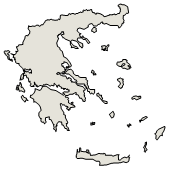

Administrative Region : West Greece
Regional unit : Achaia
Platanovrysi (Πλατανόβρυση) Achaia
Platanovrysi[1] (widely known as Metzaina from its former name) is a village and the seat of the homonymous local community of the Municipality of Erymanthos in the regional unit of Achaia, according to the administrative division of the Kallikratis Program in force in Greece since 1/1/2011[2]. According to the 2011 Census, the population of the settlement is 200 inhabitants, while that of the homonymous local community is 403 inhabitants.
Geography - Location
The village is built at the foot of the southwestern extensions of the Panachaikos mountain range, at an altitude of approximately 450 meters, and is almost united with the neighboring settlement of Agia Paraskevi. It is 8 km by road from Chalandritsa (seat of the Municipality of Erymanthos) and 18.5 km. from the city center of Patras. Near the village pass: to the west and at a distance of approximately 3.5 kilometers the National Road Patras-Tripoli ("111"), as well as to the south at a distance of less than 2 kilometers the Provincial Road Patras-Kalavryta. The horizon of the village is wide and offers views to the west and southwest looking towards western Achaia, the Gulf of Patras, the coasts of Aitoloakarnania, and Ionian islands such as Kefalonia, Ithaca and faintly towards Zakynthos.[3]
Local Community of Platanovrysi
The homonymous local community consists of the settlements: Platanovrysi, Agia Paraskevi, Kato Platanovrissi (or Hani Kourlampa) and Koimisi[4]. The settlement of Platanovrysi has a permanent population of 200 residents, according to the 2011 census, while the homonymous Local Community has 403 residents.
Name
There are various opinions about the old name of the village, Metzaina, which is still preserved today and often prevails over the current name:
a) That it is anthroponymic, derived from the first settler of the village, unknown when, most likely of Arvanite origin, named Mentzana or it may be due to a Mentzana, wife of Mentzos[5][6].
b) Another opinion connects the old name with horse-shoeing that existed in the area from words of the Albanian-speaking old inhabitants of the area, i.e. mez-i, which means foal, or mezet, which means horse-shoeing[6].
c) According to the historian Stefanos Thomopoulos, it is a name that indicates a location, i.e. amidst mountains or in the midst of the Barony of Chalandritsa of the Principality of Achaia[6].
Historical evidence
Two Mycenaean cemeteries have been found in Platanovrysi, one of which has been looted[7], as well as remains of a settlement from historical times[8]. Near the village there are also the ruins of a small fortress, known as Sarakinokastro, whose exact construction date and construction are unknown[9]. Platanovrysi is mentioned in the Venetian lists of 1699 and 1713.
During the Greek Revolution of 1821, and specifically in 1824, a battle was fought in the village between the chieftain Gennaios Kolokotronis and his army and the Ottomans[5].
Administrative development
In 1835, Metzaina, by royal decree of 8 April, became a settlement of the then Municipality of Pharos until 1912[2]. With the Government Gazette 256A of 28/08/1912, and the dissolution of the municipalities, it became the seat of the then newly established Community of Metzaina of the District of Patras of the Prefecture of Achaia-Ilis (hereinafter: "Achaia")[2]. In 1928 (Government Gazette 156A of 08/08/1928) it was renamed "Platanovrysi"[2][10], as was the community[4]. In 1997, with the "Kapodistrias" Plan (Government Gazette 244A of 04/12/1997), it became a municipal district of the new Municipality of Pharres[2][11].
Demographic development
In 1700, it is mentioned in the Venetian census "Grimani" as "Menzena" with a population of 12 families (63 inhabitants)[6]. According to historical data, in 1828 it had 28 families and in 1899 it had 325 inhabitants[5].
Overall, the demographic evolution of the settlement according to the national censuses[12][13] is as follows:
1830 1835 1844 1848-1851 1861 1879 1889 1896 1907 1920 1928 1940 1951 1961 1971 1981 1991 2001 2011
29 households[6] 39 households /
201 inhabitants[6][14] 260[6] 38 households /
216 inhabitants[6] 255 inhabitants[6] 301[6] 313[6] 355[6] 394[6] 440[6] 407[6] 600[6] 598[6] 446[6] 407[5][6] 419[6] 239[6] 155[6][15] 200[16]
Sights
The visitor deserves to see the remains of the settlement of historical times at the location Elliniko, the two Mycenaean cemeteries, the Byzantine church of the Theotokou[17], the historic Monastery of Babioti, the church of Agia Paraskevi, the traditional stone fountains, the plane trees and the beautiful natural landscape of the area, as well as the panoramic view it offers.
References and footnotes
The name is phytonymic, from the many plane trees and fountains that exist in the area. See Triantafyllou 1995, Mentzaina entry.
E.E.T.A.A. - Administrative changes of Platanovrysi Achaias. eetaa.gr. Retrieved: 12/11/2017.
See Google Earth program.
E.E.T.A.A. - Administrative changes of the Community of Platanovrissi, Achaia. eetaa.gr. Retrieved: 10/11/2017.
Triantafyllou 1995, entry Mentaina.
Louloudis 2010, p. 284.
Municipality of Farron - Historical findings[dead link]. farron.gov.gr. Retrieved: 07/10/2010.
Municipality of Farron[dead link]. farron.gov.gr. Retrieved: 07/10/2010.
Lazaris (ed.), Volume B', 1999, p. 67.
Pandektis: Renamings of Settlements in Greece - Mentzaina-Platanovrysi. pandektis.ekt.gr. Retrieved: 07/10/2010.
Law 2539/1997 - EEP[dead link]
Digital library of E.S.Y.E./EL.STAT.. dlib.statistics.gr. Retrieved: 24/10/2017.
E.E.T.A. - Administrative changes in the T.A. - Census publications. eetaa.gr. Retrieved: 24/10/2017.
Censused as Mentzaina. See Louloudis 2010, p. 284 [footnote 6].
Resident population: 129 inhabitants. See E.S.Y.E. - Resident Population of Greece. Census 2001 Archived 2018-06-28 at the Wayback Machine.
"EL.STAT. - Resident population of Greece. Census 2011" (PDF). Archived (PDF) from the original on 17 May 2017. Retrieved 18 March 2016.
It is located in the old location of the village of Platanovrissi. See Louloudis 2010, p. 285.
Sources
Results of the Population-Housing Census 2011 concerning the Resident Population of the Country, Government Gazette of the Hellenic Republic, vol. 2, p. 3465 (28 December 2012).
N.S.Y.E. - Resident Population of Greece. Census 2001, Athens 2004. ISBN 960-86704-8-9.
Vasilis K. Lazaris (ed.), Stefanos N. Thomopoulos "History of the city of Patras from the earliest times until 1821". Fourth edition in the vernacular and based on the author's manuscripts, Volume B, Achaikes Ekdoseis, Patras 1999. ISBN 960-7960-09-2.
Bibliography
Louloudis, Theodoros H. (2010). Achaia. Settlements, settlers, self-government. Patras: Prefectural Cultural Development Enterprise of South-Eastern Achaia.
Costas N. Triantafyllou, Historical Dictionary of Patras, Volume B, Petros Chr. Koulis Printing House, Patras 1995, Third Edition, entry Mentzaina.
Greece :
A - B - C - D - E - F - G - H - I - J - K - L - M -
N - O - P - Q - R - S - T - U - V - W - X - Y - Z
Retrieved from "http://en.wikipedia.org/"
All text is available under the terms of the GNU Free Documentation License
| Ancient Greece
Science, Technology , Medicine , Warfare, , Biographies , Life , Cities/Places/Maps , Arts , Literature , Philosophy ,Olympics, Mythology , History , Images Medieval Greece / Byzantine Empire Science, Technology, Arts, , Warfare , Literature, Biographies, Icons, History Modern Greece Cities, Islands, Regions, Fauna/Flora ,Biographies , History , Warfare, Science/Technology, Literature, Music , Arts , Film/Actors , Sport , Fashion --- |

