

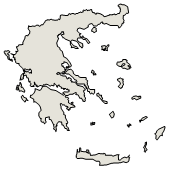

Administrative Region : Thessaly
Regional unit : Trikala
Paramero (Παράμερο) Trikala
Paramero is a mountainous village in the prefecture of Trikala, with no permanent residents according to the 2011 census.[1] It is built at an altitude of 1,000 meters (with a maximum point of 1,040 meters) on the slopes of southern Pindos and is one of the most mountainous settlements in the prefecture of Trikala. Administratively, it falls under the municipal unit of Pindaion of the municipality of Pyli of the regional unit of Trikala. It is about an hour and a quarter from Trikala, that is, about 61 km, while its road access has recently been improved with the Gropa tunnel.
Administrative changes
In 1883, the settlement, then called Vardari and with a population of 72 residents, was annexed to the newly founded municipality of Kothonia with its seat in Vitsista (present-day Mesochora).[2]
In 1912, the settlement of Vardari was detached from the municipality of Kothonia, which was abolished and annexed to the newly established community of Vitsistas.[3]
In 1919, the settlement was detached from the community of Vitsistas and annexed to the newly established community of Balkanos.[4]
In 1927, the settlement was detached from the community of Balkanos and annexed to the community of Gionthis (present-day Livadochori).[5] Later in the same year, it was renamed Parameron and the community of Gionthis to which it belongs was renamed Livadochori.[6]
In 1966, the settlement was detached from the community of Livadochori and designated as the seat of the newly established community of Parameron.[7]
In 1997, with the implementation of the Kapodistrias program (law 2539/97), the community of Parameros was abolished and the settlement was annexed to the newly established municipality of Pindaion with the seat in the settlement of Stournareika.[8]
In 2010, with the implementation of the Kallikratis program (law 3852/2010), the municipality of Pindaion was abolished and the settlement was annexed to the municipality of Pyli with the seat in Pyli.[9]
Today, after the last change in 2010 (Kalikratis program), the settlement falls under the municipal unit of Pindaion of the municipality of Pyli of the regional unit of Trikala.[1]
Historical information
This is a settlement of the Byzantine era and is first mentioned in a document of 1336 as Vardani. In the Turkish census of 1454-55 it is mentioned as Vantan. From then on it is referred to as Vardari. The word designates the rattles of the watermill. From 1927 onwards it is called Paramero.[10] Otherwise, sufficient evidence has not yet been found regarding the history of the village.
Geomorphological elements
The terrain of the area is mostly sloping, while in some places in the west there are small meadows ideal for grazing. It has a rich relief and natural beauty. The fauna of the village includes roe deer, wild boars and bears in the forests, and at the higher levels there are wild goats, partridges and eagles. The forests mainly include firs, plane trees, chestnuts and oaks. From the south it is surrounded by the peaks "Trambala", "Karatzouni" and "Petra", while from the north by the peaks "Fourka", "Ornio", "Tsardaki" and "Kerasoula". Also from the highest points of the village you can see Mount "Avgo".
Social elements
The village is inhabited mainly during the summer months, while some stay until the beginning of winter. The majority of its inhabitants are livestock breeders, who mainly have sheep, goats or cows. The rest are mainly engaged in agriculture. The main agricultural products of the area are beans, potatoes, corn and vegetables. A large festival is held in the village on the feast of Agia Paraskevi on July 25-26.
Population evolution
Year 1883 1889 1896 1907 1920 1928 1940 1951 1961 1971 1981 1991 2001 2011
Population 72 103 113 65 64 90 169 108 90 6 30 57 4 0
Sources [2] [11] [12] [13] [14] [15] [16] [17] [18] [19] [20] [21] [22] [1]
Live Camera
https://www.meteolive.gr/p/paramero.html
References
“Government Gazette of results of PERMANENT population”, p. 10628 (p. 154 of pdf), and in Excel format “Table of results of PERMANENT Population-Census 2011” on the ELSTAT website. Archived 24/11/2017. Retrieved 09/01/2018.
“Government Gazette 126A - 02/04/1883” p. 661 (p. 19 of pdf), by EETAA. Archived 15/10/2018. Retrieved 15/10/2018.
“Government Gazette 261A 31/8/1912” p. 1519 (p. 7 of pdf), by EETAA. Archived 16/06/2012. Retrieved 27/02/2018.
“Government Gazette 66A - 22/03/1919” p. 494, para. 10 (p. 2 of pdf), by EETAA. Archived 18/10/2018. Retrieved 18/10/2018.
“Government Gazette 147A - 19/07/1927” p. 1037 (p. 1 of pdf), by EETAA. Archived 18/10/2018. Retrieved 18/10/2018.
“Government Gazette 306A - 22/12/1927” p. 2384, para. 213 and 212 (p. 5 of pdf), by EETAA. Archived 18/10/2018. Retrieved 18/10//2018.
"Government Gazette 118A - 04/06/1966" p. 733 (p. 3 of pdf), by EETAA. Archived 19/10/2018. Retrieved 19/10//2018.
"Government Gazette 244A - 04/12/1997" p. 8829, line 45.17 (p. 41 of pdf ), by EETAA. Archived 30/03/2017. Retrieved 27/02/2018.
"Government Gazette 87A - 07/06/2010" p. 1793, para. 45.1 (p. 9 of pdf ), by EETAA. Archived 27/02/2018. Retrieved 27/02/2018.
“Pandektis: Vardari -- Parameron”. pandektis.ekt.gr. Retrieved 8 October 2016.
It is reported as Vardarion and 52 males and 51 females were enumerated. “Population: census of 15-16 April 1889”, p. 152 (p. 175 of pdf), by ELSTAT. Archived 07/11/2017. Retrieved 08/01/2018.
It is reported as Vardar and 61 males and 52 females were enumerated. “Statistical results of the population census of 5-6 October 1896”, p. 161 (p. 300 of pdf), by ELSTAT. Archived 07/11/2017. Retrieved 08/01/2018.
It is reported as Vardari and 35 males and 30 females were enumerated. "Statistical results of the general population census on 27 October 1907", p. 423 (p. 426 of the pdf), by ELSTAT. Archived 07/11/2017. Retrieved 08/01/2018.
It is reported as Vardari and 25 males and 39 females were enumerated. "Population of the Kingdom of Greece according to the census of 19 December 1920", p. 292 (p. 313 of the pdf), by ELSTAT. Archived 07/06/2015. Retrieved 08/01/2018.
37 males and 53 females were counted. "Population of Greece according to the census of 15-16 May 1928", p. 337 (p. 357 of pdf), by ELSTAT. Archived 4/3/2016. Retrieved 8/1/2018.
74 males and 95 females were counted. "Population of Greece according to the census of 16 October 1940", p. 370 (p. 394 of pdf), by ELSTAT. Archived 25/4/2017. Retrieved 8/1/2018.
"Population of Greece according to the census of 7 April 1951", p. 172 (p. 172 of pdf), by ELSTAT. Archived 4/3/2017. Retrieved 8/1/2018.
"Results of the population - housing census of 19 March 1961", Table 1, p. 194 (p. 264 of pdf), by ELSTAT. Archived 6/3/2017. Retrieved 8/1/2018.
"Population of Greece according to the census of 14 March 1971", p. 163 (p. 163 of pdf), by ELSTAT. Archived 24/10/2014. Retrieved 8/1/2018.
"Results of the population - housing census of 5 April 1981", p. 353 (p. 353 of pdf), by ELSTAT. Archived 8/1/2018. Retrieved 8/1/2018.
"Actual population of Greece according to the census of 17 March 1991 by prefectures, provinces, municipalities, communities and settlements", p. 214 (p. 216 of pdf), by ELSTAT. Archived 20/08/2017. Retrieved 08/01/2018.
"Population - housing census of 18 March 2001", p. 205 (p. 207 of pdf), by ELSTAT. Archived 29/07/2017. Retrieved 08/01/2018.
| Municipal unit Pindeon |
|---|
| Community Vathyrrevma |
| Vathyrrevma (Βαθύρρευμα, το) |
| Community Valkano |
| Valkano (Βαλκάνον, το) |
| Zografaiika (Ζωγραφαίικα, τα) |
| Panagiotaiika (Παναγιωταίικα, τα) |
| Community Livadochori |
| Livadochori (Λιβαδοχώριον, το) |
| Community Mesochora |
| Exochi (Εξοχή, η) |
| Mesochora (Μεσοχώρα, η) |
| Spitia (Σπίτια, τα) |
| Community Moschofyto |
| Leptokarya (Λεπτοκαρυά, η) |
| Moschofyto (Μοσχόφυτον, το) |
| Oreini (Ορεινή, η) |
| Platanakia (Πλατανάκια, τα) |
| Community Nea Pefki |
| Nea Pefki (Νέα Πεύκη, η) |
| Community Paramero |
| Paramero (Παράμερον, το) |
| Community Polyneri |
| Panagia (Παναγία Πυνδαίων Τρικάλων, Παναγία, η) |
| Polyneri (Πολυνέριον, το) |
| Community Stournaraiika |
| Agios Konstantinos (Άγιος Κωνσταντίνος, ο) |
| Isiomata (Ισιώματα, τα) |
| Kallithea (Καλλιθέα, η) |
| Karyes (Καρυές, οι) |
| Kastania (Καστανέα, η) |
| Palaiochori (Παλαιοχώρι, το) |
| Stournaiika (Στουρναραίικα, τα) |
| Psarro (Ψάρρο, το) |
Greece :
A - B - C - D - E - F - G - H - I - J - K - L - M -
N - O - P - Q - R - S - T - U - V - W - X - Y - Z
Retrieved from "http://en.wikipedia.org/"
All text is available under the terms of the GNU Free Documentation License
| Ancient Greece
Science, Technology , Medicine , Warfare, , Biographies , Life , Cities/Places/Maps , Arts , Literature , Philosophy ,Olympics, Mythology , History , Images Medieval Greece / Byzantine Empire Science, Technology, Arts, , Warfare , Literature, Biographies, Icons, History Modern Greece Cities, Islands, Regions, Fauna/Flora ,Biographies , History , Warfare, Science/Technology, Literature, Music , Arts , Film/Actors , Sport , Fashion --- |

