

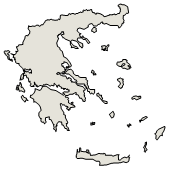

Administrative Region : Thessaly
Regional unit : Trikala
Moschofyto (Μοσχόφυτον) Trikala
Moschofyto[1] (Kornesi until 1927[2]) is a settlement in Thessaly and the Trikala Regional Unit.
General information
Moschofyto is located in South Pindos and belongs to the Municipality of Pyli with 7 permanent residents (2011 census),[3] at an altitude of 854 meters. The settlement of Moschofyto with Leptokarya (8 km), Orini (5 km) and Platanakia (7 km) form the local community of Moschofyto (27 km), which is under the city of Pyli and is served by it. It is first mentioned in a document of 1336, in favor of the Bishopric of Stagion. In the Ottoman census of 1454/55 it is mentioned as kornisi and comes from the Vlach word cornu, meaning skull.[4]
Around Moschofyto rise the peaks of Laiousa and Xirovouni. The village took its name from the musk plant. The village has a festival on July 20 and July 26 with a two-day feast, while in the meantime cultural events such as theatrical performances are held. The houses in Moschofyto are made of stone. At the entrance to the village there is a playground, with a fountain and a kiosk for visitors to rest.
Folklore
There is a Folklore Museum in the village, which was founded in 2002 and operates in the basement where in the past the village school was housed, right next to the Holy Church of Agia Triada.
In the past, two schools operated in Platanakia. One next to the church of Prophet Elias and one in the central settlement of the village near Agia Triada.
Natural environment
The flora of the village is quite rich with many fir and cedar trees as well as thousands of fruit trees such as walnut, cherry, dogwood, hazelnut (leptokaryes) etc. Just below Moschophyto there is the gorge - stream of Arendas which is a tributary of the Acheloos and stands out for its unparalleled beauty. The stone bridge at Korakonisi is considered the most remote bridge in the prefecture of Trikala. It connects the villages of Myrofyllo, Polyneri with Ellinika by bridging the Arendas stream, just before its confluence with the Acheloos. The Arendas stream originates from the south-eastern slopes of Mount Hatzis.[5]
Churches and chapels
The church of Agios Nikolaos (1810).
The chapel of Agia Paraskevi.
The Church of Agia Triada which dates back to 1849
In the settlement of Platanakia there is an old church of Prophet Elias which is opposite the village square. The village celebrates the memory of Prophet Elias on July 20.
The church of Agios Nikolaos which is one of the oldest in Moschofytos since it dates back to 1810 and there is the village cemetery.
The chapel of Agia Paraskevi which is located in the settlement of Kechri. It celebrates on July 26.
Historical data
The 1821 fighter Nikolaos Stournaris, who, as A. Hatzigakis states, takes his surname from the mountain Stournari located between Mesochora and Moschophytos. The exact location is located on Mount Hatzi and west of the settlement of Orini Moschophytos. There, according to tradition, a pre-revolutionary gathering of the kleftarmatoles of Pindos and Aitolocarnania took place, at which it was decided to give the armatoliki to Stournaris. However, because he did not have a fixed surname, they decided to call him Stournaris, as well as the location of the mountain where they gathered. As we are informed by the sources, the Stournareoi had a special relationship with this mountainous area, where there were summer pastures with their sheepfolds.
The information of the fighter Nikolaos Kasomoulis on the human geography of the Aspropotamis villages, during the period of the revolution, is interesting. "Then, we went to Paleochoria, which was inhabited for the most part by old soldiers, soldiers of the Stornareans and by their fellow farmers. All these villages of Paramero, Mesochora, Moschofyto, Balkano, Polyneri and Myrofyllo, were protected by many narrow places and streams, around the high mountain of Alamanos and Gavaliora. These villages were better protected than the Vlachohoria. I toured mountains with steep rocks, gorges, caves, narrows and forests with beautiful and endless waters. I said that freedom truly exists in these places, because the mountains I had crossed and seen up until then did not have such gifts, or at least I did not walk them in such detail as these. I concluded that the feeling of freedom and the old theft (meaning of unruly men) is born from the moral upbringing of those people.”
Administrative changes
In 1883, the settlement, then called Kornesi and with a population of 421 inhabitants, was annexed to the newly founded municipality of Kothonia, with its seat in Vitsista (present-day Mesochora).[6]
In 1912, it was decided that settlements with more than 300 inhabitants and an elementary school would become independent communities. The settlement of Kornesi was detached from the municipality of Kothonia, which was abolished and designated as the seat of the newly founded community of Kornesi. The settlement of Balkanos was also annexed to the community.[7]
In 1927, the settlement was renamed Moschofyton and the community accordingly.[8]
In 1961, in the census, the settlements of Leptokarya (59 km), Platanakia (31 km), Kapsiohaiika (61 km, today's Orini) were recognized and annexed to the community of Moschofytos.[9]
In 1997, with the implementation of the Kapodistrias program (law 2539/97), the community of Moschofytos was abolished and the settlement was annexed to the newly established municipality of Pindaion with headquarters in the settlement of Stournareika.[10]
In 2010, with the implementation of the Kallikrates program (law 3852/2010), the municipality of Pindaion was abolished and the settlement was annexed to the municipality of Pyli with its seat in Pyli.[11]
Today, after the last change in 2010 (Kalikrates program), the settlement of Moschofyto with Leptokarya (8 km), Orini (5 km) and Platanakia (7 km) constitute the local community of Moschofylos (27 km), which falls under the municipal unit of Pindaion of the municipality of Pyli of the regional unit of Trikala.
Censuses
Population evolution
The change in the permanent population is as follows:
Year 1883 1889 1896 1907 1920 1928 1940 1951 1961 1971 1981 1991 2001 2011
Population 421 346 482 604 332 530 708 297 108 82 59 45 18 7
Sources [6] [12] [13] [14] [15] [16] [17] [18] [19] [20] [21] [22] [23] [3]
Other data
Census 2011. 7 permanent residents and 15 present residents[24] (actual or de facto population) were counted. The local community covers an area of 22,289 sq km.[25]
Census 2001. 18 permanent residents were counted, of whom 13 were residents of the same municipality, 3 were non-residents and 2 were foreigners. The municipal district covered an area of 22,329 sq km.[23]
Photos
The river in the village.
The square of Moschofyto.
The river stands out for its crystal clear and transparent water.
The iconostasis of Agios Nikolaos.
August twilight in Moschofyto.
The village as seen from the location of Xerovrysi.
The imposing Xirovouni - its peak reaches 1,823 m. altitude.
Avgo as seen from Arendas.
Church and old school in Platanakia.
References
Encyclopedia Nea Domii. 22. Athens: Tegopoulos - Maniateas. 1996. p. 309.
«EETAA-Administrative Changes of Settlements». www.eetaa.gr. Retrieved on April 17, 2023.
«Official Gazette of results of PERMANENT population», p. 10628 (p. 154 of the pdf), and in Excel format «Table of results of PERMANENT Population-Census 2011 Archived 2019-11-28 at the Wayback Machine» on the ELSTAT website. Archived 24/11/2017. Retrieved 09/01/2018.
"MUNICIPALITY OF PYLIS | Moschophyto". dimospylis.gr. Archived from the original on 17 April 2023. Retrieved 17 April 2023.
"In the gorge of the Arendas stream - Korakonisi - Hiking Association of Trikala Hiking Association of Trikala". trikalasport.gr. Retrieved 17 April 2023.
"Government Gazette 126A - 02/04/1883" p. 661 (p. 19 of pdf), from EETAA. Archived 15/10/2018. Retrieved 15/10/2018.
"Government Gazette 261A 31/8/1912" p. 1517, para. 19 and p. 1519 (pp. 5 and 7 of pdf), by EETAA. Archived 16/06/2012. Retrieved 27/02/2018.
“Government Gazette 306A - 22/12/1927” p. 2384, para. 206 (pp. 5 of pdf), by EETAA. Archived 18/10/2018. Retrieved 18/10//2018.
“Government Gazette 16B - 19/1/1962” p. 250 (pp. 142 of pdf) by EETAA. Archived 18/01/2018. Retrieved 18/10/2018.
"Government Gazette 244A - 04/12/1997" p. 8829, line 45.17 (p. 41 of pdf ), from EETAA. Archived 30/03/2017. Retrieved 27/02/2018.
"Government Gazette 87A - 07/06/2010" p. 1793, para. 45.1 (p. 9 of pdf ), from EETAA. Archived 27/02/2018. Retrieved 27/02/2018.
It is reported as Kornesio and 173 males and 173 females were enumerated. "Population: census of 15-16 April 1889", p. 152 (p. 175 of pdf), from ELSTAT. Archived 07/11/2017. Retrieved 08/01/2018.
It is reported as Kornesi and 256 males and 226 females were enumerated. "Statistical results of the population census on 5-6 October 1896", p. 161 (p. 300 of the pdf), by ELSTAT. Archived 07/11/2017. Retrieved 08/01/2018.
It is reported as Kornesi and 312 males and 292 females were enumerated. "Statistical results of the general population census on 27 October 1907", p. 423 (p. 426 of the pdf), by ELSTAT. Archived 07/11/2017. Retrieved 08/01/2018.
It is reported as Kornesio and 100 males and 232 females were enumerated. "Population of the Kingdom of Greece according to the census of 19 December 1920", p. 292 (p. 313 of the pdf), by ELSTAT. Archived 07/06/2015. Retrieved 08/01/2018.
235 males and 295 females were enumerated. "Population of Greece according to the census of 15-16 May 1928", p. 337 (p. 357 of the pdf), by ELSTAT. Archived 4/3/2016. Retrieved 8/1/2018.
348 males and 360 females were enumerated. "Population of Greece at the census of 16 October 1940", p. 371 (p. 395 of pdf), by ELSTAT. Archived 25/4/2017. Retrieved 8/1/2018.
"Population of Greece at the census of 7 April 1951", p. 172 (p. 172 of pdf), by ELSTAT. Archived 4/3/2017. Retrieved 8/1/2018.
"Results of the population - housing census of 19 March 1961", Table 1, p. 195 (p. 265 of pdf), by ELSTAT. Archived 6/3/2017. Retrieved 8/1/2018.
"Population of Greece according to the census of 14 March 1971", p. 163 (p. 163 of pdf), by ELSTAT. Archived 24/10/2014. Retrieved 8/1/2018.
"Results of the population - housing census of 5 April 1981", p. 352 (p. 352 of pdf), by ELSTAT. Archived 8/1/2018. Retrieved 8/1/2018.
"Actual population of Greece according to the census of 17 March 1991 by prefectures, provinces, municipalities, communities and settlements", p. 214 (p. 216 of pdf), by ELSTAT. Archived 20/08/2017. Retrieved 08/01/2018.
“Population - Housing Census of March 18, 2001”, p. 205, other data p. 391 (p. 207 and 393 of pdf), by ELSTAT. Archived 29/07/2017. Retrieved 08/01/2018.
“Population-Housing Census 2011, Official Gazette of DE FACTO population results”, p. 11065 (p. 159 of pdf), and in Excel format “Table of DE FACTO Population - Census 2011 results” on the ELSTAT website. Archived 08/04/2018. Retrieved 21/10/2018.
“Results table of PERMANENT Population by urbanity, mountainous area, area”, Excel file from ELSTAT.
| Municipal unit Pindeon |
|---|
| Community Vathyrrevma |
| Vathyrrevma (Βαθύρρευμα, το) |
| Community Valkano |
| Valkano (Βαλκάνον, το) |
| Zografaiika (Ζωγραφαίικα, τα) |
| Panagiotaiika (Παναγιωταίικα, τα) |
| Community Livadochori |
| Livadochori (Λιβαδοχώριον, το) |
| Community Mesochora |
| Exochi (Εξοχή, η) |
| Mesochora (Μεσοχώρα, η) |
| Spitia (Σπίτια, τα) |
| Community Moschofyto |
| Leptokarya (Λεπτοκαρυά, η) |
| Moschofyto (Μοσχόφυτον, το) |
| Oreini (Ορεινή, η) |
| Platanakia (Πλατανάκια, τα) |
| Community Nea Pefki |
| Nea Pefki (Νέα Πεύκη, η) |
| Community Paramero |
| Paramero (Παράμερον, το) |
| Community Polyneri |
| Panagia (Παναγία Πυνδαίων Τρικάλων, Παναγία, η) |
| Polyneri (Πολυνέριον, το) |
| Community Stournaraiika |
| Agios Konstantinos (Άγιος Κωνσταντίνος, ο) |
| Isiomata (Ισιώματα, τα) |
| Kallithea (Καλλιθέα, η) |
| Karyes (Καρυές, οι) |
| Kastania (Καστανέα, η) |
| Palaiochori (Παλαιοχώρι, το) |
| Stournaiika (Στουρναραίικα, τα) |
| Psarro (Ψάρρο, το) |
Greece :
A - B - C - D - E - F - G - H - I - J - K - L - M -
N - O - P - Q - R - S - T - U - V - W - X - Y - Z
Retrieved from "http://en.wikipedia.org/"
All text is available under the terms of the GNU Free Documentation License
| Ancient Greece
Science, Technology , Medicine , Warfare, , Biographies , Life , Cities/Places/Maps , Arts , Literature , Philosophy ,Olympics, Mythology , History , Images Medieval Greece / Byzantine Empire Science, Technology, Arts, , Warfare , Literature, Biographies, Icons, History Modern Greece Cities, Islands, Regions, Fauna/Flora ,Biographies , History , Warfare, Science/Technology, Literature, Music , Arts , Film/Actors , Sport , Fashion --- |

