

ART

GreeceGreece

Administrative Region : East Macedonia and Thrace
Regional unit : Kavala

Lydia (Λυδία) Kavala
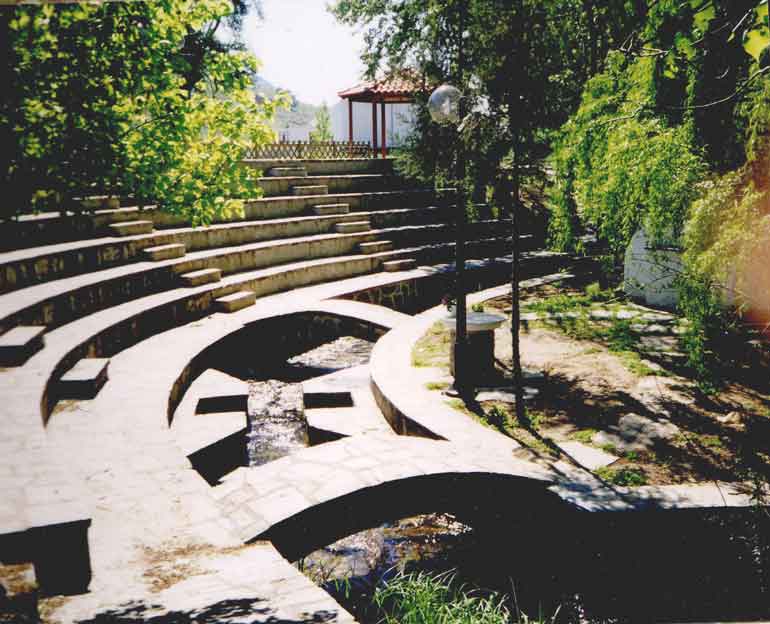
Saint Lydia (Baptisterium, Photo: Dr. Emma Niebe

Lydia is a settlement in the Prefecture of Kavala. It is located 17 kilometers northwest of the city of Kavala. It belongs to the Municipal Unit of Philippi of the Municipality of Kavala and until 1968 was called Ydromyloi.

Information

Lydia was inhabited by refugees from Eastern Thrace and Asia Minor, who settled in the area around 1923, after the population exchange.

The majority of the population is engaged in agricultural work. A seasonal increase in the population is observed during the summer months, a phenomenon that is due both to the growing tourist role of the area and to expatriates returning to their place of origin for their summer holidays. There are important archaeological and religious monuments in the area. The patron saint of the settlement is Saint John the Baptist, whose memory is honored on August 29 (Beheading of the Holy Forerunner).

Name

The settlement was named Lydia, as the Asia Minor Saint Lydia was baptized in the area by the Apostle Paul, who was the first Christian baptized on European soil.

Demographic data

The recent demographic development of the settlement, based on the national censuses, is as follows:

Year Population
1991 798
2001 821
2011 808
2021 631

The Archaeological Site of Philippi

In the adjacent Archaeological Site of Philippi, there are clearly visible traces of the Roman Via Egnatia, which passed through Philippi and was the main avenue of the ancient city.

The Ancient Theatre of Philippi

At the foot of the Acropolis hill, supported by the eastern wall of the city of Philippi, the theatre is located some 130m. NE from the arch of the Basilica. The building went through various phases. The oldest building with the general lines and the orchestra dates back to the time of Philip II (4th century). After the Roman colonization, changes were made according to the aesthetic requirements of the time. Many elements of this large theatre are still preserved today. Once restored, it is usually used for performances of ancient plays and concerts, which are part of the summer programs of the Philippi and Thassos Festival.

The prison of the Apostle Paul

According to the account in the Acts of the Apostles, the Apostle Paul was imprisoned in Philippi after he healed a girl possessed by a spirit of divination. Today, above the market of Philippi, there is the propylon of the great Early Christian Church. A narrow corridor leads to the crypt of the Church in a small, dark building with two rooms covered by arches. This building is believed to have been the prison of the Apostle Paul.

History of the baptism of Lydia

The riverbed at the Holy Baptistery

In 49 AD, the Apostle Paul founded the first Christian Church in Europe in Philippi, baptizing the first European Christian, Lydia and her family in the Zygaktis River. The inhabitants of Philippi were the first Europeans to hear the preaching of the new Religion.

One day in 49 (or 50) AD, a ship landed the Apostle Paul, Timothy and the author of the Acts of the Apostles - probably Luke - in Neapolis, today's Kavala. From Neapolis, via the Via Egnatia, they arrived in the city of Philippi, where they settled. Near the western side of the city wall, next to the Zygaktis River, was the place where the Jews gathered. There the Apostle Paul headed one Sabbath with his companions and for the first time addressed his sermon to the women present. Lydia from Thyatira listened to him attentively and was the first to receive the baptism of the new Religion. Then she begged Paul to accept her hospitality. Lydia became the first European to be baptized as a Christian. For many days the Apostle Paul and his companions walked the road from the gate to the Jewish quarter and proclaimed the Word of God. All along the way he was followed by a female slave - according to the Philippians, demonized - by whose divination ability her masters earned money. This "demonized" slave accepted the preaching of the Apostle Paul and showed faith in the new Religion. She proclaimed in the city that she had been healed of the demon that was inside her. This resulted in the interests of her masters being harmed, who arrested Paul and Silas and took them to the Agora. There they were abused and then imprisoned. There is a detailed account of the night of their imprisonment, the strong earthquake that occurred at midnight, and the baptism of the jailer and his family in the Acts of the Apostles.

Modern building development
The Church of the Holy Baptistery of Agia Lydia

On the Zygaktis River, west of Philippi and on the border of the settlement of Lydia, the Holy Baptistery of Agia Lydia was erected in 1972, following the inspiration of the then Metropolitan of Philippi, Neapolis and Thassos Alexander. It soon became internationally known and is a magnet for believers who come for pilgrimage or to be baptized from every corner of the earth. The Church dedicated to Saint Lydia gathers the faithful to honor the Equal-to-the-Apostles Lydia of Philippi on May 20th of each year, performing adult baptisms in the open-air Baptistery of the Zygaktis River.

The balanced development of the building complex of the Baptistery of Saint Lydia and the promotion of the spiritual radiance and the important historical role of Philippi in the European and global community imposed and led in mid-2011 to the construction in the wider area of the Holy Baptistery of another building suitable for the creation of a spiritual and scientific center, with a building organization capable of holding international conferences. This building was named the "Apostle Paul Conference Center" and was inaugurated on May 20, 2011 by the Ecumenical Patriarch Bartholomew.

References

Sources

"Apostles Paul and Philippi. The Baptistery of Saint Lydia" (Prokopios, Metropolitan of Philippi, Neapolis and Thassos - Georgios Karanikas, published by the Holy Metropolis of Philippi, Neapolis and Thassos, 1995)

Municipal unit Filippoi
Municipal Community Zygos
Zygos (Ζυγός, ο)
Πρόσφυγες, οι
Municipal Community Krinides
Krinides (Κρηνίδες, οι)
Community Amygdaleonas
Αμυγδαλεών, ο
Community Koryfes
Koryfes (Κορυφές, οι)
Community Kryoneri
Kryoneri (Κρυονέρι, το)
Community Limnia
Βουνοχώρι, το
Limnia (Λιμνιά, τα)
Lykostomo (Λυκόστομο, το)
Community Lydia
Lydia (Λυδία, η)
Community Παλαιάς Καβάλας
Παλαιά Καβάλα, η
Community Polynero
Kranochori (Κρανοχώρι, το)
Polynero (Πολύνερο, το)
Community Polystylo
Dato (Δάτο, το)
Mikrochori (Μικροχώρι, το)
Polystylo (Πολύστυλο, το)
Community Φιλίππων
Φίλιπποι, οι

Greece :

A - B - C - D - E - F - G - H - I - J - K - L - M -
N - O - P - Q - R - S - T - U - V - W - X - Y - Z

Retrieved from "http://en.wikipedia.org/"
All text is available under the terms of the GNU Free Documentation License

Ancient Greece

Science, Technology , Medicine , Warfare, , Biographies , Life , Cities/Places/Maps , Arts , Literature , Philosophy ,Olympics, Mythology , History , Images

Medieval Greece / Byzantine Empire

Science, Technology, Arts, , Warfare , Literature, Biographies, Icons, History

Modern Greece

Cities, Islands, Regions, Fauna/Flora ,Biographies , History , Warfare, Science/Technology, Literature, Music , Arts , Film/Actors , Sport , Fashion

---

Cyprus

Greek-Library - Scientific Library

Greece

World

Index

Hellenica World
