
Administrative Region : East Macedonia and Thrace
Regional unit : Drama
Kato Nevrokopi (Κάτω Νευροκόπι) Drama
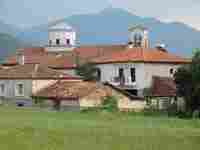
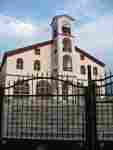
Kato Nevrokopi, Kato Nevrokopi, Kato Nevrokopi,
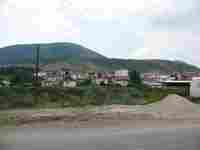
Kato Nevrokopi, Kato Nevrokopi, Kato Nevrokopi,
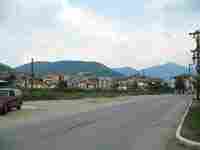
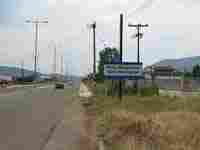
Kato Nevrokopi is a town in Macedonia, and the seat of the Municipality of Kato Nevrokopi, while it had a population of 2,157 inhabitants in 2011 and 1,855 in 2021. Administratively, it belongs to the Drama Regional Unit of the Region of Eastern Macedonia and Thrace.
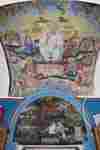
The Church of Agios Demetrios in Kato Nevrokopi
Kato Nevrokopi is located in the center of the homonymous plateau, northwest of Drama at a distance of 47 km. from its center. It is 12 km. from the border with Bulgaria, where the Exochi customs office is located. The old name of the commune was Zyrnovo and was renamed Kato Nevrokopi by the Greeks of Ano Nevrokopi (today in Bulgaria) who took refuge there after the Treaty of Neugy.[1]
History
The wider area of Kato Nevrokopi has been inhabited since the Paleolithic period. The inhabitants during the Archaic period had contacts with the central Balkans, but also with the coasts of Macedonia and Thrace. The tribes that inhabited it were Thracian, mainly Odomantes and Idonoi. The area of the Kato Nevrokopi basin was conquered by Philip II. After the Battle of Philippi, in 42 BC, the Romans settled in the area. During the Byzantine period, there were large estates, both private and monastic. After the 7th century, the area received waves of Slavic raids from the North.
In 1383, the area was conquered by the Ottomans and Muslims settled in the area. In 1530 it had 385 Christian and 219 Muslim households [citation pending].
In 1870 the Bulgarian exarchate was established and a long period of national antagonism took place in Kato Nevrokopi. In 1882 the Greek side began its effort to defend itself against Bulgarian claims with the help of the Greek Orthodox Metropolis. The exarchs of Kato Nevrokopi claimed the church of Agios Demetrios. In 1899 the exarchs caused incidents for control of the church and the Ottoman administration decided to suspend its operation. At Easter 1901, the Ottoman administration allowed the church to reopen with the agreement of alternating service in Greek and Bulgarian, but at Easter 1902, due to the continuation of the incidents, the church was closed again. The following year, Bulgarian partisans took up armed action in the area in order to terrorize the Greek population. At that time, the teacher Thomas Papageorgiou was also murdered. At the height of the Macedonian Struggle, in October 1903, at the initiative of the Metropolitan of Drama, the church of Saint Demetrius reopened, in view of the feast of the saint of the same name, with the participation of patriarchs and exarchs. On the day of Saint Demetrius, however, an armed group of 30 komitatzes attacked the church and arrested the Greek ecclesiastical commissioners Ioannis Zafiriou, Nikolaos Germanos, his son Georgios Germanos and the teacher Konstantinos Christidis, whom they executed. On Christmas Eve 1906, a body of 300 komitatzes surrounded Kato Nevrokopi and after a three-hour attack murdered the Greek dignitaries.
The Greek Army liberated the town on 4 July 1913. In the following years, and after the population exchanges, refugees from Asia Minor, Pontus and Eastern Thrace took refuge in Kato Nevrokopi.[2] The Muslim inhabitants migrated to Turkey in accordance with the Greek-Turkish population exchange, while, by 1932, 324 exarchate families migrated to Bulgaria.[3]
On 1 April 1927, the town was renamed from Zyrnovo to Kato Nevrokopi.[4]
Personalities
Many prominent icon painters of the 19th century came from the area of the present-day Municipality of Nevrokopi, such as Stergios Georgiadis and Georgios Zyrnovitis (from Kato Nevrokopi) and Dimitriou (from Katafyto), who painted the churches of the area: in the commune of Kato Nevrokopi and in the villages of Dasosoto, Kato Vrontou, Perithori, Lefkogia, Pagoneri, Volakas, Akrino, Livadaki, Ochiro, Exochi, Vathytopo and Graniti, during the period 1812-1890.[5]
The inhabitants of the area actively participated in the struggles for Macedonia during the Macedonian Struggle. The most important Macedonian fighters were Ioannis Avrionis from Perithori, Dimitrios Pentsas from Pagoneri and Armen Kouptsios from Volakas[6]. Another personality of the region was Christos Taskas from Pagoneri who acted as the chieftain of the resistance forces during the Occupation[7]. Bishop of Rogo, Philotheos Theodoropoulos, was born in Kato Nevrokopi, who serves as an assistant bishop to the Archbishop of Athens.[8]
Climate
Kato Nevrokopi is located 42 km from Drama and has a continental climate with cool summers and characteristically cold winters.
| Climate data for Kato Nevrokopi (2010-2019) |
|||||||||||||
|---|---|---|---|---|---|---|---|---|---|---|---|---|---|
| Month | Jan | Feb | Mar | May | Μάι | Jun | Jul | Aug | Sep | Oct | Nov | Dec | Yead |
| Average Maximum °C (°F) | 5.2 | 9.3 | 13.4 | 18.5 | 22.6 | 26.9 | 30.3 | 31.1 | 26.0 | 19.2 | 13.6 | 6.8 | 18,58 |
| Average Monthly °C (°F) | 0.45 | 3.9 | 7.2 | 11.5 | 15.7 | 19.7 | 22.25 | 22.5 | 18.15 | 12.4 | 8.05 | 1.85 | 11,97 |
| Average Monthly °C (°F) | −4.3 | −1.5 | 1.0 | 4.5 | 8.8 | 12.5 | 14.2 | 13.9 | 10.3 | 5.6 | 2.5 | −3.1 | 5,37 |
| Rainfall mm (inches) | 65 | 67 | 64 | 39 | 68 | 59 | 39 | 37 | 46 | 47 | 73 | 61 | 665 |
| Source: National Observatory of Athens[9] | |||||||||||||
References
«P. N. Nigdelis, From Nevrokopi to Athens, the epitaph inscription IG II/III 10770 and its origin, p. 152». Archived from the original on 5 March 2016. Retrieved 28 October 2014.
General Lyceum of Kato Nevrokopi, Nevrokopi Yesterday and Today
«KATO NEVROKOPI». Municipality of Kato Nevrokopi. Archived from the original on December 21, 2022. Retrieved December 21, 2022.
«Pandektis: Zyrnovon -- Kato Nevrokopion». pandektis.ekt.gr. Retrieved December 21, 2022.
Tilemachos Tselepidis, "Nevrokopi - A Brief Historical Chronicle 1850-1913", unpublished research, Drama October 29, 1995
Unknown Native Macedonian Fighters, edited by Ioannis S. Koliopoulos, EMS, Thessaloniki 2008
Hatzianastasiou, Tasos (2003). Guerrillas and Captains. The National Resistance Against the Bulgarian Occupation of Eastern Macedonia and Thrace, 1942-1944. Thessaloniki: Kyriakides Brothers Publishing House. p. 44. ISBN 960-343-703-4.
Church of Greece
«Climate». National Observatory of Athens. Retrieved 13 August 2022.
| Municipal Community Kato Nevrokopi |
|---|
| Kato Nevrokopi (Κάτω Νευροκόπιο, το) |
| Community Achladia |
| Αχλαδέα, η |
| Community Vathytopos |
| Vathytopos (Βαθύτοπος, ο) |
| Community Volakas |
| Volakas (Βώλαξ, ο) |
| Community Granitis |
| Granitis ( Γρανίτης, ο) |
| Community Dasoto |
| Dasoto (Δασωτόν, το) |
| Community Exochi |
| Exochi (Εξοχή, η) |
| Community Katafyto |
| Katafyto (Κατάφυτο, το) |
| Community Kato Vrontou |
| Kato Vrontou (Κάτω Βροντού, η) |
| Community Lefkogeia |
| Lefkogeia (Λευκόγεια, τα) |
| Community Mikrokleisoura |
| Μικροκλεισούρα, η |
| Πέρασμα, το |
| Community Mikromilia |
| Μικρομηλέα, η |
| Community Ochyro |
| Ochyro (Οχυρόν, το) |
| Community Pagoneri |
| Pagoneri (Παγονέριο, το) |
| Community Perithorio |
| Perithorio (Περιθώριο, το) |
| Community Potamoi |
| Potamoi (Ποταμοί, οι) |
| Community Chrysokefalos |
| Chrysokefalos (Χρυσοκέφαλος, ο) |
Greece :
A - B - C - D - E - F - G - H - I - J - K - L - M -
N - O - P - Q - R - S - T - U - V - W - X - Y - Z
Retrieved from "http://en.wikipedia.org/"
All text is available under the terms of the GNU Free Documentation License
| Ancient Greece
Science, Technology , Medicine , Warfare, , Biographies , Life , Cities/Places/Maps , Arts , Literature , Philosophy ,Olympics, Mythology , History , Images Medieval Greece / Byzantine Empire Science, Technology, Arts, , Warfare , Literature, Biographies, Icons, History Modern Greece Cities, Islands, Regions, Fauna/Flora ,Biographies , History , Warfare, Science/Technology, Literature, Music , Arts , Film/Actors , Sport , Fashion --- |