

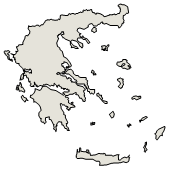

Administrative Region : Peloponnese
Regional unit : Argolida
Iliokastro (Ηλιόκαστρον) Argolida
Iliokastro (old name: Karakassi) is a semi-mountainous village in the Argolida prefecture.[1] The village is built on the Ileion plateau, at the foot of the Aderes mountain range and at an altitude of 198 meters[2]. It is 7 km from Ermioni and 66 km from Nafplio. Administratively, it falls under the community of Iliokastro of the municipal unit of Ermioni of the municipality of Ermioni.[3]
The village has, according to the 2021 census, 507 permanent residents[4] who are mainly engaged in livestock farming, olive growing and viticulture. The wine of Iliokastro is known for its taste while the oil produced is considered to be of excellent quality.
Name
The name of the village was given by Ioannis V. It was founded in 1931, because it is bathed in abundant light. Before 1928, it was called "Karakasi", which meant "black eyebrows" (kara kaş) in Turkish.[5] The name Karakassi was retained until 1927, when the Greek state decided to rename the village Iliokastro.[6]
History
The modern village is built on the site of ancient Ileous, known for its wine. Even today, the walled enclosure with polygonal construction on the small hill that served as the acropolis of the village is preserved. According to Pausanias, there were sanctuaries of Demeter and her daughter there.
Towards the end of the Byzantine period, Emperor Theodore I Palaiologos founded a small settlement, Paleokatounti. This settlement served as the residences of the guards, who guarded the passage to Thermisia. Next to this settlement is the fortress of Iliokastro, which was used to control the passages to Thermisia and formed the border of the faltering Byzantine Empire with the Venetian-held Troizinia. A characteristic of the fortress of Iliokastro was the visibility of both the bay of Nafplio and Hydra.
From the beginning of the 20th century 1905-1978, mines operated in the area where iron pyrite was extracted, giving an economic boost to the area.
Population
Although the village had been recognized since the founding of the Greek state[7], it was not recognized in the censuses until 1907. From 1907 to 1940, the village had a very large increase in its population, while since then there has been a significant decrease.
Historical population evolution
Year Pop. ±%
1907 351 —
1920 366 +4.3%
1928 446 +21.9%
1940 756 +69.5%
1951 745 −1.5%
1961 744 −0.1%
1971 710 −4.6%
1981 633 −10.8%
1991 595 −6.0%
2001 578 −2.9%
2011 550 −4.8%
2021 507 −7.8%
Source: ELSTAT Population Censuses 1879 - 2021
Attractions
The visitor can enjoy the quality of the food but especially the good wine. In September, there is a wine festival with locally produced wines, where one has the opportunity to taste fine varieties of wine. There are several traditional taverns with local meats and local wine. The central point of the village is its square with a stone fountain, which is located next to the bridge that divides the village in two. Next to it is the village church, dedicated to the apostles Peter and Paul, and the village cultural events building, which used to be a primary school. Along with the church of the apostles Peter and Paul, there is another church below it dedicated to Nikolaos Planas.
References
Encyclopedia Papyrus Larousse Britannica. 26. Papyrus Publishing House. 1996. p. 359.
«Iliokastro ARGOLIDAS, Municipality of ERMIONIDAS | buk.gr». buk.gr. Retrieved February 15, 2025.
"Iliokastron of Argolis". Administrative changes of local governments. Hellenic Society for Local Development and Self-Government. Retrieved February 15, 2025.
"Official Gazette of the results of the 2021 PERMANENT population census". p. 21894 (p. 312 of the pdf).
"Karakasi -- Iliokastron". Pandektis. EKT. Retrieved May 15, 2023.
"Government Gazette" (PDF). Hellenic State. September 28, 1927.
"EETAA-Administrative Changes of Settlements". www.eetaa.gr. Retrieved February 28, 2022.
| Municipal unit Ermioni |
|---|
| Municipal Community Ermioni |
| Agioi Anargyroi (Άγιοι Ανάργυροι, οι) |
| Achladitsa (Αχλαδίτσα, η) |
| Ermioni (Ερμιόνη, η) |
| Kouverta (Κουβέρτα, η) |
| Petrothalassa Ermionis (Πετροθάλασσα Ερμιόνης, η) |
| Community Iliokastro |
| Iliokastro (Ηλιόκαστρον, το) |
| Τριανταφύλλι, το |
| Community Thermisia |
| Agia Aikaterini (Αγία Αικατερίνη, η) |
| Akti Ydras (Ακτή Ύδρας, η) |
| Thermisia (Θερμησία, η) |
| Metochi (Μετόχι, το) |
| Pigadia (Πηγάδια, τα) |
| Plepi (Πλέπι, το) |
| Solinari (Σωληνάρι, το) |
Greece :
A - B - C - D - E - F - G - H - I - J - K - L - M -
N - O - P - Q - R - S - T - U - V - W - X - Y - Z
Retrieved from "http://en.wikipedia.org/"
All text is available under the terms of the GNU Free Documentation License
| Ancient Greece
Science, Technology , Medicine , Warfare, , Biographies , Life , Cities/Places/Maps , Arts , Literature , Philosophy ,Olympics, Mythology , History , Images Medieval Greece / Byzantine Empire Science, Technology, Arts, , Warfare , Literature, Biographies, Icons, History Modern Greece Cities, Islands, Regions, Fauna/Flora ,Biographies , History , Warfare, Science/Technology, Literature, Music , Arts , Film/Actors , Sport , Fashion --- |

