

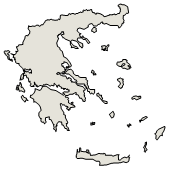

Administrative Region : Central Macedonia
Regional unit : Imathia
Diavatos (Διαβατός) Imathia
Diavatos is a village in the Prefecture of Imathia and is part of the Municipality of Veroia. According to the 2021 census, it has 1,096 residents.
History
It first appears in an Ottoman text from 1500, in which the Ottoman resident of Veroia Sinan Bey, son of Yakoub Bey, gives as a waqf to a mosque with a school (medrese) of the city, a mill in a single space and with three millstones located in the village. Around 1550, the village did not belong to any waqf. In the mid-18th century. it is referred to as a manor. In circulars of the bishop of Campania Theophilos (1749-1795), the village of '' Diavaton '' which belongs to his province is also mentioned.
In 1876 it is reported that 41 families (sefana) lived in the village and that there was 1 church and a priest. In 1898 a Greek school was operating.
During the Macedonian struggle (1904-08) Theocharopoulos Georgios and Theocharopoulos Stefanos showed activity. Also Amniotis Georgios and Maniopoulos Georgios joined the body of Captain P. Papatzanetea as hoplites. In 1907 two Romanian-Vlach shepherds were killed by a Greek body in Diavato, accused of being feeders of a Romanian armed body.
In 1913 the inhabitants were 128 men and 109 women. In the 1920s, 45 families (127 individuals) of refugees settled. During the same period between the wars (1930s), Vlachs (Perivoliotes) arrived in the village, who had already settled in the Kalyvia of Istok (an area between Lake Prespa and Ohrid on Mount Galisitsa in present-day North Macedonia) since the late 19th century. Today, approximately 40 Vlach families still live in the village.
The location of the village was further south than it is today (approximately 2 kilometers). The reason for the relocation is the frequent destructive floods of the Aliakmon River. After the flood of 1935, the residents of the old village decided to move permanently. Only the church of the Holy Apostles, a simple three-aisled basilica from the 19th century, remains in the old location. The new village was designed based on the Hippodamian system and wide streets. The church of the new village celebrates on May 21 (Saints Constantine and Helen).
During World War II, out of a total of 155 houses, 2 were completely destroyed and 15 were partially destroyed by the Italians.
Sports
The Diavatos Athletic Club "O Atromitos" is the local football club of Diavato. Its official year of foundation is 1956 and its official colors are blue and white. It belongs to the power of the E.P.S. Imathia and participates in its local championships. In the summer of 2022, after a short period of competitive inactivity, it was re-established.[1]
The greatest distinction in its history is the conquest of the local championship in 1979 and the promotion to the National Amateur Division, which was the 3rd tier of the national division, in the 1979-80 season, but without success as it finished last in 20th place in the 3rd group and was relegated.
References
Atromitos Diavatou from… the beginning - The new board of directors and the first two transfer moves! gnomi.news
Bibliography
Kallianiotis, A. et al. (eds.), The Great Synaxaris: Invisible Native Macedonian Fighters (1903-1913), Society for Macedonian Studies, Thessaloniki 2011.
Karadimas, D., Destroyed Cities and Villages as a Result of the War 1940-1945, Coordination Office of the Ministry of Social Welfare, Athens 1946.
Koukoudis, A., The Vergian Vlachs and the Arvanito-Vlachs of Central Macedonia, Thessaloniki 2001.
Moschopoulos, I., Roumlouki (Campania) during the Early and Middle Ottoman Period, Thessaloniki 2012.
Moschopoulos, I., Roumlouki (Campania) during the Late Ottoman Period, Thessaloniki 2019
Moschopoulos, I., ''Summary News for the Vlachs in Roumlouki'', Chronicles of History and Culture of the Prefecture of Imathia, vol. 39, Sept.- Dec. 2019, pp. 225-249.
Papastathis, Ch., ''The Greeks of Resna at the beginning of the 20th century: Contribution to the demographic and economic structure of the Pelagonian town'', Macedonian, vol. 14 (1974), p. 17.
Cheimonidou, M. "The twin baths of Alatas", Chronicles of the Prefecture of Imathia, ( E.M.I.P.I.), vol. 30 (September-December 2016), pp. 4-9.
| Municipal unit Apostolos Pavlos |
|---|
| Municipal Community Makrochori |
| Makrochori (Μακροχώρι, το) |
| Community Diavatos |
| Diavatos (Διαβατός, ο) |
| Community Kouloura |
| Kouloura (Κουλούρα, η) |
| Community Lykogianni |
| Nea Lykogianni (Νέα Λυκόγιαννη, η) |
| Palaia Lykogianni (Παλαιά Λυκόγιαννη, η) |
| Community Nea Nikomideia |
| Nea Nikomideia (Νέα Νικομήδεια, η) |
Greece :
A - B - C - D - E - F - G - H - I - J - K - L - M -
N - O - P - Q - R - S - T - U - V - W - X - Y - Z
Retrieved from "http://en.wikipedia.org/"
All text is available under the terms of the GNU Free Documentation License
| Ancient Greece
Science, Technology , Medicine , Warfare, , Biographies , Life , Cities/Places/Maps , Arts , Literature , Philosophy ,Olympics, Mythology , History , Images Medieval Greece / Byzantine Empire Science, Technology, Arts, , Warfare , Literature, Biographies, Icons, History Modern Greece Cities, Islands, Regions, Fauna/Flora ,Biographies , History , Warfare, Science/Technology, Literature, Music , Arts , Film/Actors , Sport , Fashion --- |

