.
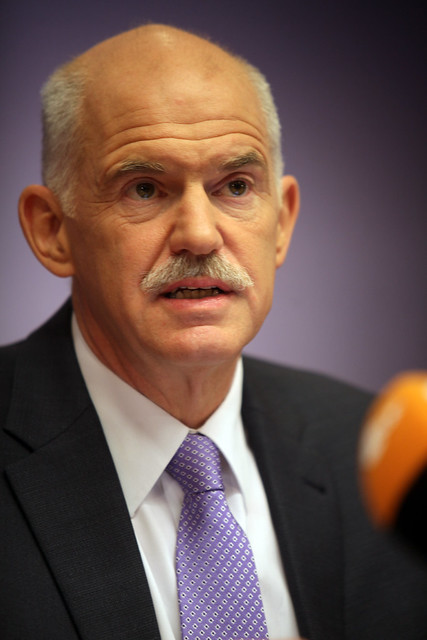
Georgios A. Papandreou (Greek: Γεώργιος Α. Παπανδρέου, [ʝe̞ˈo̞ɾʝio̞s papanˈðɾe̞u];[1][2][3] born 16 June 1952), commonly anglicised to George and shortened to Γιώργος (Yórgos, [ˈʝo̞ɾɣo̞s]) in Greek, is a Greek politician who served as Prime Minister of Greece following his party's victory in the 2009 legislative election. Belonging to a political dynasty of long standing, he previously served as Minister for National Education and Religious Affairs (1988–1989 and 1994–1996) and Minister for Foreign Affairs from 1999 to 2004. Following his grandfather Georgios Papandreou and his father Andreas Papandreou, he was the third member of the Papandreou family to serve as the country's prime minister. Papandreou was leader of the Panhellenic Socialist Movement (PASOK) party from February 2004 until March 2012, and President of the Socialist International since January 2006. George Papandreou became the 182nd Prime Minister of Greece on 6 October 2009. He resigned on 11 November 2011 to make way for a national unity government charged with tackling the Greek government debt crisis.
Early life
He was born in Saint Paul, Minnesota, United States, where his father, Andreas Papandreou, held a university post. His mother is American-born Margaret Papandreou, née Chant. He was educated at schools in Toronto (King City Secondary School), at Amherst College in Massachusetts (where he was a friend and dormitory roommate of fellow Greek Antonis Samaras[4]), at Stockholm University, the London School of Economics and Harvard University. He has a Bachelor of Arts degree in sociology from Amherst and a Μaster's degree in sociology from the LSE. He was a researcher on immigration issues at Stockholm University in 1972–73. He was also a Fellow of the Foreign Relations Center of Harvard University in 1992–93.
In 2002 he was awarded an Honorary Doctorate of Laws by Amherst College and in 2006 he was named Distinguished Professor in the Center for Hellenic Studies by Georgia State College of Arts and Science.
![Yorgos Papandreou - Chalkida [21.09.2008]](http://farm4.staticflickr.com/3274/2872291046_41e6c080f8.jpg)
Papandreou's father studied and worked as professor of Economics from 1939 to 1959. His paternal grandfather, Georgios Papandreou, was three times Prime Minister of Greece.
Political career
The younger George Papandreou came to Greece after the restoration of Greek democracy in 1974. He then became active in the political party his father had founded, the Panhellenic Socialist Movement (PASOK). He joined the Central Committee of PASOK in 1984.
Papandreou was elected to the Greek Parliament in 1981, the year his father became Prime Minister, as MP for the constituency of Achaea. He became Under Secretary for Cultural Affairs in 1985, Minister of Education and Religious Affairs in 1988, Deputy Minister of Foreign Affairs in 1993, Minister for Education and Religious Affairs again in 1994, Deputy Minister of Foreign Affairs again in 1996 and Minister of Foreign Affairs in February 1999. He was also Minister Responsible for Government Coordination for the Bid for 2004 Olympic Games in 1997.
Papandreou in 2001, as Minister of Foreign Affairs
In his second term as Minister of Education, Papandreou was the first politician in Greece to introduce affirmative action, allocating 5% of university posts for the Muslim minority in Thrace. He was also instrumental in initiating the Open University in Greece.
Papandreou received numerous awards and honorary degrees in recognition of his work for human rights. As Foreign Minister he fostered closer relations with Turkey and Albania. He worked to solve the dispute over Cyprus. Papandreou also worked to resolve tensions regarding the Macedonia naming dispute.
In December 2003 European Voice shortlisted him for nomination of the Europeans of the Year award as "Diplomat of the Year",[5][6] naming him as "The Bridge-Builder" and quoting Le Monde that dubbed him the "architect of Greek-Turkish rapprochement".[7] He is a founding member of the Helsinki Citizens Assembly.
Party leadership
In anticipation of the 2004 national elections in Greece, polls indicated that PASOK was very likely to lose as the conservative New Democracy party was heading towards a landslide. In January 2004, the incumbent PM Costas Simitis announced his resignation as leader of PASOK, and passed the leadership to Papandreou by recommending him as the new leader.
On 8 February 2004 PASOK introduced for the first time the procedure of open primaries for the election of party leadership. Even if Papandreou had no opponent, this was a move designed to solidify the open primaries, democratise the party, and make a clean break with a tradition of “dynastic politics.”
In May 2005, Papandreou was elected Vice President of the Socialist International following a proposal by the former President, António Guterres. In January 2006, Papandreou was unanimously elected President of the Socialist International.
In the 2007 general election, PASOK again lost to the incumbent New Democracy party of Kostas Karamanlis and Papandreou’s leadership was challenged by Evangelos Venizelos and Kostas Skandalidis. Papandreou, however, retained his party's leadership at a leadership election in November.
In June 2009 and under his leadership, his party won the 2009 European Parliament election in Greece.[8] Four months later, PASOK won the October 2009 general elections with 43.92% of the popular vote to ND's 33.48%, and 160 parliament seats to 91.[9]
Prime Minister
George Papandreou takes the oath of office of the Prime Minister of Greece.
Taking office and revelations
The inauguration of George Papandreou as the 182nd Prime Minister of Greece took place on 6 October 2009.[10]
Upon inauguration, Papandreou's government revealed that its finances were far worse than previous announcements, with a year deficit of 12.7% of GDP, four times more than the eurozone's limit, and a public debt of $410 billion.[11] This announcement served only to worsen the severe crisis the Greek economy was undergoing, with an unemployment rate of 10%[12] and the country's debt rating being lowered to BBB+, the lowest in the eurozone.[13] Papandreou responded by promoting austerity measures,[14] reducing spending, increasing taxes,[15] freezing additional taxes and hiring and introducing measures aimed at combatting rampant tax evasion[16] and reducing the country's public sector. The announced austerity program caused a wave of nationwide strikes[17] and has been criticised by both the EU and the eurozone nations' finance ministers as falling short of its goals.[18]
Crisis management and bailouts
On 23 April 2010 during a visit at the island of Kastelorizo, Papandreou issued a statement to the press that he instructed the Finance Minister to officially ask the EU partners to activate the support mechanism, 'an unprecedented mechanism in the history and practice of the European Union'.[19] The support mechanism, which was put in place by the European heads of state and government and further elaborated by Euro Group ministers, is a European mechanism to which the IMF is associated with financing and it involves a comprehensive three-year economic program and financing conditions.[20] On 23 April 2010, Dominique Strauss-Kahn, the Managing Director of the International Monetary Fund (IMF) announced that Greece made a request for a Stand-By Arrangement.[21] Greece's sovereign debt crisis, which is considered as part of the European sovereign debt crisis is marked by massive strikes and demonstrations.
On an opinion poll published on 18 May 2011, 77% of the people asked said they have no faith in Papandreou as Prime Minister in handling the Greek economic crisis.[22]
On 25 May 2011 the Real Democracy Now! movement started protesting in Athens and other major Greek cities. The peaceful protests are ongoing, and are considered to be a sign of popular rejection of Mr. Papandreou and his government's economic policies,[23][24] with as much as three quarters of the Greek population being against the policies of the Papandreou government.[25] Among the demands of the demonstrations at Athens's central square, who claim to have been over 500,000 at one point,[26] is the resignation of Papandreou and his government.
In the early hours of 22 June, George Papandreou and his government narrowly survived a vote of confidence in the Greek parliament, with 155 of the 300 seats in parliament.[27] His government held 152 seats.[28]
On 17 September, he cancelled a visit to the IMF building in Washington D.C and the UN Headquarters in New York City amid mounting concern over the country's debt crisis.[29]
An opinion poll by Public Issue[clarification needed] on behalf of Skai TV and Kathimerini in October 2011 showed that Papandreou's popularity has dropped considerably.[30] Of the people asked, only 23% had a positive view of George Papandreou,[30] while 73% had a negative opinion;[30] ranking him lower than any other leader of a party in the Hellenic Parliament.[30] Papandreou also ranked low on the question of who is more suitable for Prime Minister, with just 22%, as both Antonis Samaras (28%) and "neither" (47%) ranked higher than him.[30]
George Papandreou and Antonis Samaras with Karolos Papoulias, the President of Greece, on 6 November 2011 discussing the formation of a caretaker government.
On 26 October 2011, the European Summit agreed to hand to the Greek government the Sixth Tranche of € 8 billion bailout early in the 2012, while the private-sector banks, the holders of Greek debt, have agreed to a 50% haircut on their outstanding Greek government bonds.[31]
On 28 October 2011, during the national day parade, protesters blocked the parades, forcing the President of Greece and other officials to leave.[32]
On 31 October, Papandreou announced his government's intentions to hold a referendum for the acceptance of the terms of a eurozone bailout deal.[33] The referendum was to be held in December 2011 or January 2012.[34] On 3 November, however, Papandreou scrapped the plan, following vehement opposition both within and outside the country. On 5 November, his government narrowly won a confidence vote in parliament.[35]
On 6 November, Papandreou met with opposition leaders to try to reach an agreement on the formation of an interim government. A day earlier, the leader of the opposition New Democracy party Antonis Samaras had rejected the proposal and called for an immediate election.
Agreeing to step aside
After Papandreou agreed to step aside, however, the two leaders announced their intention to form a national unity government that would allow the EU bailout to proceed and pave the way for elections on 19 February 2012.[36][37] The Communist Party and the Coalition of the Radical Left Party refused Papandreou's invitation to join talks on a new unity government.[38] After several days of intense negotiations, the two major parties along with the Popular Orthodox Rally agreed to form a grand coalition headed by former Vice President of the European Central Bank Lucas Papademos.[39]
On 10 November, George Papandreou formally resigned as Prime Minister of Greece.[40]
The new coalition cabinet and Prime Minister Lucas Papademos were formally sworn in on 11 November 2011.[41]
In August 2012, Papandreou was re-elected President of the Socialist International at its congress in Cape Town.[42]
Personal life
Papandreou and his wife attend the Quadriga Award 2010 ceremony on 3 October 2010 in Berlin.
George Papandreou is married to Ada Papapanos and they have a daughter, Margarita-Elena (born 1990).[43] He also has a son, Andreas (born 1982), from a previous civil wedding to Evanthia Zissimides (1976–1987).
He has two younger brothers, Nikos Papandreou and Andreas Papandreou, and two younger sisters, Sophia Papandreou and Emilia Nyblom.[44]
Apart from Greek and English, he is also fluent in Swedish.[45] One of his paternal greatgrandfathers was of Polish descent.[46]
Honours and decorations
1996: Commander of the Order of Prince Yaroslav the Wise (Ukraine) Ukraine-republic007.png
1996: Grand Cross of the Order of the Lion (Finland)
1996: Order of Merit of the Republic of Poland II class (Poland) POL Order Zaslugi RP kl2 BAR.png
1998: Grand Cross of the Order of Civil Merit (Spain)
1999: Grand Cross of the Order of the Polar Star (Sweden) Order of the Polar Star - Ribbon bar.svg
1999: Grand Cross of the Order of the White Star (Estonia)
1999: Grand Cross of the Order of Honour, first class (Austria) AUT Honour for Services to the Republic of Austria - 1st Class BAR.png
2000: Grand Cross of the Order of Merit, first class (Germany) GER Bundesverdienstkreuz 7 Grosskreuz.svg
2001: Grand Cross of the Order of Isabella the Catholic (Spain)
2001: Grand Cross of the Order of the Crown (Belgium) Belgium Order Crown rib.png
2002: Grand Cross of the Order of Infante dom Henrique (Portugal)
2002: Grand Cross of the Order of Pius IX (Vatican) Order Pius Ribbon.png
2003: Grand Commander of the Order of Merit (Hungary)
2003: Grand Cross of the Order of Merit (Italy) ITA OMRI 2001 GC-GCord BAR.svg
2003: Gran Cruz El Sol de Peru (Peru) Order of the Sun Ribbon.jpg
Awards
1988: " Botsis's Foundation for the Promotion of Journalism " award for "his multifaceted struggles, which established the Free Radio as part of our democratic institutions"
1996: SOS against anti-Semitism, and affiliated organizations" Committee award, for his work against anti-Semitism
1997: Abdi Ipekci special award for Peace and Friendship ( June 1997) "for his activities in favor of Greek-Turkish approach during the period 1995–1996 while serving as Minister of National Education and Religion"
2000: Eastwest Institute 2000 Awards – Peace Building Awards . The 2000 "Statesman of the Year Award" given to Foreign Minister George Papandreou of Greece and Foreign Minister Ismail Cem of Turkey for their great efforts at improving relations between their respective countries
2002: Jackie Robinson Humanitarian Award (United States Sport Academy)
2003: Recipient: Defender of Democracy (Parliamentarians for Global Action)
2006: Open Fields Award (Truce Foundation USA)
2010: Quadriga Award (Werkstatt Deutschland, Germany), for The Power of Veracity (transparency regarding the state of the Greek economy)
See also
Politics of Greece
List of Prime Ministers of Greece
References
^ "George A. Papandreou Personal Site". Papandreou.gr. Retrieved 2011-11-04.
^ "Government of Greece via Internet Archive". primeminister.gov.gr. Retrieved 2011-11-11.
^ "Official curriculum-vitae of George A. Papandreou from the Greek Government website via Internet Archive". primeminister.gov.gr. Retrieved 2011-11-11.
^ "As good as it gets". ekathimerini. 4 December 2009. Retrieved 8 December 2009.
^ "EV50: Europeans of the Year 2003". EuropeanVoice.com. Retrieved 2011-12-03.
^ "EV award winners: Europeans of the Year 2003". EuropeanVoice.com. Retrieved 2011-12-03.
^ "George A. Papandreou Personal Site". Papandreou.gr. Retrieved 2011-11-04.
^ "European election results 2009 for Greece". Results of the 2009 European Elections. Ministry of Internal Affairs. Retrieved 6 October 2009.
^ "Greek legislative election, 2009 results". Results of the 2009 Greek legislative elections. Ministry of Internal Affairs. Retrieved 6 October 2009.[dead link]
^ "Papandreou sworn in as Greek PM". BBC News. 6 October 2009. Retrieved 6 October 2009.
^ "Greece Bailout: France, Germany Angry Over Rescue". Time Magazine. 16 February 2010. Retrieved 17 February 2010.
^ "Greece's unemployment rate hits 10%". BBC News. 11 February 2010. Retrieved 17 February 2010.
^ "Greece's Debt and Economy Woes: As Bad as Dubai's?". Time Magazine. 9 December 2009. Retrieved 17 February 2010.
^ "Greece unveils austerity programme to cut deficit". BBC News. 3 February 2010. Retrieved 17 February 2010.
^ "Greek Tragedy: Athens' Financial Woes". Time Magazine. 15 February 2010. Retrieved 17 February 2010.
^ "No tax please, we're Greek". BBC News. 11 February 2010. Retrieved 17 February 2010.
^ "Greece hit by nationwide strike over austerity measures". BBC News. 10 February 2010. Retrieved 17 February 2010.
^ "Greece told to make more spending cuts". BBC Nwes. 16 February 2010. Retrieved 17 February 2010.
^ "/ George A. Papandreou :: Personal Site \". Papandreou.gr. Retrieved 6 November 2011.
^ "Transcript of a Press Conference by George Papaconstantinou, Finance Minister of Greece". IMF. 25 April 2010. Retrieved 6 November 2011.
^ "Statement by IMF Managing Director Dominique Strauss-Kahn on Greece". IMF. 23 April 2010. Retrieved 6 November 2011.
^ "Mνημόνιο ένα χρόνο μετά: Aποδοκιμασία, αγανάκτηση, απαξίωση, ανασφάλεια (One Year after the Memorandum: Disapproval, Anger, Disdain, Insecurity)". skai.gr. 18 May 2011. Retrieved 18 May 2011.
^ "Inside the Greek parliament protest camp". BBC. 24 June 2011. Retrieved 24 June 2011.
^ "Greece austerity: PM Papandreou tries to persuade MPs". BBC. 22 June 2011. Retrieved 24 June 2011.
^ "EU leaders urge Greek politicians to support new cuts". BBC. 24 June 2011. Retrieved 24 June 2011.
^ ""Αγανακτισμένοι": Πρωτοφανής συμμετοχή σε Αθήνα και άλλες πόλεις" (in Greek). skai.gr. 5 June 2011. Retrieved 24 June 2011.
^ "Greek government survives confidence vote". BBC. 21 June 2011. Retrieved 21 June 2011.
^ "Βουλευτές – Ανά Κοινοβουλευτική Ομάδα [MPs – By Parliamentary Group]". www.hellenicparliament.gr. Retrieved 25 August 2011.
^ "Greek crisis: PM George Papandreou cancels US visit". BBC News. 18 September 2011. Retrieved 17 September 2011.
^ a b c d e "Πολιτικό Βαρόμετρο 95 – Οκτώβριος 2011". Public Issue (www.skai.gr). October 2011. Retrieved 7 October 2011.
^ Gow, David (27 October 2011). "Eurozone crisis: banks agree 50% reduction on Greece's debt". London: The Guardian. Retrieved 11 November 2011.
^ "Greek protesters call president "traitor," halt parade". The Guardian. 28 October 2011. Retrieved 11 November 2011.
^ "Ρίσκα και αβεβαιότητες από την πολιτική "βόμβα" για δημοψήφισμα [Risks and uncertainties by the political "bomb" for a referendum]". Skai TV. Retrieved 31 October 2011.
^ "Ευ. Βενιζέλος: Από το νέο έτος το δημοψήφισμα [Evangelos Venizelos: Referendum to take place after the new year]". Skai TV. Retrieved 31 October 2011.
^ "Greek PM Papandreou faces unity challenge over bailout" at bbc.co.uk
^ Kington, Tom; Smith, Helena (2011-11-06). "Papandreou out as Greek leaders agree unity government deal". London: The Guardian. Retrieved 2011-11-06.
^ "Greek PM George Papandreou resigns; polls set for February". Business Today. Retrieved 7 November 2011.
^ "Political opposition divided over unity government". e.kathemerini.com. 7 November 2011. Retrieved 11 November 2011.
^ "Lucas Papademos named as new Greek prime minister". BBC News. 10 November 2011. Retrieved 10 November 2011.
^ "George Papandreou resigns as Greece's prime minister". London: The Telegraph. 9 November 2011. Retrieved 11 November 2011.
^ "New Greek govt takes over, former banker at helm". Associated Press. 11 November 2011. Retrieved 11 November 2011.
^ "XXIV Congress of the Socialist International, Cape Town". Socialist International. Retrieved 2 September 2012.
^ "/ George A. Papandreou :: Personal Site \". Papandreou.gr. Retrieved 2011-11-04.
^ "Hon är Papandreous okända svenska syster (She is Papandreou's unknown Swedish sister)". www.expressen.se. 26 September 2011. Retrieved 6 November 2011.
^ "/ George A. Papandreou :: Personal Site \". Papandreou.gr. Retrieved 6 November 2011.
^ "PM`s George Papandreou visit to Poland". Embassy of Greece in Poland Press and Communication Office. Retrieved 14 November 2011.
External links
papandreou.gr, his official personal website
| Political offices | ||
|---|---|---|
| Preceded by Apostolos Kaklamanis |
Minister for National Education and Religious Affairs 1988–1989 |
Succeeded by Vasileios Kontogiannopoulos |
| Preceded by Dimitrios Fatouros |
Minister for National Education and Religious Affairs 1994–1996 |
Succeeded by Gerasimos Arsenis |
| Preceded by Theodoros Pangalos |
Minister for Foreign Affairs 1999–2004 |
Succeeded by Tassos Yiannitsis |
| Preceded by Dora Bakoyannis |
Minister for Foreign Affairs 2009–2010 |
Succeeded by Dimitrios Droutsas |
| Preceded by Kostas Karamanlis |
Prime Minister of Greece 2009–2011 |
Succeeded by Lucas Papademos |
| Party political offices | ||
| Preceded by Costas Simitis |
Leader of the Panhellenic Socialist Movement 2004-2012 |
Succeeded by Evangelos Venizelos |
| Preceded by António Guterres |
President of the Socialist International 2006–present |
Incumbent |
| Ancient Greece
Science, Technology , Medicine , Warfare, , Biographies , Life , Cities/Places/Maps , Arts , Literature , Philosophy ,Olympics, Mythology , History , Images Medieval Greece / Byzantine Empire Science, Technology, Arts, , Warfare , Literature, Biographies, Icons, History Modern Greece Cities, Islands, Regions, Fauna/Flora ,Biographies , History , Warfare, Science/Technology, Literature, Music , Arts , Film/Actors , Sport , Fashion --- |
Retrieved from "http://en.wikipedia.org/"
All text is available under the terms of the GNU Free Documentation License
